Analysis
The Country That Profited Without Having to Compete
A London School of Economics thesis compares Brazil and South Korea across fifty years and reaches an uncomfortable explanation for the Brazilian puzzle: industry here was profitable without being efficient because it lived off a slice of the wealth of the soil. Without competing, there was no reason to learn how to compete.
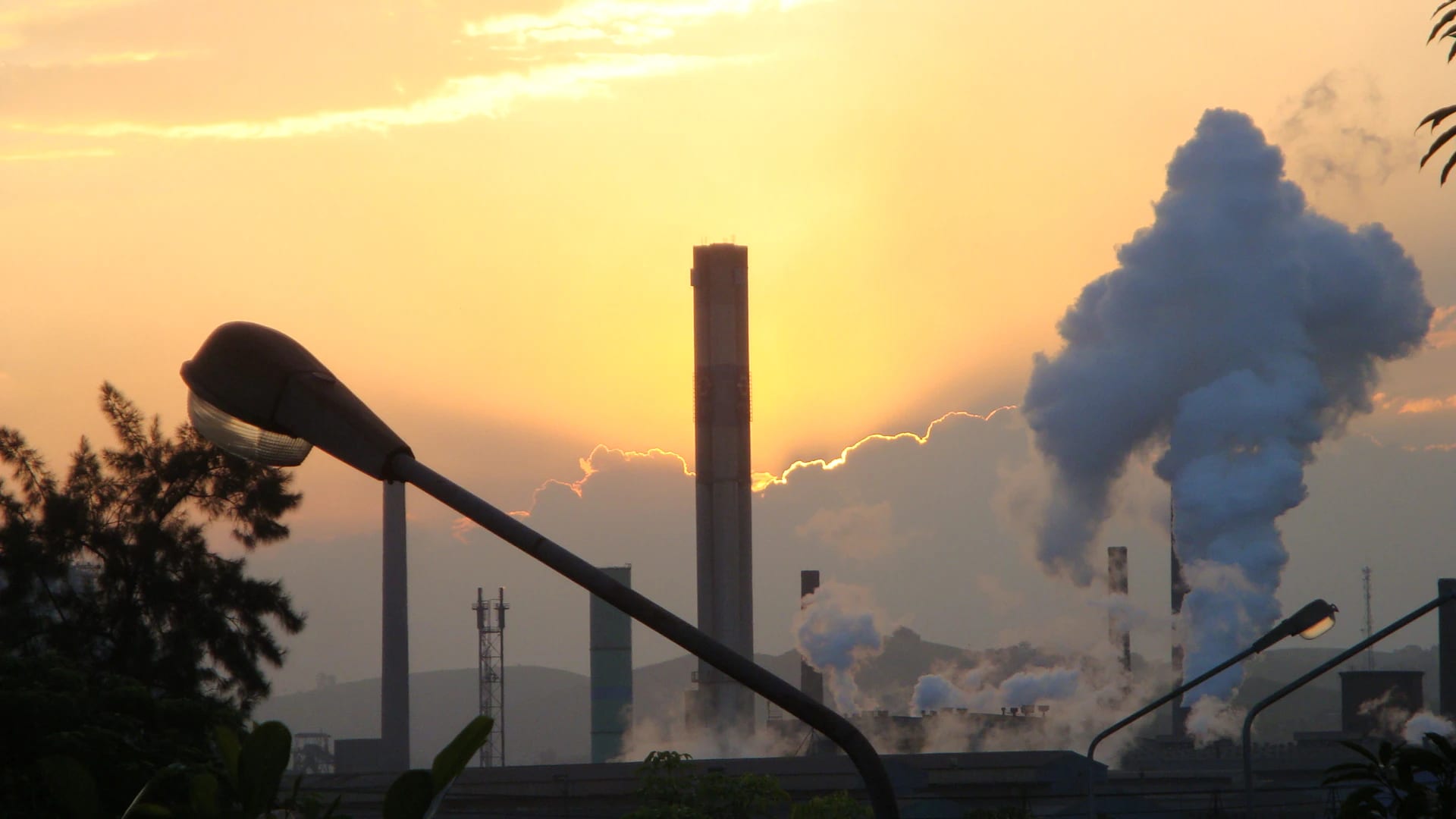
The Companhia Siderúrgica Nacional steelworks in Volta Redonda, Brazil, photographed in 2012. Illustrative image: it postdates the period discussed in this article.
Alexandre Amorim Caa… · CC BY-SA 3.0 · Source
In 1974, the plants of American multinationals operating in Brazil exported 5.5% of everything they produced. The same companies, at their plants in Canada and Europe, exported between 19% and 23% — a 1970 figure, but the comparison already says what matters. This was not a statistical detail. It was a portrait.
Brazil at that time was not a country without industry. It had automakers, steel mills, petrochemicals, engineers, quality steel. It had, in fact, far more heavy industry than South Korea would have for another decade. What Brazil did not have was a reason to sell that output abroad.
| Country/Region | Year | % exported |
|---|---|---|
| Brazil | 1974 | 5,5% |
| Canada and Europe | 1970 | 19-23% |
Share of total output exported by affiliates of American companies.
Elaboração Sip Dölyn com dados de Grinberg, 2011, p. 48.
This is the starting point of the doctoral thesis that Nicolas Grinberg defended at the London School of Economics in 2011, comparing the trajectories of Brazil and South Korea from the mid-1950s to the mid-2000s. The question he pursues is simple to state and hard to answer: why did half a century of Brazilian industrialization never produce a country that sells manufactured goods to the world?
The answer was not inside the factory
The best-known explanations look inside the production process or inside the state. Either Brazil protected its industry too much and let it grow lazy, or protected it badly, or had a poor bureaucracy, or incompetent politicians, or complacent businessmen. Grinberg proposes looking somewhere else: at where the money that made those factories profitable actually came from.
There is a kind of wealth that comes neither from industrial labor nor from anyone's efficiency. It is the extra gain obtained by controlling a resource that cannot be reproduced — fertile land, ore, natural conditions that another country simply has no way of manufacturing. Economists call this ground rent. Brazil had a great deal of it. The world paid for it.
The central argument of the thesis is that this wealth did not all stay with the owners of land or mines. Part of it was systematically diverted into industry — through three main channels: an exchange rate kept artificially overvalued, which meant that exporters of coffee, soy, or ore received less domestic currency for each dollar sold while imported machinery grew cheaper; the direct taxation of primary exports; and subsidized public credit channeled to industrial capital.
And here is the part that unsettles the classic debate on import substitution. This was not protection for an infant industry that would one day grow up and go out into the world. The biggest beneficiaries were the multinationals already established in the country — mature companies, with mature technology, that were not learning anything at all.
The process of 'subsidizing' the valorization of industrial capital with a portion of ground rent cannot be considered a form of 'infant industry' promotion, especially when the main beneficiaries of that 'support' have been the multinationals.
Belgium and India at the same address
With that cushion underneath, the factory's arithmetic works out in a strange way. There is no need to produce cheaply. There is no need to produce at large scale. There is no need to sell to 200 million people across three continents. It is enough to sell dearly to those who can pay dearly — and in the Brazil of the 1960s there was a very specific number of people in that position.
A Brazilian economist described the country of that period as an economy with a core of some 10 million consumers whose purchasing power matched that of Western Europe, living alongside 30 million consumers with far less purchasing power. He named the arrangement Belíndia: Belgium and India within the same borders. Just to give a sense of what was left out of that account: Brazil already had 70 million inhabitants in 1960.
The 'Belíndia': the market Brazilian industry served
View the data
| Segment | Consumers (millions) |
|---|---|
| Purchasing power similar to Western Europe | 10 |
| Significantly lower purchasing power | 30 |
Segmentation of the Brazilian consumer market in the mid-1960s.
Elaboração Sip Dölyn com dados de Grinberg, 2011, p. 48.
A car plant designed to serve ten million Europeans stranded in the tropics is, by world standards, a small plant. It produces expensively. It is, technically, inefficient. And it still turns a profit — because the gap between the high cost and the price charged is covered by that wealth which came out of the soil and reached the plant through the back door of the exchange rate and of credit.
The most eloquent sign of this appears in a study the thesis recovers: the Brazilian affiliates of American companies obtained average rates of return higher than those of comparably sized firms in the United States itself. It is worth rereading slowly. The operation set up in the peripheral country, with smaller scale and higher costs, was more profitable than the operation at the heart of industrial capitalism. This cannot be explained by cheap labor — if it could, those factories would have been exporting. It is explained by a source of profit that did not come from production.
On the other side of the world, the same trick — only smaller
The comparative part of the thesis is where the argument becomes genuinely uncomfortable for the usual narratives. Before the mid-1960s, Grinberg says, South Korea accumulated capital on a base structurally similar to Brazil's: a limited ground rent, complemented by a massive inflow of foreign aid and by part of the profits that small agrarian capital failed to retain. There, too, there was a cushion. It was simply a thin cushion — and, unlike Brazilian soil, it depended on another country's decision to keep paying.
What changes the Korean trajectory, in the thesis's reading, is not a national virtue or a stroke of genius by planners. It is a technological transformation that takes place outside Korea: mechanization, automation, and later electronics simplify industrial tasks that had previously depended on skill accumulated on the shop floor — that practical knowledge a worker takes years to acquire and cannot write down in a manual. When the machine absorbs that knowledge, the cheap and disciplined worker suddenly becomes productive enough to produce at world prices.
From the late 1960s and early 1970s onward, Korean industrial capital comes to maximize profit by doing exactly what industrial capital in Brazil had no reason to do: selling to the world. Not because it was more virtuous. Because no more profitable alternative was available.
That inversion is the heart of the work. The question stops being "where did Brazil go wrong?" and becomes "what was the most profitable thing to do in each place?". Brazil's inability to move beyond the position of raw-material supplier, according to Grinberg, did not come from badly designed policy or defective institutions: it came from the concrete, and perfectly rational, possibility of making money by producing at small scale for the domestic market, offsetting high costs with a slice of the country's abundant agrarian and mineral rent.
So what about institutions?
There is a far more popular explanation for all this: Korea supposedly had a cohesive, competent, and reasonably honest state, and Brazil a captured and corrupt one. The thesis goes after that story and finds two problems.
The first is factual. It is now widely acknowledged — including by authors who once argued the opposite — that the bureaucrats of the Korean state were just as corrupt as the Brazilian ones throughout the entire period studied. The myth of the incorruptible Asian civil servant does not survive the more recent literature on Korea itself.
The second is logical, and more serious. The analyses that credit success to the "cohesion" of the state locate that cohesion precisely in the periods of rapid industrial growth, and locate its absence in the periods of stagnation. The cause is deduced from the effect it is supposed to explain. It is the old confusion between "happened alongside" and "caused" — and, once pointed out, the whole argument loses its footing.
There is also a historical irony that the thesis records with precision. In the 1950s, when Asia was doing badly and Latin America was doing well, important authors explained poor Asian performance by appealing to... Asian cultural and institutional factors. Decades later, with the score reversed, the same traits came to explain Korean success. An explanation that works equally well for failure and for success is not explaining much.
What holds these numbers up — and what does not
The work is not an opinion essay. To sustain the argument, Grinberg builds his own statistical series — of ground rent, of exchange-rate overvaluation, of profit rates — and cross-references them with sectoral case studies, such as steel and the automobile industry. In the appendices, he even assembles a model to estimate the profitability of specific firms, such as the Korean steelmaker POSCO. But the author himself warns that these figures are not direct measurements taken from balance sheets: they are estimates built with standardized assumptions from aggregate sources.
And this is where he raises his hand more than once. To calculate how much wealth from the soil was transferred to industry, one must first estimate how artificially overvalued the exchange rate was — and that requires choosing a reference period in which that distortion is assumed to have been, on average, absent. That choice is the researcher's judgment. It cannot be audited from outside. Anyone who disagrees with it will see the numbers change.
The same holds for strong conclusions about the automobile industry: the claim that no Brazilian plant in the 1990s had competitive scale depends on which minimum efficient scale criterion one accepts — and there is no consensus in the literature on that figure.
There is, on the other hand, a caveat that runs in the opposite direction from what one would expect of an author defending his own thesis: by using the industrial profit rate as the benchmark for estimating the "normal" profit of agrarian activity, the method probably underestimates the real size of ground rent. If the calculation is wrong, the error tends to favor those who doubt the argument, not those who defend it.
One last warning from Grinberg himself is worth adding: the cleanest and most seductive version of the thesis, the one that fits into a single paragraph, is presented by him as schematic and stylized. The proof comes later, in the technical chapters. The beautiful story and the demonstrated story are not exactly the same text — and it is honest of him to say so.
The cushion was there all along
What remains, in the end, is an image that is hard to dismantle. For decades, the country treated industrialization as the way out of the trap of living off exports of food and ore. It raised tariffs, created state companies, attracted automakers, planned in five-year cycles. And it financed all of that, on this reading, with money that came from exactly that food and that ore.
Brazilian industry did not stop competing in the world market out of incompetence. It stopped competing because, as long as the soil paid the bill, competing was the worst business available. A country can spend fifty years building factories to escape the land and discover, in the end, that it was the land that was paying for the factories.
Sources and method
The information in this article was gathered from the sources listed below, with cross-referencing of public data and academic review.
- Nicolas Grinberg. Transformations in the Korean and Brazilian Processes of Capitalist Development between the mid-1950s and the mid-2000s: The Political Economy of Late Industrialisation, London School of Economics and Political Science, 2011. Open
Keep reading
- Why the best technology usually losesTechnical superiority is a weak criterion for predicting an invention's fate. What matters is who is already locked into the current standard, who loses income from the switch, which routines would have to be remade—and who bears the cost of the first step.
- The Math Nobody Does: Why 'Buy 3, Pay 2' Convinces Even With a Small DiscountA three-for-two offer is two things at once: simple arithmetic that almost nobody does in the supermarket aisle and a pricing tool that separates customers without announcing different prices. What happens in a buyer's head—and what the seller is buying with that discount.
- Why the Producer Sells Raw Material and the Consumer Buys MeaningThe gap between the price of a sack and the price of a cup is neither accident nor malice. It is the result of three machines operating simultaneously: one that sets commodity prices, another that distributes bargaining power throughout the chain, and a third that manufactures meaning — and only the last one has margin, because only it produces something that cannot be substituted.