Analysis
The carmaker far less efficient than Toyota — and far more profitable
Between 1985 and 1996, Hyundai posted a higher profit rate than Toyota — while being far less productive. A London School of Economics dissertation shows why this apparent absurdity is in fact the rule that organizes global industry — and why Brazil, with equally low wages, was left out.
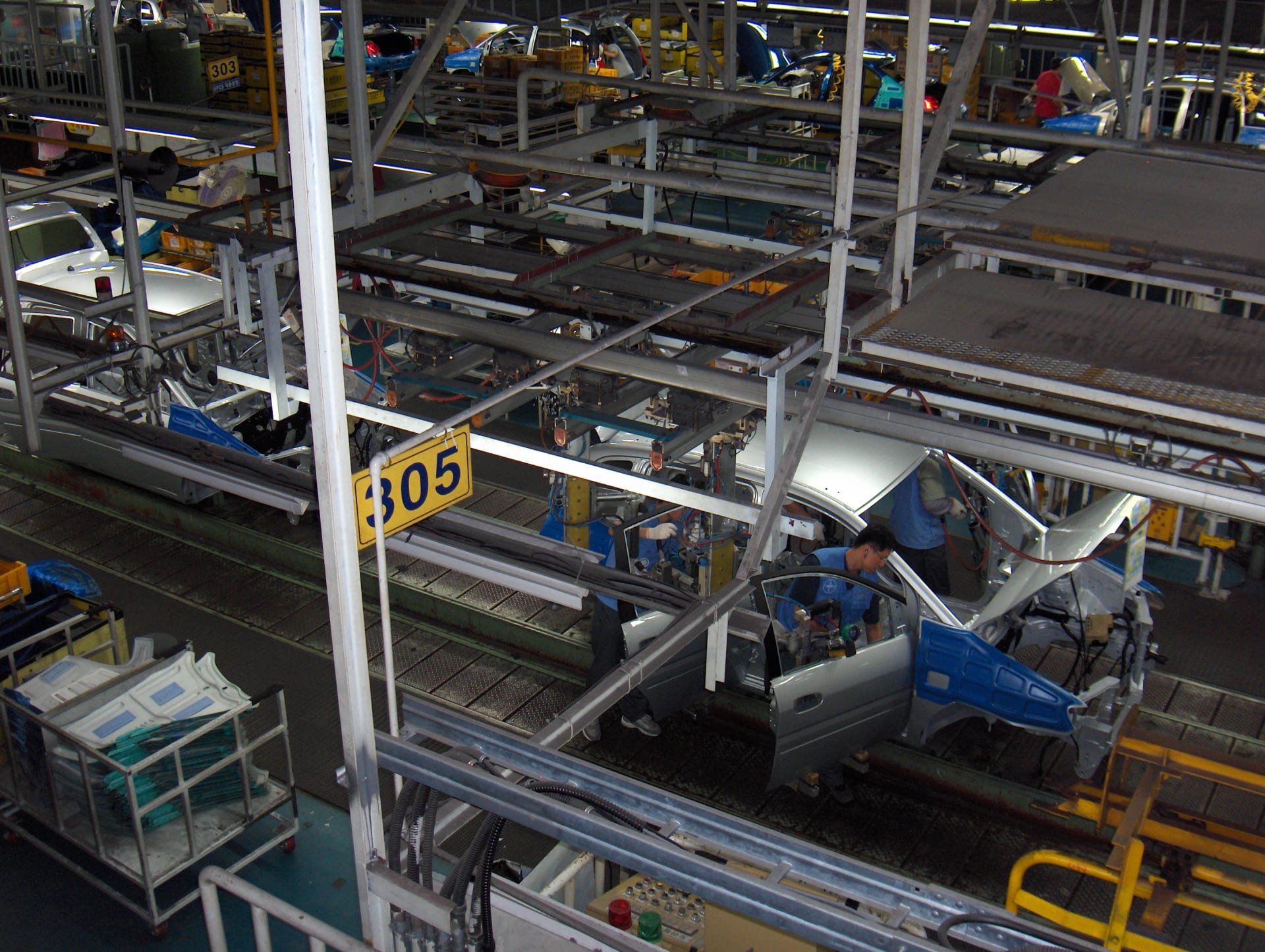
Hyundai's assembly line in Ulsan, South Korea, in 2006. Illustrative image: it postdates the period discussed in this article.
User: Anonyme · CC BY 2.5 · Source
Picture two carmakers. One is the world's gold standard of industrial organization, the place consultants cross the planet to visit. The other is a Korean company that, a decade earlier, barely existed on the automotive map, and whose labor productivity was far below the first one's.
Which of the two makes more money?
The answer, across a full decade, was the Korean one. Between 1985 and 1996, Hyundai's profit rate hovered around 11% a year. Toyota's, over the same period, stood at 8.36% — or 10.57%, if you are generous and include the interest Toyota earned on its financial assets. On a slightly longer comparison of balance sheets, from 1983 to 1997, the gap looks even wider: 13.32% for the Korean company against 9.29% for the Japanese one.
This is the kind of figure usually treated as a spreadsheet error. In the doctoral dissertation Nicolas Grinberg defended at the London School of Economics, it is treated as a clue. It is the starting point for understanding something that "economic miracle" stories almost always hide: efficiency and profitability are not the same thing, and the difference between them explains much of the world's industrial geography.
The real size of the gap
The dissertation does not quantify the productivity gap between Hyundai and Toyota company by company — it says only that it was very large. But it does measure the gap at the level where the data exist: the industry as a whole. Between 1975 and 1981, building a vehicle in the Korean auto industry took roughly eight times more labor time than in the Japanese one. In 1981, the figure was 8.1. The gap collapsed over the course of the 1980s — by 1988 it was already down to 2.7 — but it remained a disadvantage that, in any business textbook, would spell the company's death.
How many times more labor it took to build a car in Korea than in Japan
View the data
| Period | Korea/Japan ratio |
|---|---|
| 1975-1981 | 8 |
| 1981 | 8.1 |
| 1988 | 2.7 |
A comparison between the two countries' auto industries as a whole — not between Hyundai and Toyota specifically. The Korean disadvantage shrank fast, but it was still large in the years when Hyundai was more profitable than Toyota.
Elaboração Sip Dölyn com dados de Grinberg, 2011, p. 145.
And the author himself takes care to note that this "eight times" is, if anything, generous to the Koreans: Korea's industry was far less self-sufficient and imported a larger share of its inputs, so part of the labor embodied in each car simply never showed up in the domestic accounts. The real productivity gap was wider than the number suggests.
The uncomfortable arithmetic
The way out of the puzzle is embarrassingly simple: Japanese labor cost far more. If you spend three times the hours but pay a quarter of the wage, you come out ahead. There is no magic, no entrepreneurial genius, no Confucian culture. There is a multiplication.
The dissertation measures that gap directly in the neighboring sector, steel, where cost data are comparable line by line. In 1985, an hour of work in a mill cost $2.85 in Korea and $11.70 in Japan. The Korean mill needed 8.20 man-hours per ton; the Japanese one, 5.35. Less productive, then — and still far cheaper in wages per ton produced.
| Input | Japan | Korea | Brazil |
|---|---|---|---|
| Labor | 63 | 25 | 26 |
| Iron ore | 44 | 48 | 24 |
| Coal or coke | 52 | 55 | 68 |
| Other energy | 15 | 24 | 27 |
| Miscellaneous | 112 | 118 | 129 |
| Total operating cost | 286 | 270 | 274 |
Look at the first and the last row: total cost is practically tied, but the composition is radically different. Japan spent on wages what Korea and Brazil did not.
Elaboração Sip Dölyn com dados de Grinberg, 2011, p. 119.
It is the whole table at a glance: in the end, the three countries arrive at almost the same cost per ton. What differs is how they get there. Japan buys efficiency. Korea and Brazil buy cheap hours.
Why this did not work before
There is an old and convenient version of this idea, associated with the economist Arthur Lewis: there would always be surplus peasant labor cheap enough to offset any productivity lag. Economics as pure wage arithmetic, valid anywhere and in any era.
This is exactly where Grinberg's dissertation refuses to be simple — and the argument is the most interesting part of the work. Cheap labor only becomes a competitive advantage when the work in question can be done by someone without accumulated skill. For most of industrial history, it could not. Making steel or engines depended on practical knowledge that a worker built up over years on the shop floor, hard to write down in a manual and impossible to import in a container. Against that, low wages solved nothing: a cheap worker who does not know how to make the part makes a bad part.
What changes between the 1950s and the 1970s is technical. Automated transfer lines, numerically controlled machine tools, then continuous casting and microelectronics one by one transferred that tacit worker knowledge into the machine itself. Required training time collapsed. And the moment skill migrates into the equipment, the price of an hour of labor stops being an accounting detail and becomes the variable that decides where the factory will be built.
It was that shift — global, not Korean — that repositioned Korea. Before the mid-1960s, the dissertation argues, the country was accumulating on a base similar to Brazil's, propped up by massive foreign aid and a limited agrarian surplus. Afterward, Korean industrial capital discovered it could maximize profit by producing for the entire world, with a cheap, disciplined workforce running tasks that technology had simplified. In 1970, Korea produced 28,819 vehicles in the whole year. In 2007, it produced 4.1 million, with roughly half of them going abroad.
Brazil had the low wages. And did not use them.
Here the comparison gets uncomfortable for anyone fond of explanations based on national virtue. Look again at the 1985 table: Brazilian labor cost $26 per ton, practically the same as Korea's $25. By 1996, for the same product, Brazil's wage cost per ton was already lower than Korea's — $70 against $89 — and Brazil's total operating cost was the lowest of the three countries. The supposedly decisive ingredient was here, available, cheap.
Brazil did not export. It produced for the domestic market.
The dissertation's explanation is its boldest piece, and it inverts the usual narrative of Brazilian failure. It is not a matter of badly executed policy, poor bureaucracy or a lack of state "cohesion." It is that in Brazil industrial capital — largely multinational — had a second source of profitability that the Koreans lacked: a slice of the extraordinary income generated by farmland and mines, transferred to industry through an overvalued exchange rate, export taxes and subsidized credit. With that cushion, it was possible to produce on a small scale for the domestic market, at high cost, and still turn a healthy profit. Between 1955 and 1980, the dissertation calculates, that extraordinary wealth amounted to about half of total profits in the Brazilian economy; in Korea, to 19%.
In other words: both countries had cheap labor. Only one of them needed to use it to compete abroad.
Two honest caveats, because they change the weight of the sentences above. First: the strong claim that no Brazilian plant reached internationally competitive scale depends on which minimum-scale criterion you adopt, and the literature offers no consensus on that number. Second: the profit rates that open this story — Hyundai's 13.32%, Toyota's 9.29% — are estimates built on standardized assumptions about capital turnover and payment terms, not direct readings of each company's balance sheet. The order of magnitude is what matters; the second decimal place is not.
The same math, a generation later
In 2003, the dissertation repeats the steel cost exercise with one more country in the table. Korea is now the expensive side of the comparison: $15 an hour, 3.9 man-hours per ton, $59 in wage cost per ton — well below Japan's $116, but already far from that $2.85 of 1985.
The new country in the table is China. It needs 12.7 man-hours to produce the same ton: more than three times Korea's labor. A brutal productivity gap, the kind that makes headlines about industrial backwardness. And the Chinese wage cost per ton is $22 — a little over a third of Korea's. The hour costs $1.75.
It is the same multiplication that put Hyundai ahead of Toyota, redone two decades later with different protagonists. The advantage never belonged to the company that did the job better. It belonged to the company sitting in the country where an hour of labor was cheapest — until the day an even cheaper country showed up.
Sources and method
The information in this article was gathered from the sources listed below, with cross-referencing of public data and academic review.
- Nicolas Grinberg. Transformations in the Korean and Brazilian Processes of Capitalist Development between the mid-1950s and the mid-2000s: The Political Economy of Late Industrialisation, London School of Economics and Political Science, 2011. Open
Keep reading
- Why the best technology usually losesTechnical superiority is a weak criterion for predicting an invention's fate. What matters is who is already locked into the current standard, who loses income from the switch, which routines would have to be remade—and who bears the cost of the first step.
- The Math Nobody Does: Why 'Buy 3, Pay 2' Convinces Even With a Small DiscountA three-for-two offer is two things at once: simple arithmetic that almost nobody does in the supermarket aisle and a pricing tool that separates customers without announcing different prices. What happens in a buyer's head—and what the seller is buying with that discount.
- Why the Producer Sells Raw Material and the Consumer Buys MeaningThe gap between the price of a sack and the price of a cup is neither accident nor malice. It is the result of three machines operating simultaneously: one that sets commodity prices, another that distributes bargaining power throughout the chain, and a third that manufactures meaning — and only the last one has margin, because only it produces something that cannot be substituted.