Analysis
South Korea didn't get rich because it studied — it studied because it got rich
The most repeated explanation of the Korean miracle says it all began in the classroom. A London School of Economics thesis shows the order of events was the other way around: when Korea started exporting, its people had fewer years of schooling than Brazilians. What it had was something else — and the price showed up in the accident and mortality figures.
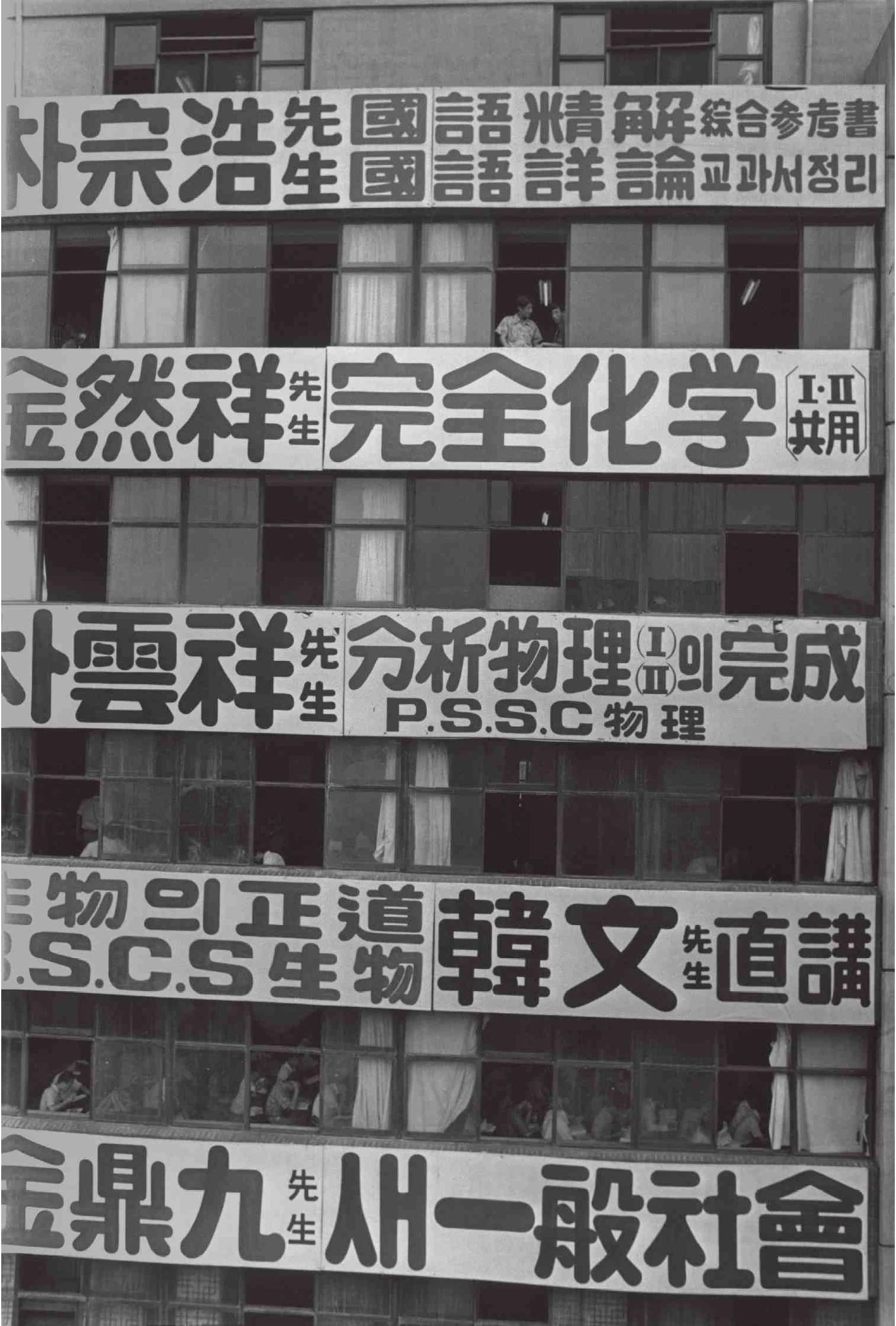
A street of hagwons — private cram schools — in Jongno, Seoul, in July 1971.
Photos taken by 전민조 and hosted by the National Museum of Korean Contemporary History · Public domain · Source
In 1955, the average Korean income was equivalent to 1.5% of the average American income. Half a century later, it was 72%. Over the same period, Brazilians went from 5.5% to 8.8%. In other words: Brazil started out several times richer per person and ended up far, far behind.
Ask someone to explain that leap and start the clock. In under thirty seconds the word education will come up. It is the most repeated public-policy lesson of the twentieth century: Korea invested in human capital, built an educated and disciplined population, and was therefore able to climb the industrial ladder. Influential economists back this reading, among them Dani Rodrik, for whom a highly educated workforce was one of the main factors behind Korean productivity gains after 1960.
In a thesis defended at the London School of Economics, the economist Nicolas Grinberg went through half a century of Brazilian and Korean statistics line by line — wages, profits, exchange rates, schooling, exports — and ran into an awkward problem with that story. Not that it is overstated. It is that it runs backward.
The educated country was the other one
Start with the starting point. In 1945, when the Japanese occupation ended, 78% of Koreans were illiterate. That is not a colorful detail: it is the population base on which, two decades later, the export industry would be built.
And when outward-oriented industrialization actually began, the average years of schooling of the Korean population were still below Brazilian levels. Note carefully what that means. The Brazil of that moment was no educational model — in 1970, a third of the adult population still could not read. Even so, it was ahead. The country with the better-schooled population of the two was the one that never took off.
| Country | Year | Illiteracy rate |
|---|---|---|
| Korea | 1945 | 78 |
| Brazil | 1970 | 33 |
| Brazil | 1980 | 25 |
| Brazil | 1990 | 18.7 |
| Brazil | 2005 | 11.1 |
Percentage of the population. The available years do not match across the two countries.
Elaboração Sip Dölyn com dados de Grinberg, 2011, p. 208.
The author himself takes care to note two caveats that, ironically, strengthen the argument. The Brazilian national average probably understates the schooling of those who actually worked in industry, because it is dragged down by rural populations and urban peripheries. And Brazil had been running large-scale vocational training since the 1940s, well before Korea did the same. If there is any distortion in the comparison, it is not working in Brazil's favor.
A school that taught, above all, obedience
The Korean educational expansion did happen, and it was fast. But it came alongside and after the industrial process, not before it. And when you look at what that school actually taught, the human-capital narrative becomes even harder to sustain.
Until the 1990s, the Korean system ran with large classes and many students per teacher, which pushed teaching toward memorization and recitation — a method frequently accused of stifling creativity and independent thinking, but extremely effective at producing discipline and the capacity for collective work. A study cited in the thesis, by Mason and coauthors, observes that what set the Korean curriculum apart from other countries was not its emphasis on science and technology. It was its emphasis on moral education, anticommunism and discipline. The authors record their discomfort with rare frankness:
It is hard to fit this feature into education's contribution to human resource development.
This is not some old rhetoric: as late as 2007, a module called "disciplined life" was still part of the compulsory curriculum for the first ten years of school in Korea.
Science arrived after the ship
The same pattern shows up on the upper floor of the educational system. In 1981, Korea had 536 scientists and engineers in research and development per million inhabitants; Brazil had 175. A Korean advantage, no doubt. Except that 1981 is far too late to explain anything: between 1965 and 1980, Korean exports grew 30% a year, and industrial exports 36%. In 1965, foreign sales were equivalent to 8% of Korean GDP; in 1980, to 44.5%.
Translation: by the time Korean researchers show up en masse in the statistics, the country had been an export powerhouse for fifteen years. Science followed industry. It did not launch it.
Scientists and engineers in R&D per million inhabitants
- Korea
- Brazil
View the data
| Year | Korea | Brazil |
|---|---|---|
| 1981 | 536 | 175 |
| 1985 | 1,017 | 391 |
| 1995 | 2,235 | 168 |
The gap opens up after the Korean export machine was already running.
Elaboração Sip Dölyn com dados de Grinberg, 2011, p. 237.
So what did it have?
If it wasn't schooling, what did Korea have in the mid-1960s that Brazil did not? The thesis does not find the answer inside Korea. It finds it in the world.
At that precise moment, world industry was going through a technical transformation — heavy mechanization, automation, then microelectronics — that did something specific to work: it simplified tasks that had previously depended on accumulated skill. That practical know-how a worker took years to build up in his hands, hard to write down in a manual, was being transferred to the machine. What was left on the other side was a task almost anyone could perform, provided they performed it fast, for many hours and without objecting.
That is Grinberg's central argument. From the late 1960s on, Korean industrial capital maximized profit by producing for the world market with cheap, disciplined labor that became particularly productive precisely in those simplified activities. What came to matter was not what the worker knew. It was how much he cost — and how much he could take.
The cost figures are brutal. In 1955, the cost of an hour of manual labor in Korea was equivalent to 2% of the American cost; in 1970, the Korean industrial average was 3.5% of the American one. In Brazil, the same cost was already 9% of the American level in 1955 and reached 28% by 1980. And Korean productivity, at that starting point, was extremely low: around 6% of the American level in the mid-1960s. It rises afterward — 12% a year between 1965 and the early 1980s, until it reached a quarter of the United States level. Cheap labor came first; productivity followed in its wake.
The bill was paid in another currency
"Cheap and disciplined" is an economic expression. Translated into the bodies of the people doing the work, it looks rather different.
For much of the period studied, industrial accidents and turnover rates in Korea were substantially higher than in the United States, Brazil, Japan and Taiwan. The result, recorded in the data gathered by the thesis, was a particularly high mortality rate among Korean workers — and notably among the women newly drawn into industry, who had gone from the countryside to the assembly line.
The length of the working day gives the measure of how long this lasted. As late as 2005, when Korea was already a rich country, Korean industrial work was 27% longer than American work. In Brazil, the industrial workday historically ran only 5% to 10% above the American standard. This is not a difference in level of development. It is a difference in what kind of advantage each industry was selling to the world.
Grinberg's conclusion on this point is one of the coldest sentences in the thesis, and one of the most precise:
Indeed, only a society with access to a massive surplus population, such as Korea's at the time, can afford the luxury of the accelerated wearing down of its labor force.
What came later, and what took its time
It would be dishonest to stop here, because the story does not end in exhaustion. It ends in high wages. The purchasing power of the Korean industrial hourly wage was less than 10% of the American level in the late 1960s; it reached 20-22% in the late 1980s; and by the mid-2000s it hit 55% of the American average — 80% in the case of regular manual workers. That is a real material transformation, in the lives of millions of people.
| Period | All employees | Permanent manual workers |
|---|---|---|
| Late 1960s | <10 | - |
| Late 1980s | 20-22 | - |
| Mid-2000s | 55 | 80 |
Wages do rise — but decades after entry into the world market.
Elaboração Sip Dölyn com dados de Grinberg, 2011, p. 214.
And social protection? It came with democratization, in the reforms of 1988-89 — though in a far narrower version than memory tends to preserve. Coverage applied to firms with more than ten employees, which left out precisely the most precarious workers, and the pension system would only become effective twenty years later. The safety net existed. It was late, and it had holes the size of small factories.
An important caveat about the strength of the argument: when Grinberg claims that without this specific kind of workforce the Korean industrial project would not have worked, he is reasoning counterfactually — logically reconstructing what would have happened had conditions been different. It is a well-built inference supported by data, not an experiment. Anyone who disagrees with the theoretical frame can read the same numbers a different way.
The order of events matters
What remains, in the end, is not a refutation of education — it is a reversal of cause and effect with practical consequences. If Korean schooling were the cause of growth, the recipe for any poor country would be clear and relatively cheap: study first, industrialize later. If it was a consequence, the recipe evaporates. Brazil, which had more years of schooling per inhabitant and vocational training since the 1940s, is the living evidence that the formula does not work on its own.
The Korean school of that period did not train engineers for the miracle. It trained people who were punctual, obedient and able to work in groups — and the world market, at that precise moment, was paying well for exactly that. Mass technical education came later, once there was something to pay for it with. The miracle was not the child of the school. It was its father. And it collected the down payment in another currency: hours, accidents and the lives of women who had just arrived from the countryside.
Sources and method
The information in this article was gathered from the sources listed below, with cross-referencing of public data and academic review.
- Nicolas Grinberg. Transformations in the Korean and Brazilian Processes of Capitalist Development between the mid-1950s and the mid-2000s: The Political Economy of Late Industrialisation, London School of Economics and Political Science, 2011. Open
Keep reading
- Why the best technology usually losesTechnical superiority is a weak criterion for predicting an invention's fate. What matters is who is already locked into the current standard, who loses income from the switch, which routines would have to be remade—and who bears the cost of the first step.
- The Math Nobody Does: Why 'Buy 3, Pay 2' Convinces Even With a Small DiscountA three-for-two offer is two things at once: simple arithmetic that almost nobody does in the supermarket aisle and a pricing tool that separates customers without announcing different prices. What happens in a buyer's head—and what the seller is buying with that discount.
- Why the Producer Sells Raw Material and the Consumer Buys MeaningThe gap between the price of a sack and the price of a cup is neither accident nor malice. It is the result of three machines operating simultaneously: one that sets commodity prices, another that distributes bargaining power throughout the chain, and a third that manufactures meaning — and only the last one has margin, because only it produces something that cannot be substituted.