.webp&w=1920&q=82)
.webp&w=1920&q=82)
.webp&w=1920&q=82)
.webp&w=1920&q=82)
.webp&w=1920&q=82)
.webp&w=1920&q=82)
.webp&w=1920&q=82)
.webp&w=1920&q=82)
.webp&w=1920&q=82)
Basílica de Nossa Senhora do Carmo
Avenida Dantas Barreto, no number, Santo Antônio neighborhood, central Recife.
In Recife’s historic center, the Basílica de Nossa Senhora do Carmo brings together Carmelite devotion, sacred architecture, and a complex heritage-listed since 1938. It offers a pause for quiet observation amid Santo Antônio’s urban rhythm.
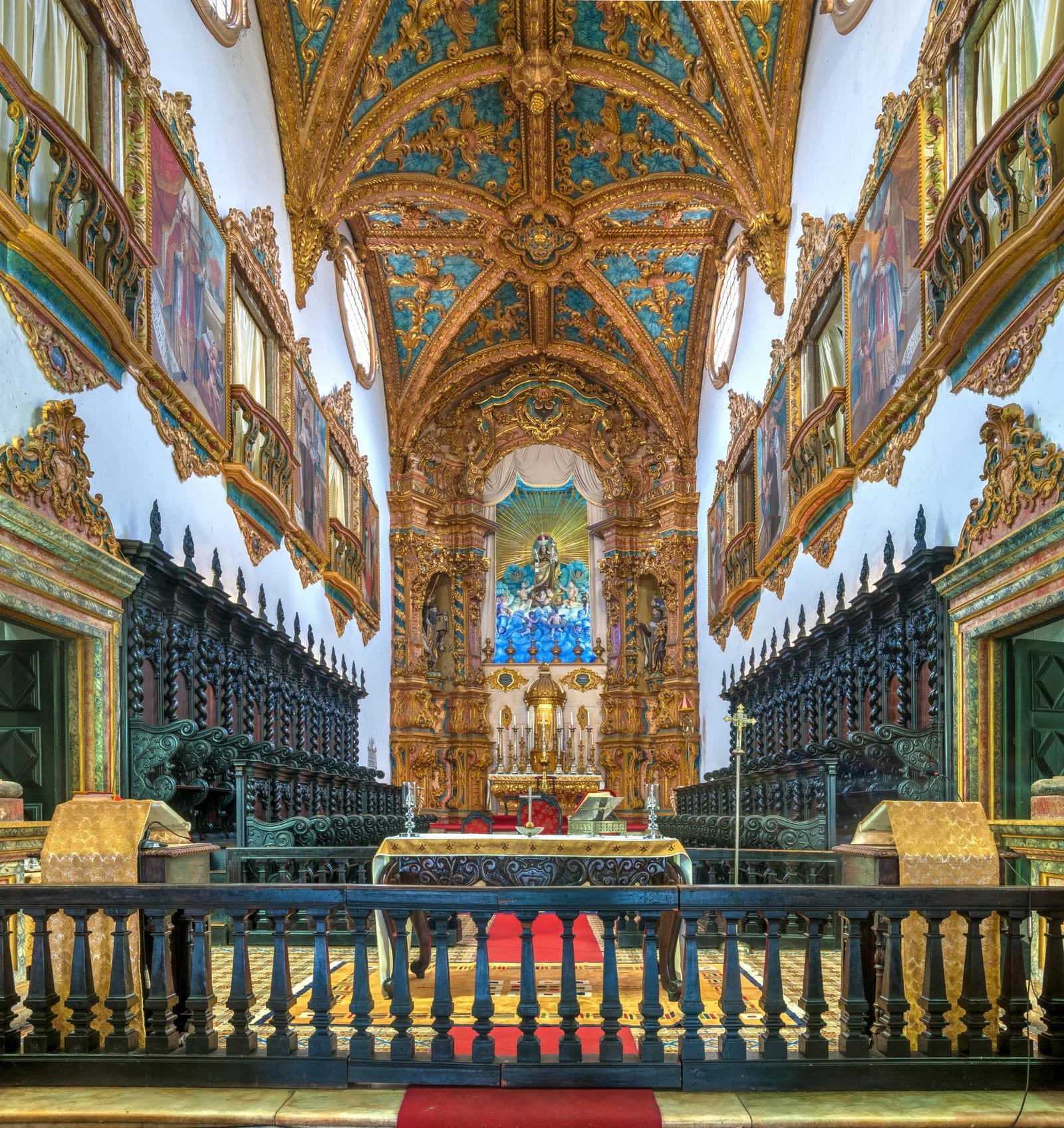
The church belongs to the Carmelite complex established in Recife in the 17th century, alongside the convent and the former Palácio da Boa Vista. Completed in 1767, it was granted the status of a minor basilica in 1917. Inside, the visit centers on the chancel, altars, sacred statuary, and ornamental detail; outside, the tower and courtyard make the complex easy to recognize in the city-center landscape.
🤔 Why does it matter?
More than a temple for a quick visit, Carmo reveals how faith, convent life, and urban development converged in Recife. The July 16 program keeps devotion to Our Lady of Mount Carmel alive, while the federal heritage listing places the complex among the city’s landmark sites.
📍 What to see
- The chancel and its retable, with images linked to Carmelite devotion.
- The side altars, sacred statuary, and gilded wood ornamentation inside.
- The basilica tower, a visual landmark of the complex in Santo Antônio.
- The courtyard and the immediate surroundings of the historic Carmo complex.
🎒 Things to do
- Visit with attention to the details of sacred art and the temple’s atmosphere.
- Attend Mass or the weekly A Hora da Graça celebration if the trip has a devotional purpose.
- Photograph the façade and the complex from the courtyard, respecting liturgical moments.
- Continue on foot through the center to Marco Zero, combining churches, museums, and public spaces.
✨ Recommended experiences
- Half-day itinerary: begin at the Carmo Basilica, explore the streets around Santo Antônio, and continue through the historic center to Marco Zero.
- Faith-centered experience: time your arrival around the Mass schedule, set aside time for prayer, and stay for A Hora da Graça on a Thursday.
- A heritage-focused view: visit the temple in the morning, then spend the afternoon at Paço do Frevo and Rua do Bom Jesus in Bairro do Recife.
🍽️ Local cuisine
🎶 Soundtrack
- La Belle de Jour — Alceu Valença
- A Praieira — Chico Science e Nação Zumbi
- Paciência — Lenine
🎭 Local culture
🌿 Nature nearby
🌎 Biomes
🏞️ Natural features
🐾 Wildlife you may spot
🌱 Plants you may see
📅 Best time to visit
August through October tends to favor walking and photography in the center, coinciding with Recife’s relatively drier period. To experience the devotion, the key date is July 16, when the flow of worshippers is greater.
- ✅ Best time:
- August through October, for exploring the surrounding area with less chance of persistent rain.
- 🟡 Shoulder season:
- November through March, when heat and humidity call for breaks and hydration.
- 🔴 Less recommended:
- April through July, the rainier period; visiting remains possible, but outdoor walks require planning. On July 16, expect intense religious activity.
- 📝 Notes:
- In a working temple, the liturgical program takes precedence over sightseeing. Confirm the schedule before traveling there.
🧭 Getting there
🏙️ Base city: Recife
✈️ Airport: Recife/Guararapes–Gilberto Freyre International Airport
- From the airport, take a taxi, ride-hailing service, or bus to the center, getting off near Avenida Dantas Barreto.
- By metro, the Central Line serves the downtown area; complete the trip on foot or by urban transport according to the stop where you get off.
- From Marco Zero, you can walk there as part of an urban itinerary, paying attention to street activity.
🚗 Local transportation
- Walking is the most rewarding way to connect the basilica with other central-city sights.
- Taxis and ride-hailing services are practical options for nighttime arrivals, people with reduced mobility, or trips beyond the tourist corridor.
ℹ️ Practical information
- 🏗️ Infrastructure:
- high in the surrounding urban area
- 🏨 Where to stay:
- Accommodations are available in central neighborhoods and Boa Viagem, connected to the destination by city roads and ride-hailing services.
- 🍴 Food:
- Restaurants, snack bars, cafés, and markets are available in the center and Bairro do Recife.
- 🧭 Guides and agencies:
- Tour guides can create historic-center itineraries; confirm in advance whether a guided interior visit is authorized.
- 📶 Internet and signal:
- Mobile coverage is usually available in the urban center, with variation inside older buildings.
- 💰 Estimated cost:
- The institutional source consulted does not state an admission fee or visiting price. Costs depend on transportation, food, and any guide hired.
- 📝 Notes:
- The Archdiocese lists Masses on Mondays at 7 a.m. and 8 a.m.; Tuesdays and Wednesdays at 7 a.m., 8 a.m., noon, and 6 p.m.; Thursdays at 7 a.m., 8 a.m., noon, and 4 p.m.; Fridays at 7 a.m., 8 a.m., noon, 3 p.m., and 6 p.m.; Saturdays at 7 a.m. and 10 a.m.; and Sundays at 10 a.m. and 7 p.m. The institutional page does not detail tourist visiting hours outside services.
♿ Accessibility
Level: consult local operators
The historic building and its surroundings may have changes in level and uneven surfaces. The institutional page consulted does not provide an accessibility information sheet for visits.
- Contact the basilica before visiting to confirm assistance, access points, and the best times.
- Visitors using a wheelchair, cane, or stroller should plan for assistance in areas with historic paving.
- Prioritize transportation that drops you near the entrance to reduce walking in the surrounding area.
⚠️ Safety
🚨 Real risks
- Opportunistic theft in busy downtown areas.
- Heat, sun exposure, and dehydration during walks.
- Uneven paving and changes in level on sidewalks and in historic areas.
✅ Recommended care
- Keep your phone, documents, and valuables put away while moving through the center.
- Carry water, use sunscreen, and wear stable shoes for the urban route.
- Respect silence, services, and restricted areas of the convent.
⛔ When to avoid: Avoid walking alone through quiet stretches after business hours and reconsider walking itineraries in heavy rain.
📝 Checklist — what to bring
- sunscreen
- hat or cap
- water bottle
- phone or camera with a fully charged battery
- comfortable shoes for uneven sidewalks
- modest clothing appropriate for a religious space
✈️ Travel tips
- Set aside a morning or afternoon to combine the basilica with other heritage sites in the center.
- Arrive early if you want to see the façade in softer light and on less crowded streets.
- In July, plan your visit in advance because of the patroness’s celebrations.
- Do not treat Mass times as a guarantee of tourist access: confirm the schedule and any restrictions on the day.
💡 Fun facts
- The Palácio da Boa Vista, associated with Maurice of Nassau, became part of the Carmelite complex in 1687.
- The patroness’s annual feast takes place on July 16.
- A Hora da Graça brings together praise, Mass, and adoration of the Blessed Sacrament on Thursdays.
🤔 Did you know?
- Benedict XV officially elevated the church to the status of a minor basilica in 1917.
- The Basilica and Convent of Carmo complex received heritage listing by IPHAN in 1938.
- Frei Caneca was a Carmelite at Recife’s convent, but there is no public confirmation of where he was buried.
📜 History and context
The Carmelite Order began work on the convent and church in Recife in 1665, under the impetus of Captain Diogo Cavalcanti Vasconcelos. In 1687, the former Palácio da Boa Vista, attributed to Maurice of Nassau, was incorporated into the complex. The church was completed in 1767. In 1909, the Virgin of Mount Carmel was declared Recife’s secondary patroness; eight years later, Pope Benedict XV granted the temple the title of minor basilica. Frei Caneca took his vows and was ordained at the convent, but the exact location of his burial is unknown.
🌍 Global importance
The title of minor basilica links the temple to the universal tradition of the Catholic Church and to St. Peter’s Basilica in Rome. In Brazilian heritage terms, federal protection extends to the basilica and convent complex, recognizing the enduring religious landscape built since the colonial period.
🗺️ Quick map (orientation)
📌 Main base: Santo Antônio neighborhood, Recife
🧭 Landmarks
📍 Nearby places
Small discoveries
- Barroca
- Wood carving covered with sheets of gold leaf, typical of Luso-Brazilian Baroque art.
- Frei Caneca
- A 19th-century religious friar, journalist, and liberal leader from Pernambuco.
- Elias
- An Old Testament prophet; in Carmelite iconography, he is associated with Mount Carmel.
- Eliseu
- Elijah’s disciple and a recurring figure in Carmelite iconography.
- Recife Antigo
- The group of islands and bridges that forms Recife’s historic center.
- IPHAN
- Brazil’s National Institute of Historic and Artistic Heritage.
- Bolo de rolo
- A sweet of thin layers of cake filled with firm guava paste, a symbol of Pernambuco.
- Tapioca
- Tapioca made from cassava starch, cooked on a griddle and filled with either sweet or savory ingredients.
- Cartola
- Fried banana with cheese and cinnamon, a Northeastern Brazilian dessert.
- Av. Domingos Ferreira/Conde da Boa Vista
- A main road corridor linking Recife’s South Zone to the city center.
- Metrô (Linha Centro)
- The Central Line of the Recife Metro; get off at São José or Recife.
Keep discovering
Flavors
Animals
Plants
Places
Culture