.webp&w=1920&q=82)
.webp&w=1920&q=82)
.webp&w=1920&q=82)
.webp&w=1920&q=82)
Turquoise-fronted Amazon
Amazona aestiva
Birds — Psittaciformes (Psittacidae)
Between the canopy and the open sky, the turquoise-fronted Amazon announces itself before it comes into view: a harsh cry cuts through the forest, then the blue forehead and yellow head break the green. At dusk, whole flocks converge on communal roosts, repeating a ritual that may endure for decades in the same stand of trees.
The voice, colors, and social life of a large South American parrot.
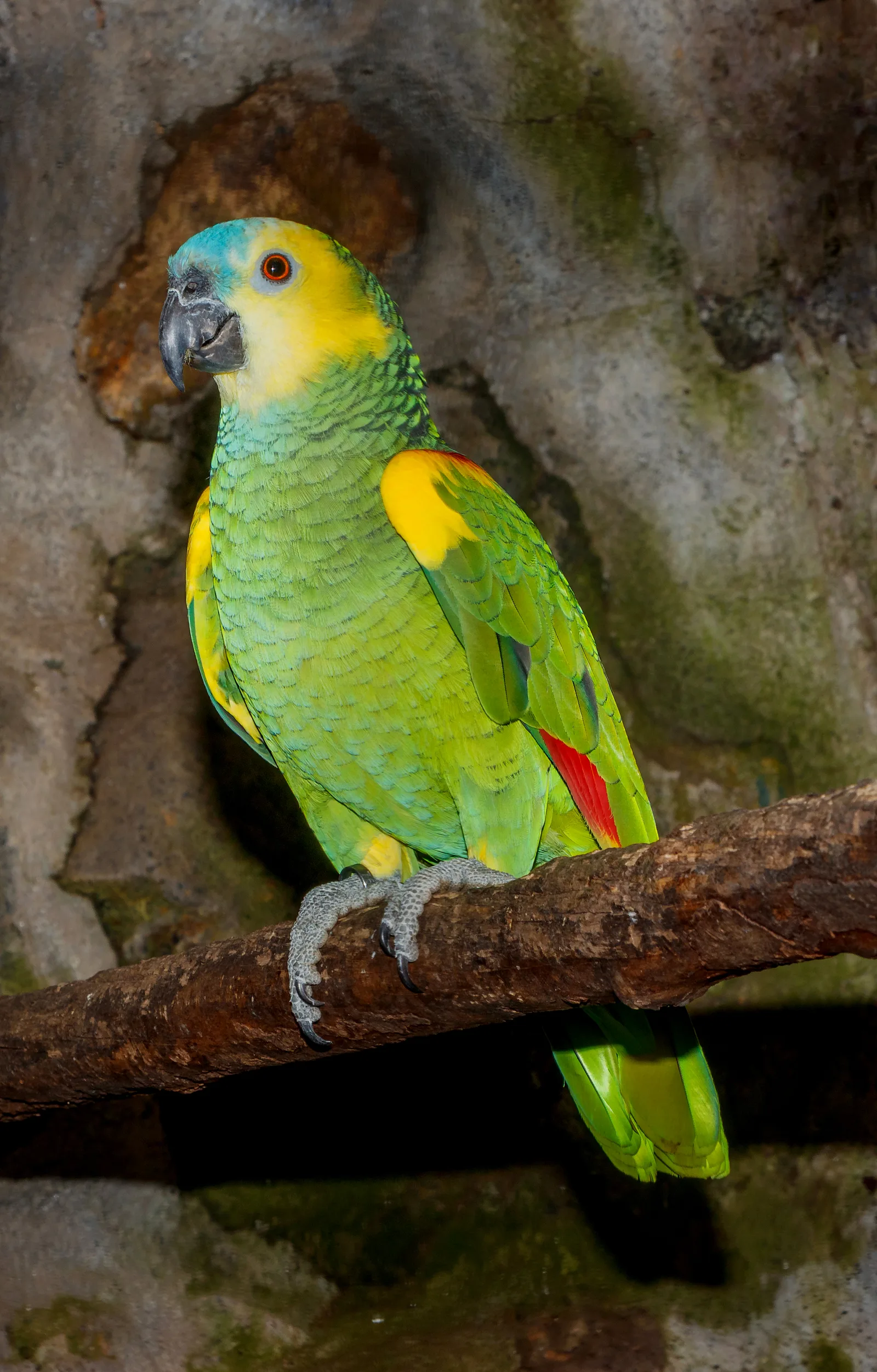
The turquoise-fronted Amazon, Amazona aestiva, is a robust parrot with crisp colors, recognized by its yellow head and blue forehead. It lives in inland South America, widespread in Brazil and also found in Bolivia, Paraguay, and northern Argentina. Outside the breeding season, its life is distinctly social: it forages and roosts in flocks. Yet once a pair forms, the two birds remain closely bonded as they travel and raise their young.
📍 Biomes it inhabits
In Brazil, the species spans sharply different landscapes, from the southern Amazon and the Caatinga—the dry thorn-scrub biome of Brazil—to inland Atlantic Forest, Cerrado, Pantanal—the world’s largest tropical wetland—and Pampa. What these places share is not a single, unbroken forest but trees that offer food, shelter, and cavities. Gallery forests, tree-dotted savannas, palm groves, and wooded fragments in rural areas can meet this set of needs; in the Pantanal, the alternation of floods, dry periods, and fruiting draws parrots between patches of vegetation.
🌍 Conservation status (IUCN)
NT · Near ThreatenedIn the IUCN Red List’s 2019 global assessment, the turquoise-fronted Amazon is classified as Near Threatened. Pressure from the cage-bird trade and the conversion of native vegetation to agriculture reduce the extent and quality of its habitat. Long-term studies in the southern Pantanal have also linked the loss of forests and savannas to a decline in the recruitment of young birds leaving the nest. Conserving mature trees, nesting cavities, and communal roosts, while combating illegal capture, protects different stages of the same life history.
🔬 Scientific classification
- Kingdom
- Animalia
- Phylum
- Chordata
- Class
- Aves
- Order
- Psittaciformes
- Family
- Psittacidae
- Genus
- Amazona
- Species
- Amazona aestiva (Linnaeus, 1758)
⚙️ Specifications and metrics
- Length: Between 35 and 37 cm (13.8–14.6 in).
- Body mass: About 400 g (14 oz).
- Plumage: Predominantly green, with yellow on the head, greenish blue on the forehead and cheeks, red shoulders, and dark blue wing tips.
- Vocalization: It gives harsh, ringing cries; transcriptions of its calls include krik-kiakrik-krik-krik and kréo.
Diet: It feeds chiefly on the fruits and seeds of many plants, as well as leaves, shoots, flowers, and nuts. It holds food in its foot and works it with its bill and tongue to reach the nourishing part. The supply of flowers and fruit changes with the season; in the Pantanal, flocks therefore range across a mosaic of forests, savannas, and open areas in search of resources. It also visits croplands, including corn and sunflower fields.
📅 Life cycle
- Reproduction: It lives in social pairs. In the southern Pantanal, nesting occurs chiefly from July to October and sometimes extends through December; the schedule may vary between regions.
- Nest: It does not excavate its own nest: instead, it occupies preexisting cavities, chiefly in trees, and may also use hollows in banks or eroded rock.
- Incubation: About 29 to 30 days in a study conducted in the Pantanal. During this period, one adult remains in the cavity while its partner forages.
- Lifespan: An educational summary records up to about 70 years in captivity; there is no equivalent, consolidated estimate here for life in the wild.
🔗 Ecological ripple effect
When the turquoise-fronted Amazon grows scarce, the landscape loses a mobile consumer of fruit, seeds, shoots, and flowers, one able to carry food and plant fragments between trees and habitat patches. It also loses the large roosts that organize the daily movement of many birds between resting and feeding areas. Because the species depends on old trees for cavities and productive canopies for food, its local disappearance signals a landscape that is less connected and poorer in tree structure.
🤔 Why it matters
- It is part of the food web as a consumer of the fruits, seeds, flowers, and shoots of numerous plants.
- It depends on mature trees, natural cavities, and communal roosts, underscoring the value of conserving entire wooded landscapes.
- It is a key species for monitoring how the clearing of forests and savannas affects the breeding of cavity-nesting birds.
- Its close association with people, its ability to mimic sounds, and its persecution by the illegal trade make it a symbol of Brazil’s relationship with wildlife.
- Studies of its roosts in the Pantanal show that counting adults alone can conceal problems in the recruitment of young birds.
🧪 Did you know?
- Turquoise-fronted Amazon roosts can gather hundreds of birds, and some sites in the Pantanal have persisted for decades.
- During incubation, it is common for one member of the pair to remain in the cavity while the other leaves to forage and spends the night away from the nest area.
- Pairs may fly so close together that, from a distance, they seem to be a single bird with four wings.
- To open and select food, it uses its foot like a hand, bracing fruit or seeds while working them with its bill and tongue.
- Its voice changes with context: calls help maintain contact in flight, while feeding, at communal roosts, and in alarm situations.
Small discoveries
- Communal roost
- A group of trees where many individuals gather regularly to spend the night.
- Nest cavity
- A natural hollow in a tree, bank, or rock used to shelter eggs and young.
- Recruitment
- The addition of surviving young to the population that will be able to breed.
- Tree layer
- The layer of vegetation formed by trees, including trunks, branches, and crowns.
📚 References
- BirdLife International. Turquoise-fronted Amazon Amazona aestiva Species Factsheet.
- Seixas, G. H. F. e Mourão, G. 2022. A long-term study indicates that tree clearance negatively affects fledgling recruitment to the Blue-fronted Amazon population.
- Seixas, G. H. F. e Mourão, G. 2018. Communal roosts of the Blue-fronted Amazons Amazona aestiva in a large tropical wetland.
- Seixas, G. H. F. e Mourão, G. 2002. Nesting success and hatching survival of the Blue-fronted Amazon Amazona aestiva in the Pantanal of Mato Grosso do Sul, Brazil.
- WikiAves. Papagaio-verdadeiro Amazona aestiva.
- GBIF — Amazona aestiva