.webp&w=1920&q=82)
.webp&w=1920&q=82)
.webp&w=1920&q=82)
.webp&w=1920&q=82)
Orange-winged Amazon
Amazona amazonica
Birds — Psittaciformes (Psittacidae)
At day’s end, the orange-winged Amazon turns the crowns of trees and palms into a gathering place: pairs and flocks arrive noisily to roost together. When it spreads its wings, the forest’s green flashes red-orange, the trait that gave the species its English name.
The collective voice and colorful wing of a parrot from South America’s lowlands.
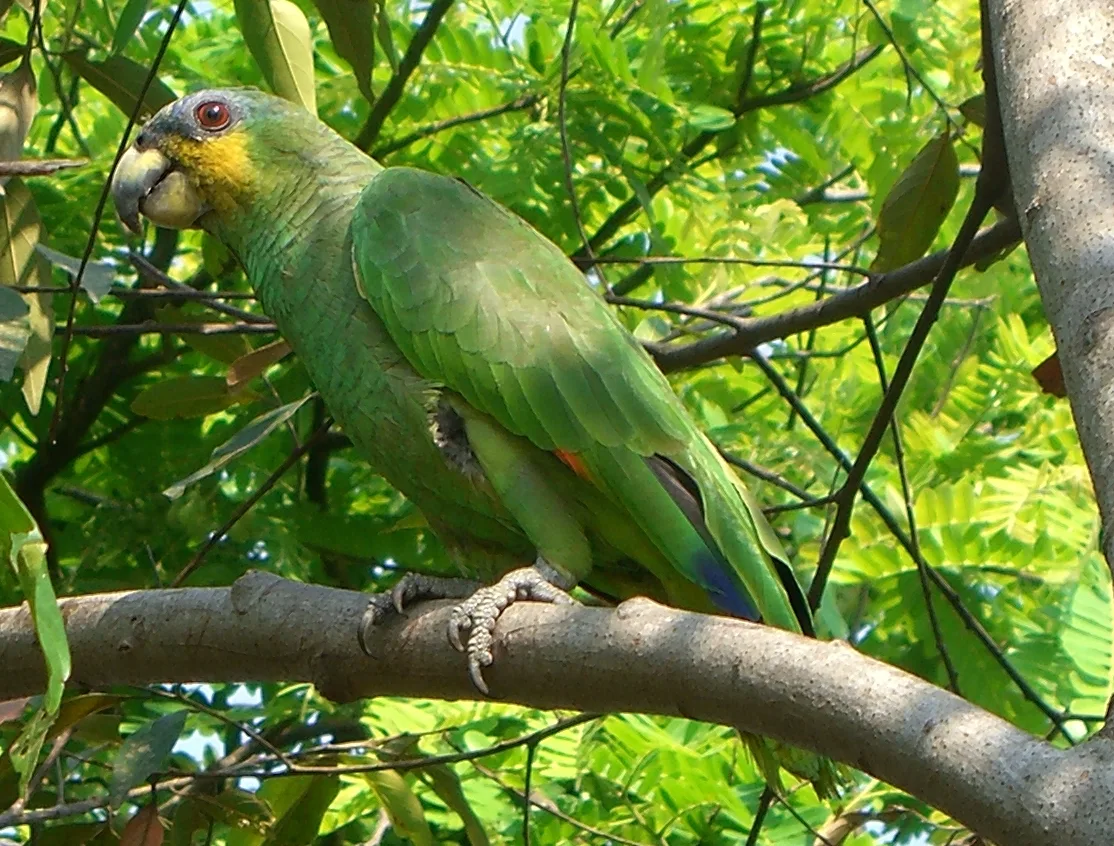
The orange-winged Amazon, Amazona amazonica, is a medium-sized, mostly green parrot, recognizable by the yellow on its head, the blue between its eyes, and the red-orange patch on its wings. It is not confined to Brazil: its native range extends across northern and central South America east of the Andes and also reaches Trinidad and Tobago. Social by nature, it usually travels in pairs or small flocks and may gather in far larger concentrations at communal roosts.
📍 Biomes it inhabits
In Brazil, the orange-winged Amazon occurs in the Amazon, the Cerrado — Brazil’s savanna —, the Caatinga — Brazil’s dry thorn-scrub biome —, and the Atlantic Forest. Its adaptability is evident in its range of landscapes: it occupies várzea and gallery forests, swampy palm groves, mangroves, savannas, forest edges, and regrowth after disturbance, as well as gardens, parks, and wooded plantations. Even so, its routine depends on trees and palms that provide food, nighttime shelter, and nesting cavities.
🌍 Conservation status (IUCN)
LC · Least ConcernThe global assessment places it in the Least Concern category, but that does not mean it faces no risk. Reports indicate a declining population trend, and its value as a pet fuels capture and illegal trade across its range. Habitat degradation and hunting are also recognized pressures; protecting large trees, palms, and vegetation corridors helps preserve feeding, resting, and breeding sites.
🔬 Scientific classification
- Kingdom
- Animalia
- Phylum
- Chordata
- Class
- Aves
- Order
- Psittaciformes
- Family
- Psittacidae
- Genus
- Amazona
- Species
- Amazona amazonica (Linnaeus, 1766)
⚙️ Specifications and metrics
- Length: About 31 cm (12 in).
- Body mass: Between 298 and 470 g (10.5–16.6 oz).
- Plumage: Predominantly green, with a yellow forehead, crown, cheeks, and throat; the lores and stripe above the eyes are blue, while the red-orange wing speculum stands out in flight.
- Vocalization: It gives everything from loud screams, squawks, and harsh calls to trills, bubbling notes, and softer whistles. In Pará, a study of breeding birds recorded flight, contact, and alarm calls associated with distinct social situations.
Diet: It feeds chiefly on fruit, seeds, and flowers, handling them with its bill among branches and treetops. In Brazil, flocks have been recorded in bacaba and açaí palms. It is resident but may make local movements as food availability changes; the sources consulted do not establish one seasonal calendar for its entire range.
📅 Life cycle
- Reproduction: It forms socially monogamous pairs. The female lays 2 to 5 eggs, and the young remain with their parents for at least three months.
- Nest: It uses pre-existing cavities in trees and palms rather than excavating its own nest.
- Incubation: Incubation is carried out by the female alone and lasts about 22 days; after hatching, both adults feed the chicks.
- Lifespan: The consulted sources provide no comparable, well-documented estimate of longevity in the wild; for that reason, a captive-life figure was not used as though it described the species in nature.
🔗 Ecological ripple effect
The loss of the orange-winged Amazon would remove from the landscape a mobile consumer of fruit, seeds, and flowers, one able to follow food supplies across different parts of the lowlands. It would also silence communal roosts where parrots gather and interact. Because the species depends on cavities and tree crowns for breeding and rest, its disappearance would be another sign of the depletion of mature trees and connectivity among wooded fragments.
🤔 Why it matters
- It is part of networks that consume fruit, seeds, and flowers in forests, mangroves, savannas, and altered landscapes.
- Its local movements track shifts in food availability, linking different areas within a single landscape.
- Its communal roosts in trees and palms reveal the importance of maintaining safe resting sites throughout the year.
- Its vocal repertoire is the subject of Brazilian research: nests in Pará have yielded documented calls associated with flight, social contact, feeding, and alarm.
- Brazilian names such as curica and papagaio-do-mangue record the species’ strong presence in the country’s varied landscapes and cultures.
🧪 Did you know?
- A study of free-ranging orange-winged Amazons in Santa Bárbara do Pará identified nine vocalizations, grouped as flight, contact, and aggressive calls.
- The red-orange wing speculum can be inconspicuous when the bird is perched, yet becomes evident in flight.
- The orange-winged Amazon may share nighttime roosts with other parrot species.
- Only the female incubates the eggs, while both adults feed the chicks after hatching.
- Although resident, it may move locally in response to food availability.
Small discoveries
- Speculum
- A contrasting patch of color in the wing feathers, more visible when a bird flies or spreads its wings.
- Secondary cavity
- A hollow already present in a tree or palm, used for nesting by a bird that does not excavate it.
- Lores
- The area between a bird’s eye and the base of its bill.
📚 References
- Birds of the World — Orange-winged Amazon (Amazona amazonica)
- BirdLife DataZone — Orange-winged Amazon (Amazona amazonica)
- World Parrot Trust — Orange-winged Amazon
- WikiAves — curica (Amazona amazonica)
- Moura, da Silva e Vielliard — Vocal repertoire of wild breeding Orange-winged Parrots Amazona amazonica in Amazonia
- GBIF — Amazona amazonica