.webp&w=1920&q=82)
.webp&w=1920&q=82)
.webp&w=1920&q=82)
.webp&w=1920&q=82)
Red-tailed Amazon
Amazona brasiliensis
Birds — Psittaciformes (Psittacidae)
Where forest meets sea, deep green takes on a red forehead, a bluish face, and a tail marked with fire. The red-tailed Amazon is found only in Brazil: every one of its natural flights takes place along the Atlantic Forest’s narrow coastal strip. At dawn and dusk, its high calls travel across channels, mangroves, and islands as flocks follow a daily route between roosting, breeding, and feeding grounds.
An endemic parrot linking mangroves, islands, and the coastal forests of the Atlantic Forest.
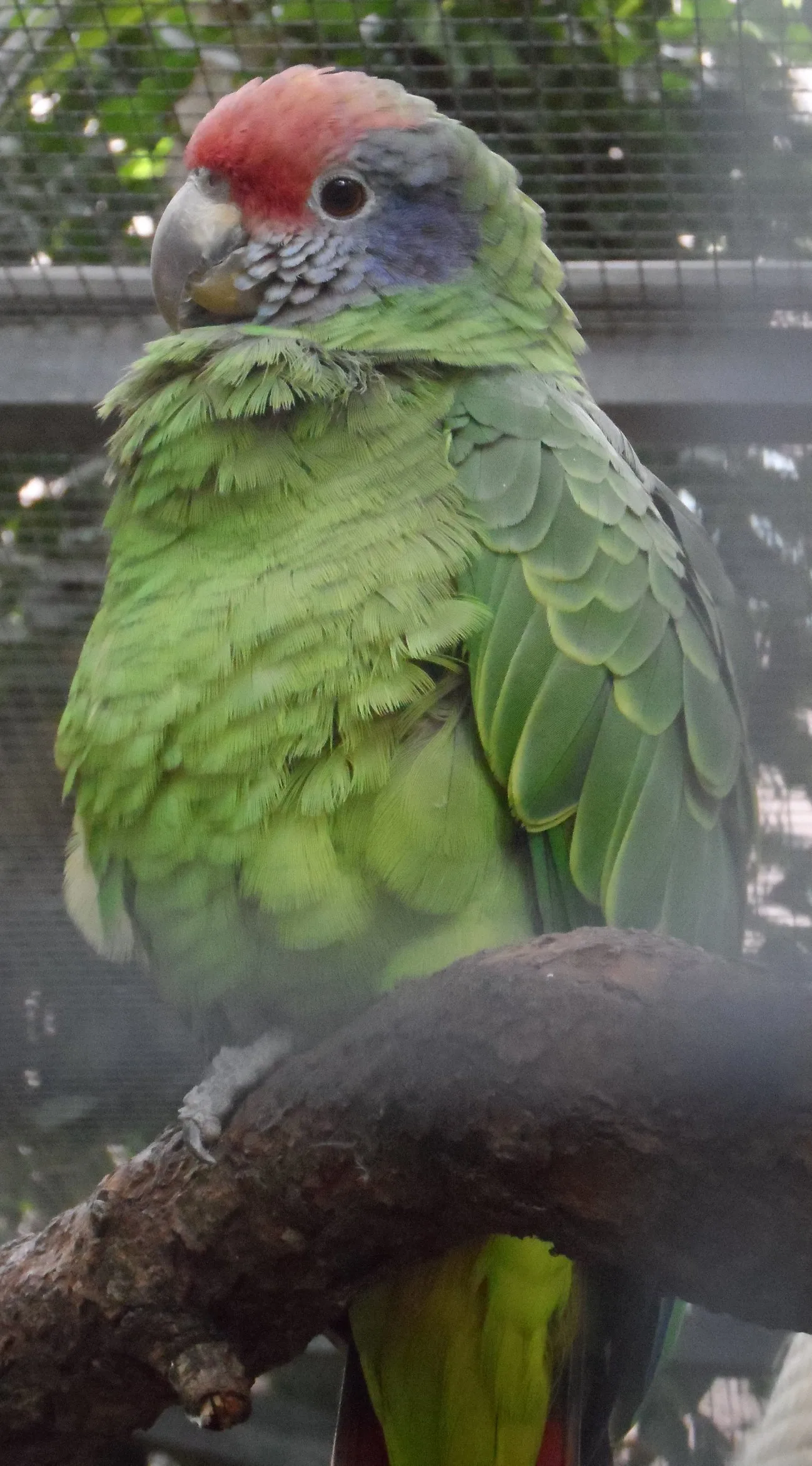
Amazona brasiliensis, the red-tailed Amazon, is endemic to Brazil and one of the birds most characteristic of the south-southeastern coast. The combination of a green body, red forehead, violet tones on the head, blue along the sides of the face, and red outer tail feathers makes it recognizable even before the flock lands. It is a monotypic species—that is, one with no recognized subspecies—and depends on a highly particular coastal landscape to complete its life cycle.
📍 Biomes it inhabits
The red-tailed Amazon belongs to the Atlantic Forest and occupies its coastal portion, now a strip stretching from the coast of São Paulo through Paraná to far northeastern Santa Catarina. An isolated forest is not enough: the species uses a mosaic of mangroves, restingas—coastal sandbank vegetation—, lowland forests, and permanently flooded areas. Mangroves and other coastal forests hold resting and breeding areas; in Atlantic Forest stands, flocks find much of their food. This daily movement makes connectivity between habitats a requirement for survival.
🌍 Conservation status (IUCN)
NT · Near ThreatenedOn the IUCN Red List, the red-tailed Amazon is classified as Near Threatened. Its breeding range is small, the population remains dependent on conservation action, and the species faces the loss, degradation, and fragmentation of coastal forests, as well as capture for the illegal trade. Protecting trees with cavities, monitoring nests, judiciously installing nest boxes where cavities have been lost, and environmental education make a tangible difference for a bird that cannot simply move to another coast.
🔬 Scientific classification
- Kingdom
- Animalia
- Phylum
- Chordata
- Class
- Aves
- Order
- Psittaciformes
- Family
- Psittacidae
- Genus
- Amazona
- Species
- Amazona brasiliensis (Linnaeus, 1758)
⚙️ Specifications and metrics
- Length: About 37 cm (14.6 in).
- Body mass: About 430 g (15 oz).
- Plumage: Predominantly green, with red forehead and lores, a purplish crown and throat, bluish sides of the head, and a red band near the tip of the outer tail feathers.
- Vocalization: Musical growls and high-pitched calls, sometimes harsh.
Diet: It feeds mainly on fruit, seeds, flowers, and nectar. Recorded resources include the fruits of jerivá, araçá, and guanandi; it may also eat invertebrates, such as beetle larvae, small spiders, and pupae. The makeup of its diet follows the seasonal fruiting and flowering cycle of the coastal plain, leading flocks to explore different stretches of forest throughout the year.
📅 Life cycle
- Reproduction: Breeding occurs chiefly from September to February and may extend through April; clutches usually contain three to four eggs.
- Nest: It uses cavities in trees in floodplain forests, especially caxetal forests; it has also been recorded in arboreal termite nests and in managed nest boxes.
- Incubation: About 26 to 28 days, according to captive records and field references.
- Lifespan: The sources consulted provide no reliable estimate of longevity for wild individuals.
🔗 Ecological ripple effect
If the red-tailed Amazon disappears, the coastal Atlantic Forest loses one of its most visible connections to plant seasonality: the flocks that consume fruit, flowers, nectar, and seeds at different points in the forest mosaic disappear. A daily link between mangroves, islands, and feeding forests also breaks. The loss would not be only of color and sound: it would show that the landscape no longer preserves the cavities, plant resources, and forest corridors on which the species depends.
🤔 Why it matters
- It is endemic to Brazil and embodies the biological singularity of the coastal Atlantic Forest.
- Its presence depends on a connected mosaic of mangroves, floodplain forests, islands, and feeding forests, making it an indicator of this landscape’s integrity.
- By consuming fruit, flowers, nectar, and seeds from many plants, it takes part in ecological interactions that follow the forest’s fruiting calendar.
- Nest monitoring and environmental education programs associated with the species have produced an important conservation case for parrots in Brazil.
- Its communal roosts and daily movements make it possible to track populations through censuses and field observation.
🧪 Did you know?
- The red that gives the species its English name, red-tailed Amazon, appears as a band near the tip of the outer tail feathers, not as an entirely red tail.
- It is a monotypic species: no subspecies are recognized for Amazona brasiliensis.
- Nearly the entire population travels daily between coastal resting and breeding areas and feeding areas in the Atlantic Forest.
- More than sixty food plants have already been recorded for the species, along with occasional consumption of invertebrates.
- In a study of breeding under human care, young birds made their first flights between 55 and 57 days of age.
Small discoveries
- Endemic
- A species that occurs naturally only in a particular geographic area.
- Mangrove
- A coastal ecosystem shaped by the mixing of fresh and salt water, with vegetation adapted to the tides.
- Caxetal forest
- A floodplain forest dominated by caxeta, a tree that can provide nesting cavities.
- Nest cavity
- A natural hollow or equivalent structure used by a bird to shelter eggs and young.
- Monotypic
- A species for which no subspecies are recognized.
📚 References
- BirdLife International — Red-tailed Amazon Amazona brasiliensis Species Factsheet
- Collar, N.; Boesman, P. F. D.; Sharpe, C. J. — Red-tailed Amazon, Birds of the World
- Martuscelli, P. — Ecology and conservation of the Red-tailed Amazon Amazona brasiliensis in south-eastern Brazil
- Marcuk, V. et al. — Reproductive parameters of the red-tailed parrot Amazona brasiliensis under ex situ conditions
- World Parrot Trust — Red-tailed Amazon
- ICMBio — Portaria nº 530, de 14 de agosto de 2017, PAN Papagaios
- GBIF — Amazona brasiliensis