.webp&w=1920&q=82)
.webp&w=1920&q=82)
.webp&w=1920&q=82)
.webp&w=1920&q=82)
Horned Screamer
Anhima cornuta
Birds — Anseriformes (Anhimidae)
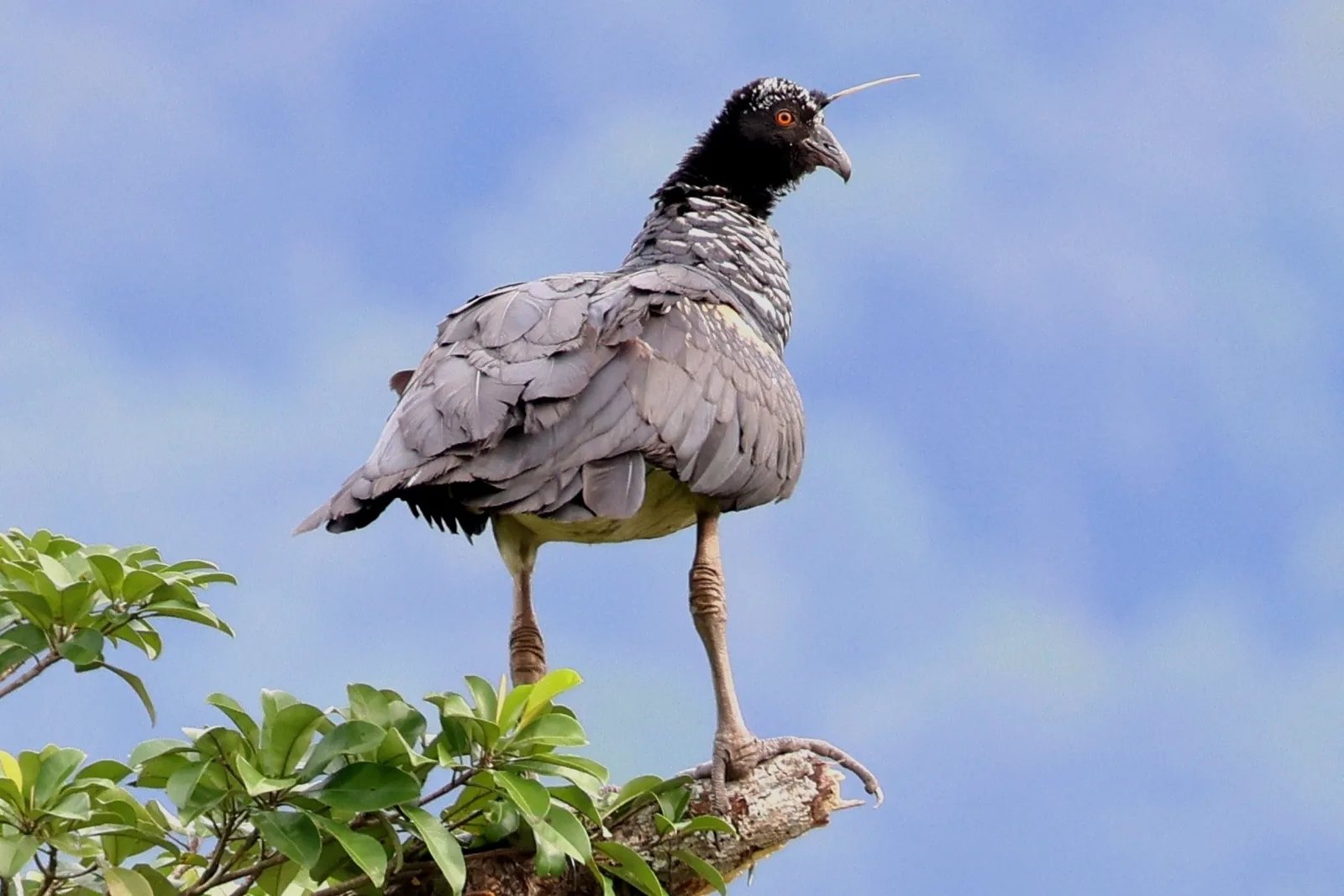
Atop its head, the horned screamer carries a pale appendage that sways like a small horn; in its wings, it conceals bony spurs that can turn a territorial dispute into a fight. When the marsh wakes, its trumpet cuts across the landscape and may draw answers from other birds in the distance. It is a large South American waterbird, also found in Brazil, where it makes the flooded shore its grazing ground.
The bird with a mobile horn that makes the marshes sound like a trumpet.
The horned screamer is a robust bird with long legs and unwebbed feet, better built for walking on waterlogged ground than for paddling. Up close, its small head contrasts with its body’s bulk and the long cartilaginous projection rising from its forehead. It alternates grazing along the shore, resting in riparian trees, and flights in which it may soar; on takeoff, air sacs beneath the skin compress and can produce a muted, crackling sound.
📍 Biomes it inhabits
In Brazil, the species is documented in the Amazon, the Cerrado — Brazil’s savanna —, the Atlantic Forest, and the Pantanal — the world’s largest tropical wetland —, always associated with freshwater and landscapes that remain wet long enough to sustain marshes, lagoons, swamps, and vegetated banks. It also occurs in other countries of northern and central South America, generally east of the Andes. It is not a bird of the dry interior: its routine depends on the transition among shallow water, grasses, mud, and shrubs or trees for perching.
🌍 Conservation status (IUCN)
LC · Least ConcernThe horned screamer is globally classified as Least Concern by the IUCN Red List. That category does not make its habitats expendable: in the Cerrado, recorded nests were found chiefly in marshes and grassy areas beside water, precisely the places most vulnerable to drainage and land-use conversion. Hunting is documented across part of its range and may create local pressure; protecting wetlands, their vegetated margins, and water quality is the measure that most directly safeguards the species.
🔬 Scientific classification
- Kingdom
- Animalia
- Phylum
- Chordata
- Class
- Aves
- Order
- Anseriformes
- Family
- Anhimidae
- Genus
- Anhima
- Species
- Anhima cornuta (Linnaeus, 1766)
⚙️ Specifications and metrics
- Length: Between 71 and 92 cm (28–36 in).
- Body mass: About 3.15 kg (6.9 lb) on average.
- Plumage: The body is mostly black or dark gray, contrasting with the white belly, crown, and parts of the wings. The legs are reddish, the eyes yellow-orange, and males and females look alike.
- Vocalization: It produces very loud calls, including mo-coo-ca, the yoik-yok honk, and a trumpeting call. It may vocalize on the ground or in flight, inflating and vibrating its neck; duets and choruses serve contact, alarm, and territorial defense.
Diet: The horned screamer is primarily herbivorous: it grazes grasses and sedges at the water’s edge and picks leaves, stems, flowers, vines, and grains. It also stirs and filters wet mud, and insects appear to play a larger role in the diet of the young. The consulted sources do not describe a regular seasonal shift in its diet; what is better known is its foraging in waterlogged areas, from midmorning until late afternoon.
📅 Life cycle
- Reproduction: It forms lasting pairs, and courtship includes mutual preening and head movements. Breeding has been recorded at different times of year; in Brazil’s Cerrado, nests with eggs were found in both predominantly dry and rainy periods, and both parents tend the nest and young.
- Nest: It builds a bulky platform from plant material such as reeds, twigs, and other vegetation in marshes or grassy areas beside the water. Some nests are described as floating platforms in emergent vegetation.
- Incubation: Incubation is shared by the pair and lasts about 40 to 47 days. In field observations, the female incubated more during the day and the male at night.
- Lifespan: The consulted sources provide no reliable published estimate of longevity for the species.
🔗 Ecological ripple effect
By grazing on shore plants and turning over mud, the horned screamer takes part in the vegetation dynamics of flooded areas. Its nests of branches and plant matter also create physical shelter for small invertebrates. If it disappeared, the marsh would lose more than a distinctive voice: it would lose a consumer of aquatic plants and a builder of structures that add complexity to the environment, with effects likely to spread through the wetland community.
🤔 Why it matters
- It consumes leaves, stems, flowers, seeds, and other plant parts, helping shape the vegetation of flooded shores.
- Its large nests of plant material may offer microhabitat to small invertebrates.
- It depends on well-preserved marshes, lagoons, and riparian strips, making the importance of protecting wetlands and their margins visible.
- The air sacs distributed across its body and the spurs on its wings make it a species of great interest for the study of bird anatomy and evolution.
- Its trumpeting call and horned silhouette make it a memorable presence in the environmental education of people who live among marshes.
🧪 Did you know?
- The horned screamer’s horn is not bone: it is a cartilaginous structure only loosely attached to the skull, which can break and grow back.
- Each wing has two bony spurs at the bend. Males may use them in confrontations during pair formation and territorial defense.
- The species gives mo-coo-ca, yoik-yok, and a trumpeting call; neighbors may answer, creating choruses audible from a distance.
- The chicks hatch with open eyes, covered in down, and able to leave the nest soon after hatching to follow their parents.
- On takeoff, the compression of air sacs beneath the skin can produce a crackling or rustling sound in addition to its vocalizations.
Small discoveries
- Emergent vegetation
- Plants rooted in flooded ground, with stems and leaves rising above the water’s surface.
- Carpal spur
- A pointed bony projection at the bend of the wing, used in displays and confrontations.
- Precocial
- A chick that leaves the nest soon after hatching and follows the adults.
- Subcutaneous air sac
- An air-filled space beneath the skin, connected to the bird’s respiratory system.
📚 References
- IUCN Red List — Anhima cornuta, registro de avaliação global
- BirdLife International DataZone — Horned Screamer Anhima cornuta Species Factsheet
- Tubelis, D. P. (2020). Breeding biology of the Horned Screamer (Anhima cornuta) in non-protected areas in the Brazilian Cerrado
- WikiAves — anhuma (Anhima cornuta)
- Animal Diversity Web — Anhima cornuta
- GBIF — Anhima cornuta