.webp&w=1920&q=82)
.webp&w=1920&q=82)
.webp&w=1920&q=82)
.webp&w=1920&q=82)
Anhinga
Anhinga anhinga
Birds — Suliformes (Anhingidae)
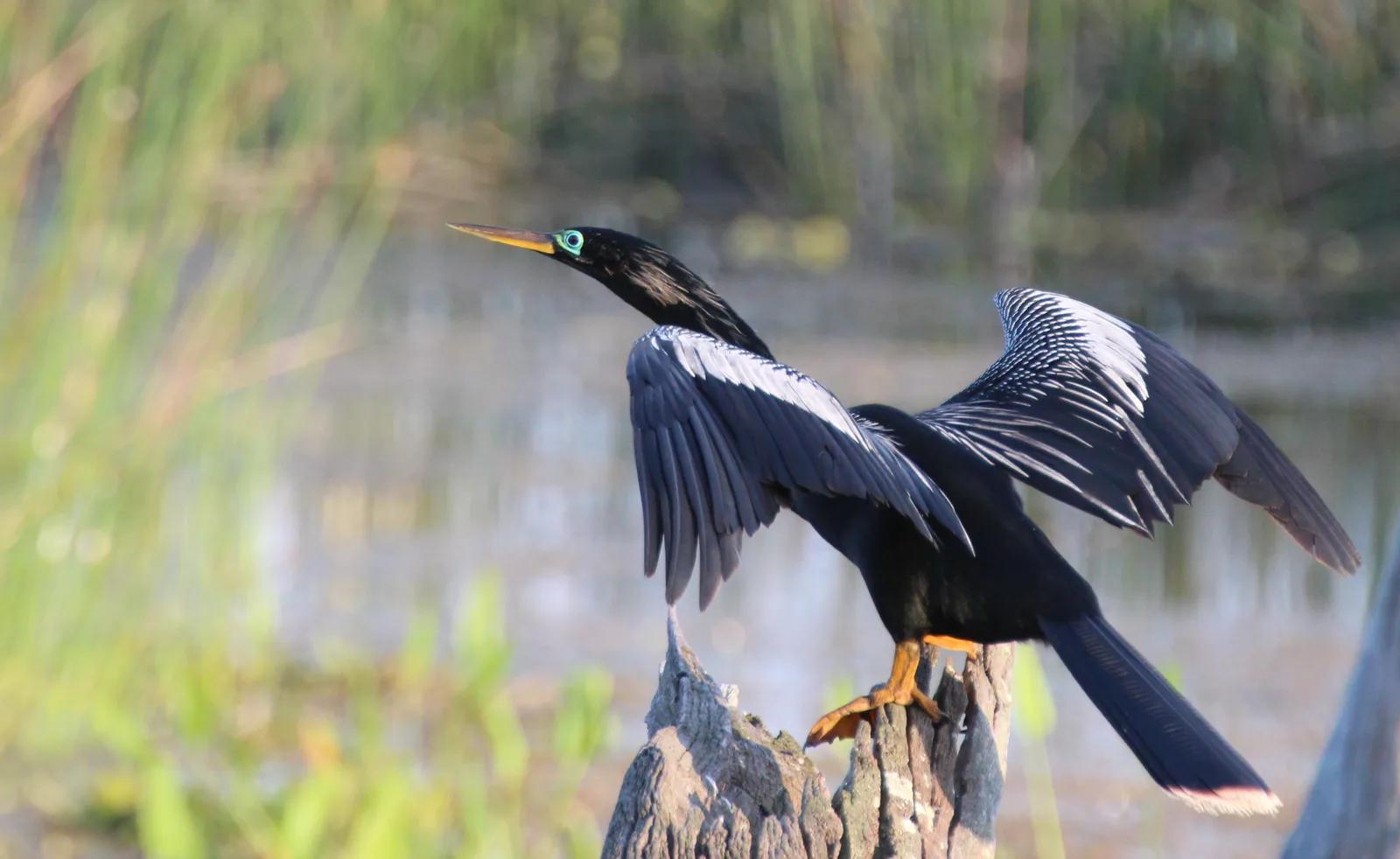
First comes a slender neck, raised above the water like a snake probing the marsh. Then the Anhinga reveals its full body: a diver with waterlogged feathers, a fisher with a dagger-shaped bill, and an unmistakable figure on the branches, wings spread to the sun.
The bird that fishes underwater and returns to the branch to wear the sun.
The Anhinga is a long-necked waterbird with a broad tail and a straight, sharp bill, found across much of the Americas. In Brazil, it occurs in every biome, always associated with bodies of water that offer places to perch. As it swims, its low-buoyancy plumage keeps its body almost submerged; observers often see only the head and neck gliding across the surface.
📍 Biomes it inhabits
From the Amazon to the Pampa, the Anhinga occupies wetlands where water meets woody vegetation: riverbanks, lakes, marshes, swamps, ponds, bay arms, and mangroves. Trees, shrubs, and emergent logs are essential parts of this setting. From these perches, it watches the water and plunges in to fish; after a dive, it spreads its wings and tail on an exposed perch, drying its feathers and absorbing heat.
🌍 Conservation status (IUCN)
LC · Least ConcernThe IUCN Red List classifies the Anhinga as Least Concern globally. That status does not make protection of its habitats dispensable: draining marshes, removing bank vegetation, water pollution, and disturbance at nesting sites can reduce opportunities to feed, rest, and breed, particularly at the local scale.
🔬 Scientific classification
- Kingdom
- Animalia
- Phylum
- Chordata
- Class
- Aves
- Order
- Suliformes
- Family
- Anhingidae
- Genus
- Anhinga
- Species
- Anhinga anhinga (Linnaeus, 1766)
⚙️ Specifications and metrics
- Length: About 86–91 cm (34–36 in).
- Body mass: About 1.35 kg (3 lb) on average.
- Plumage: The adult male is predominantly black, with a greenish sheen and silvery patterning on the wings and back; the female has a brown head and neck. Juveniles are more uniformly brown.
- Vocalization: Outside the breeding season, it is usually inconspicuous. Near the nest or colony, it gives clicks, snaps, grunts, and low croaks.
Diet: It feeds chiefly on fish, searching for them underwater and moving in slowly before delivering a sudden thrust with its neck and pointed bill. It then brings the prey to the surface, positions it in its bill, and swallows it headfirst. It may also eat aquatic insects and crustaceans; where and when these enter its diet depend on what the environment provides.
📅 Life cycle
- Reproduction: It forms monogamous pairs. In tropical regions, the breeding season may occur at different times of year and track local rainfall and water availability.
- Nest: It generally nests in colonies, often alongside other waterbirds, though isolated pairs also occur. The nest is a platform of twigs on branches over water or high in trees, sometimes lined with green leaves.
- Incubation: Males and females incubate the clutch for about 25–30 days. Clutches usually contain 2–5 eggs.
- Lifespan: One individual has been recorded living 16.4 years in the wild; this is a documented maximum, not a lifespan guaranteed for all individuals.
🔗 Ecological ripple effect
If the Anhinga vanished from a flooded landscape, it would mean the loss of a predator specialized in fish from shallow waters and of a characteristic presence in waterbird colonies. Predator–prey relationships and the composition of these communities would tend to change, and a visible sign of environments where water, fish, and wooded perches remain connected would also be missing.
🤔 Why it matters
- It preys on fish and participates in the feeding relationships of lakes, rivers, marshes, and ponds.
- Its presence depends on water with available prey and on trees or structures where it can perch, helping reveal the quality of wetlands.
- It forms part of mixed colonies with herons, cormorants, ibises, and other waterbirds, connecting life in the water with that of the canopy and banks.
- Its wings-open posture is a classic subject of studies on thermoregulation and the behavior of diving birds.
- The name anhinga comes from Tupi and preserves an Indigenous memory of South American wildlife.
🧪 Did you know?
- While swimming, the Anhinga may leave only its head and neck visible, giving rise to comparisons with a snake in the water.
- Rather than chasing prey at high speed, it usually approaches and strikes it with a very swift thrust of the neck and bill.
- After diving, it perches with its wings open because its feathers become waterlogged, reducing buoyancy and making diving easier.
- Males and females share incubation and care of the young.
- Although it is seen throughout Brazil, the species also occurs from warm areas of the United States to southern South America.
Small discoveries
- Buoyancy
- The ability of a body to remain supported in water.
- Thermoregulation
- The set of processes by which an animal keeps its body temperature within suitable limits.
- Nesting
- The stage of building, occupying, and using a nest for reproduction.
- Mixed colony
- A breeding aggregation in which individuals of more than one bird species live together.