.webp&w=1920&q=82)
.webp&w=1920&q=82)
.webp&w=1920&q=82)
.webp&w=1920&q=82)
Hyacinth Macaw
Anodorhynchus hyacinthinus
Birds — Psittaciformes (Psittacidae)
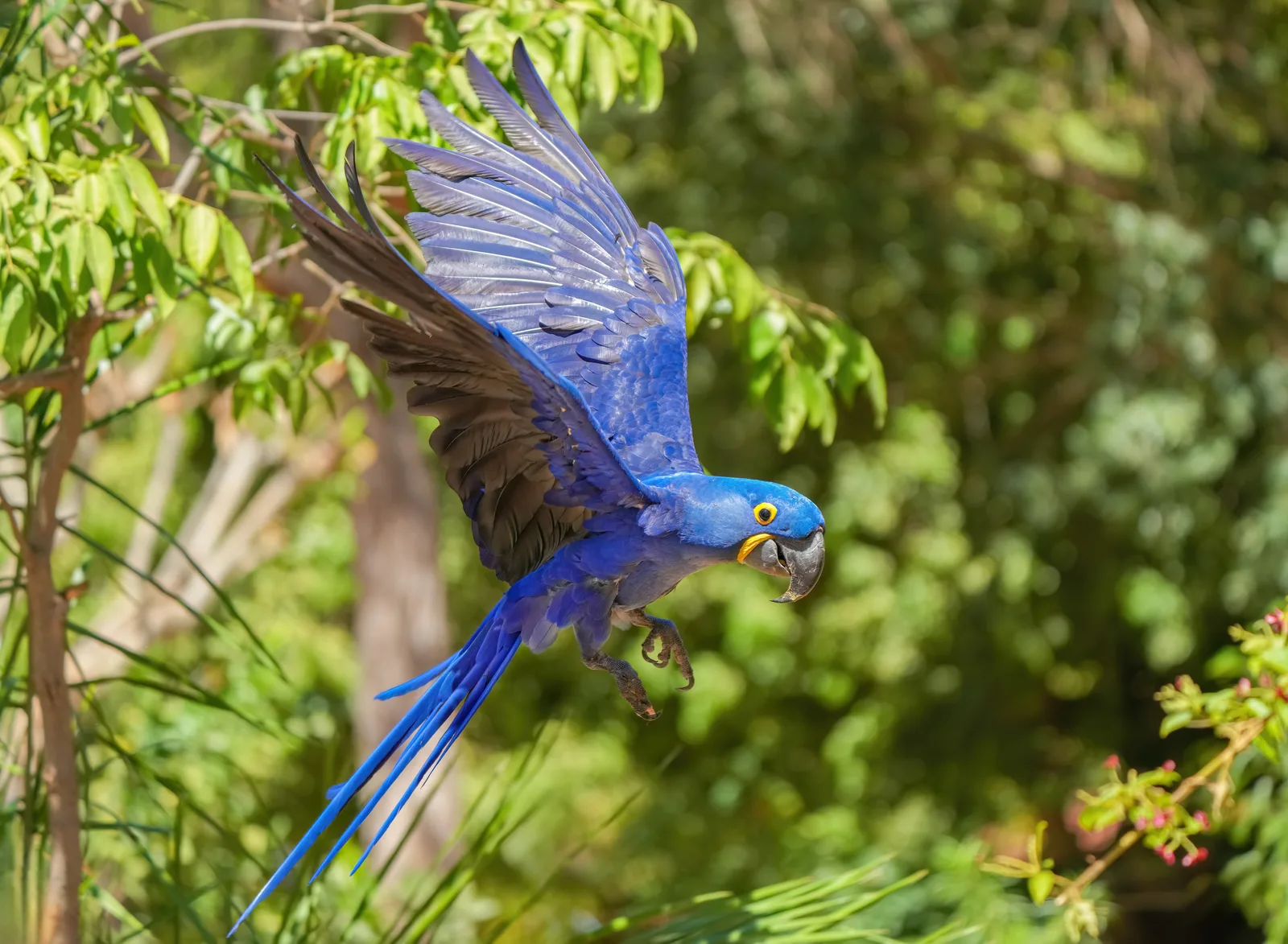
Few birds seem to carry as much sky in their feathers as the hyacinth macaw. Passing in pairs or flocks, its cobalt-blue plumage is matched by a hoarse call that travels across the palm groves; when it lands, it turns its monumental bill into a tool for opening fruits that would withstand many other animals.
The great specialist of South American palm groves.
Anodorhynchus hyacinthinus, the hyacinth macaw, is the largest species in the Psittacidae family. Its cobalt-blue plumage, yellow eye ring, and thick, curved black bill make it unmistakable. Social and diurnal, it is often seen in pairs, family groups, and flocks, faithful to feeding and breeding areas. Although Brazil holds its principal strongholds, the species also occurs in Bolivia and Paraguay.
📍 Biomes it inhabits
In Brazil, the species has populations in the Pantanal—the world’s largest tropical wetland—the Cerrado, the Brazilian savanna, and the Amazon. Forest alone is not enough: for the hyacinth macaw, the presence of fruiting palms and suitable sites for cavities is decisive. In the Pantanal, it uses open areas and palm forests; in Pará, it occupies humid várzea forests rich in these plants; in drier stretches, it reaches seasonal landscapes and cliffs where it can find shelter for nesting.
🌍 Conservation status (IUCN)
VU · VulnerableGlobally, the hyacinth macaw is classified as Vulnerable on the IUCN Red List. The species has been severely affected by illegal capture for the bird trade, habitat loss and fragmentation, the destruction of cavity-bearing trees, and its specialization in palm resources. Nest protection, enforcement against trafficking, conservation of palm groves and mature trees, and the involvement of local communities are complementary fronts for its continued survival in the wild.
🔬 Scientific classification
- Kingdom
- Animalia
- Phylum
- Chordata
- Class
- Aves
- Order
- Psittaciformes
- Family
- Psittacidae
- Genus
- Anodorhynchus
- Species
- Anodorhynchus hyacinthinus (Latham, 1790)
⚙️ Specifications and metrics
- Length: About 1 m (3.3 ft) from bill tip to tail tip.
- Body mass: On average, about 1.5 kg (3.3 lb); individual variation occurs.
- Plumage: Cobalt blue, deepest on the head and shading toward the tail; the undersides of the wings and tail are dark. Bright yellow bare skin rings the eyes and borders the base of the lower mandible.
- Vocalization: It gives very loud, hoarse, piercing calls, described as kraaa; a trara may serve as a warning. In flocks, a single alarm can trigger a collective departure.
Diet: It is a palm-seed specialist. Its massive bill breaks the hard shells of fruits such as acuri and bocaiúva in the Pantanal, as well as inajá, babaçu, tucumã, licuri, piaçava, and buriti elsewhere in its range. It often feeds on the ground, taking acuri nuts whose pulp has already been stripped away by other animals; when bocaiúva fruits ripen, it hangs from the clusters. In the Pantanal, acuri sustains much of its diet throughout the year, while the seasonal availability of bocaiúva broadens the menu. Feeding in groups includes vigilance: one bird alert to its surroundings can sound the alarm for the rest.
📅 Life cycle
- Reproduction: It forms long-lasting pairs. In the Pantanal, pairs inspect and refurbish cavities from July onward, and breeding typically peaks between September and October. Eggs are laid asynchronously, one to three per clutch, most often two.
- Nest: It is a secondary excavator: it uses and enlarges cavities already opened by woodpeckers, termites, fungi, or broken branches, lining the base with wood shavings. In the Pantanal, it chiefly uses manduvi trees; elsewhere, it may nest in hollows of palms, emergent trees, or rock fissures. Many nests are reused in successive years.
- Incubation: About 28–30 days. The female incubates the eggs, and the male feeds her.
- Lifespan: It may live for several decades; available estimates for birds in the wild are uncertain and do not support a single age as a reference.
🔗 Ecological ripple effect
Without the hyacinth macaw, palm groves would lose a consumer and disperser of fruits that moves between feeding areas and roosts. The loss would also affect the architecture of the habitat: by enlarging and reusing cavities, the species helps maintain spaces that other birds may use. Because its populations occupy separate regions and depend on specific resources, local disappearance can weaken ecological and genetic connections that are difficult to restore.
🤔 Why it matters
- It maintains ecological relationships with palms by consuming and dispersing fruits and seeds.
- It helps make cavities available for other birds after using or enlarging a nest.
- It is an emblematic species of the Pantanal and other South American palm groves, inspiring research, environmental education, and birdwatching.
- Monitoring its nests has become a reference for the participatory conservation of large birds in Brazil.
🧪 Did you know?
- Its bill does more than crack seeds: it also acts as a third point of support when the macaw climbs and hangs from palm clusters.
- At roosts, young birds and nonbreeding pairs gather in groups that seem to function as centers for exchanging information about food and safety.
- In the Pantanal, many hyacinth macaws use manduvi cavities and enlarge them with wood shavings; suitable nests are therefore a valuable and contested resource.
- Its diet changes with availability: acuri is important for much of the year in the Pantanal, while bocaiúva fruiting draws the birds directly to the clusters.
- A single sentinel call can send an entire group into flight almost at once.
Small discoveries
- Secondary excavator
- A bird that uses and modifies cavities already begun by other agents, rather than excavating its own nest from scratch.
- Várzea
- A floodplain subject to periodic flooding beside rivers.
- Roost
- A communal site used by birds to rest and spend the night.
📚 References
- BirdLife International DataZone — Hyacinth Macaw, Anodorhynchus hyacinthinus
- Birds of the World — Hyacinth Macaw, Anodorhynchus hyacinthinus
- Instituto Arara Azul — Arara-azul, Anodorhynchus hyacinthinus
- Guedes, N. M. R. — Biologia reprodutiva da arara azul no Pantanal, dissertação de mestrado, USP
- Vilaça et al. — Prioritizing Conservation Areas for the Hyacinth Macaw in Brazil From Low-Coverage Genomic Data
- GBIF — Anodorhynchus hyacinthinus