.webp&w=1920&q=82)
.webp&w=1920&q=82)
.webp&w=1920&q=82)
.webp&w=1920&q=82)
Lear's Macaw
Anodorhynchus leari
Birds — Psittaciformes (Psittacidae)
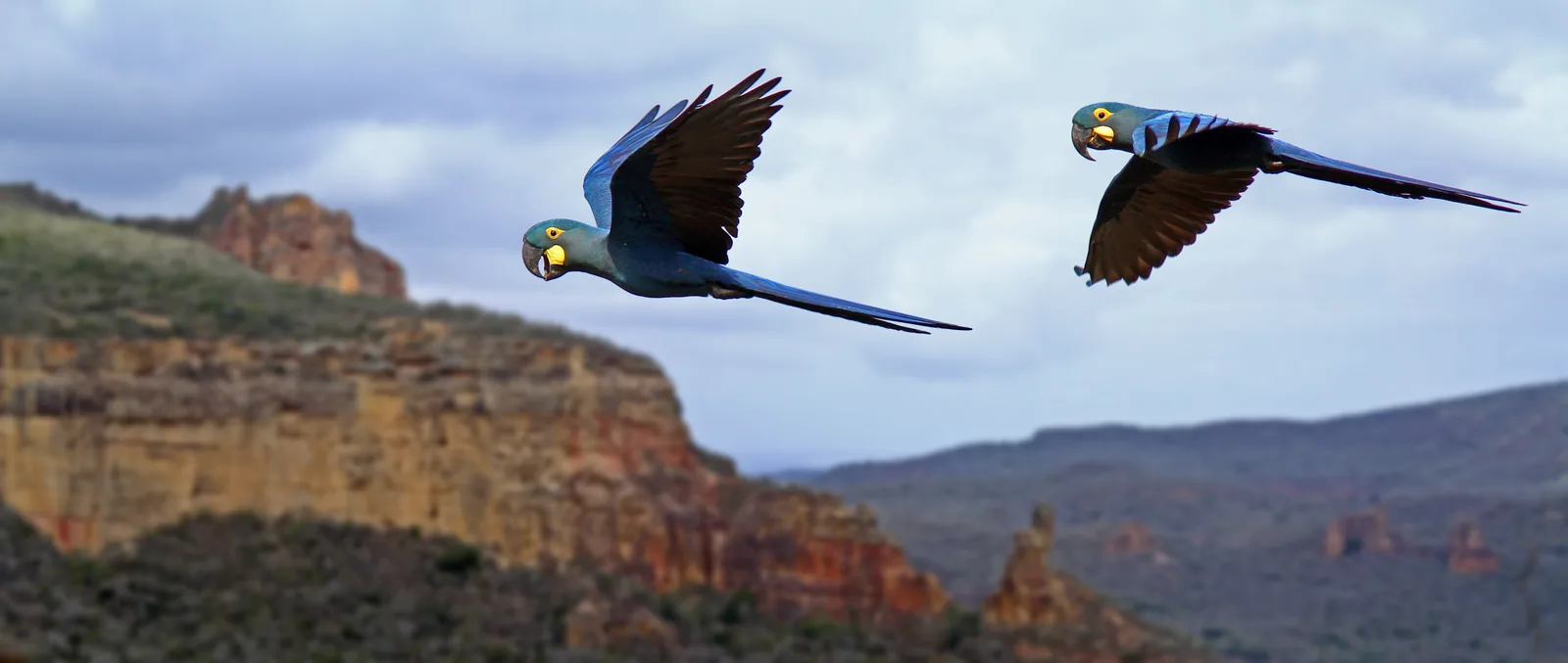
In Bahia’s sertão—the semi-arid Brazilian backlands—a blue flash cuts through the Caatinga, Brazil’s dry thorn-scrub biome, between licuri palms and sandstone cliffs. It is Lear's macaw: cracking hard nuts with its bill, calling across the distance with a rough greeee-ah, and returning to the cliffs where the species roosts and raises its young.
Brazil's endemic macaw, whose story is written between licuri palms and stone.
Lear's macaw, Anodorhynchus leari, is a large parrot endemic to Brazil: it occurs naturally only in the country, within a restricted area of northeastern Bahia. Its metallic blue plumage, bare yellow skin around the eyes and at the base of the bill, and hoarse voice make it unmistakable in the Caatinga. More than a striking bird, it is a specialist of the semi-arid landscape, tied to the licuri palms that sustain its routine of flight, feeding, and rest.
📍 Biomes it inhabits
The species lives exclusively in the Caatinga, especially in and around Raso da Catarina in northeastern Bahia. There, the vegetation alternates between shrub and tree cover, licuri palms, and open pastureland; sandstone outcrops form cliffs with cavities for roosting and nesting. The association is no accident: licuri palms feed the macaw, while the cliffs provide shelter and breeding sites.
🌍 Conservation status (IUCN)
EN · EndangeredThe IUCN Red List classifies Lear's macaw as Endangered. The species has recovered in number after intensive conservation action, but it remains vulnerable because its distribution is very small and depends on resources that are equally concentrated. The loss of licuri groves and baraúna trees, capture for trafficking, and conflict with farmers when the macaws use corn during periods of licuri scarcity remain significant pressures. Protecting nests, maintaining feeding sites, and building solutions with rural communities are inseparable parts of its conservation.
🔬 Scientific classification
- Kingdom
- Animalia
- Phylum
- Chordata
- Class
- Aves
- Order
- Psittaciformes
- Family
- Psittacidae
- Genus
- Anodorhynchus
- Species
- Anodorhynchus leari Bonaparte, 1856
⚙️ Specifications and metrics
- Length: About 71–75 cm (28–30 in) in total length.
- Body mass: About 940 g (33 oz).
- Plumage: Metallic blue, sometimes with a slight greenish cast; it has a yellow orbital ring and a semicircular yellow patch at the base of the lower mandible.
- Vocalization: While flying or perched, it gives a hoarse, piercing call transcribed as greeee-ah.
Diet: The fruit of the licuri palm, Syagrus coronata, is central to its diet. The macaw holds the licuri nut, breaks the hard endocarp with its bill, and extracts the endosperm; it also eats baraúna and umbu. When licuri is scarce, it may turn to corn, bringing it into conflict with local crops. Some individuals have been recorded taking licuri and umbu seeds regurgitated or expelled by cattle and goats. During the hottest hours, baraúna serves both as a food source and as a perch for resting and keeping watch.
📅 Life cycle
- Reproduction: The breeding phase involves copulation, incubation, and parental care; at least one member of the pair may remain to guard the cavity while the other forages.
- Nest: It nests in cavities and openings in sandstone cliffs, which also serve as communal roosts.
- Incubation: About 28 days in the wild.
- Lifespan: The sources consulted do not provide a consolidated estimate of longevity in the wild; data from captivity should not be extrapolated to wild populations.
🔗 Ecological ripple effect
If Lear's macaw disappears, the Caatinga will lose a large consumer and transporter of fruits from native plants. By carrying fruits to perches and discarding viable seeds, macaws of the genus Anodorhynchus may contribute to the dispersal of large-fruited plants; reducing that circulation impoverishes the interactions among bird, vegetation, and landscape. In the case of Lear's macaw, preserving the population also keeps visible the ecological dependence linking threatened fauna, licuri palms, and the cliffs of the semi-arid region.
🤔 Why it matters
- It is endemic to Brazil and represents one of the most singular expressions of Caatinga biodiversity.
- It depends heavily on licuri, making the conservation of palm groves and resting trees a matter of survival for the species.
- It may contribute to the dispersal of seeds from large-fruited plants by carrying fruits across the landscape.
- It is a flagship species for reconciling wildlife conservation, native-vegetation management, and rural production in the semi-arid region.
- Monitoring reveals how cliff nests, food, and protection from trafficking must work together to conserve a rare species.
🧪 Did you know?
- The wild population was only located by science in 1978, although the species was already known from traded specimens.
- In one field study, a macaw took an average of 32 seconds to open a licuri nut and consume its contents.
- When licuri is scarce, it may raid corn; this alternative food helps explain conflicts with farmers in the region.
- The same sandstone cliffs may serve as both communal roosts and nesting sites.
- It gives a hoarse, piercing call recorded as greeee-ah, audible both in flight and when perched.
Small discoveries
- Endemic
- A species that occurs naturally only within a defined geographic area.
- Endocarp
- The hard, protective inner layer of a fruit; in licuri, it surrounds the nutritious part eaten by the macaw.
- Foraging
- The set of actions an animal uses to seek, obtain, and consume food.
- Nesting
- The period and process of selecting, occupying, and using the site where birds breed.
- Seed dispersal
- The transport of seeds away from the parent plant, helping them reach new locations.
📚 References
- IUCN Red List of Threatened Species — Anodorhynchus leari
- Birds of the World — Indigo Macaw, Anodorhynchus leari
- eBird — arara-azul-de-lear, Anodorhynchus leari
- Silva-Neto, G. F.; Sousa, A. E. B. A.; Santos-Neto, J. R. 2012. Novas informações sobre a dieta da arara-azul-de-lear. Ornithologia 5(1): 1-5.
- Amaral, A. C. A. et al. 2005. Dinâmica de ninho de arara-azul-de-lear em Jeremoabo, Bahia. Ornithologia 1(1): 59-64.
- Tella, J. L. et al. 2020. Conserving the diversity of ecological interactions: The role of two threatened macaw species as legitimate dispersers of megafaunal fruits. Diversity 12(2): 45.
- GBIF — Anodorhynchus leari