.webp&w=1920&q=82)
.webp&w=1920&q=82)
.webp&w=1920&q=82)
.webp&w=1920&q=82)
Araripe Manakin
Antilophia bokermanni
Birds — Passeriformes (Pipridae)
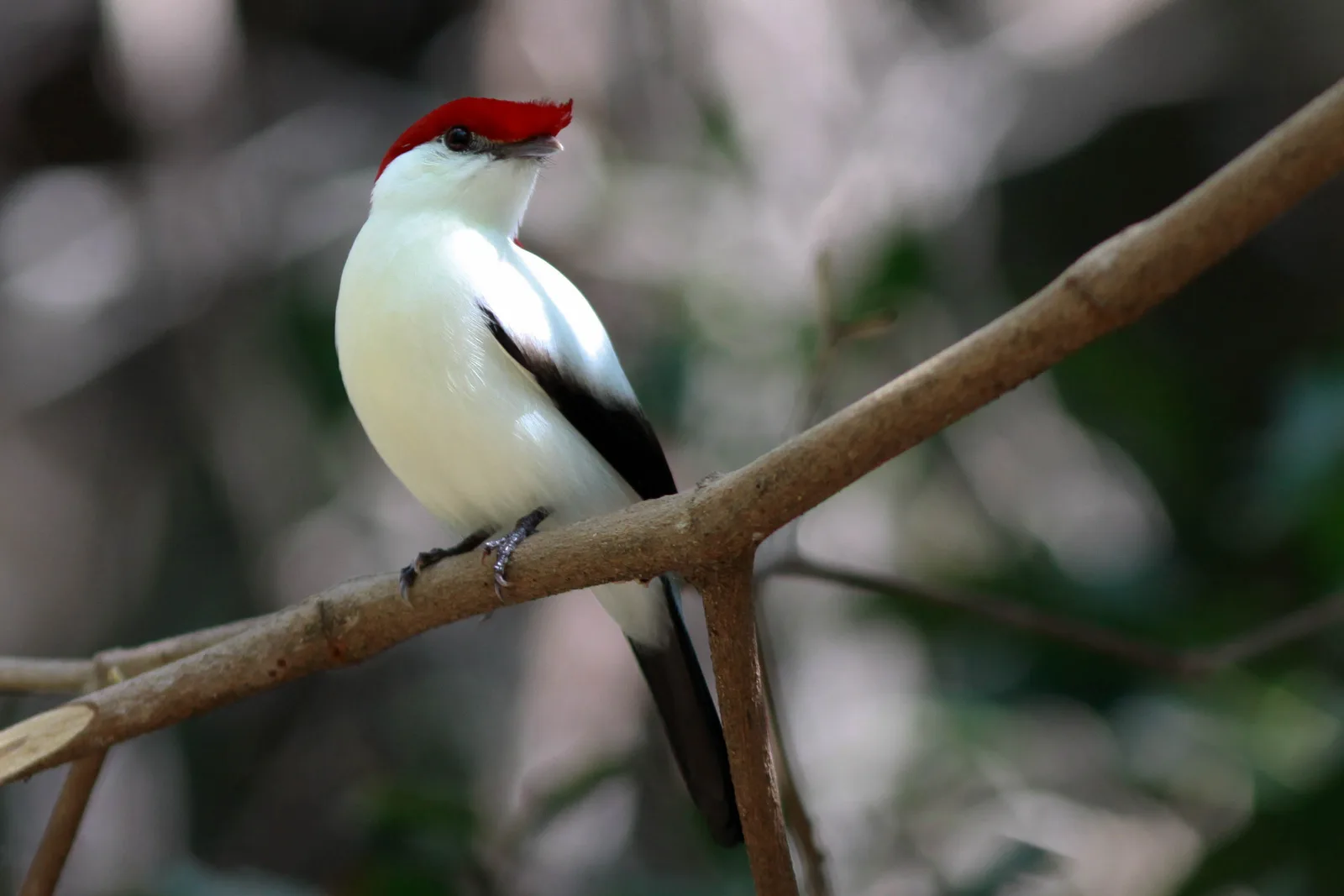
Between the dry scrubland and a hidden spring in Chapada do Araripe—a highland tableland with escarpments—a red crest lights the forest green. The Araripe manakin lives only here: endemic to Brazil, it depends on a narrow strip of humid forest in Ceará to sing, feed, and raise its young.
The red-crested bird that depends on the springs of Chapada do Araripe.
The Araripe manakin is a Brazilian manakin of unforgettable contrast. The male, white and black beneath a red crest, announces itself with a musical guru-uí; the olive-green female blends into the vegetation and takes on nest building, incubation, and care of the young alone. This extreme division between display and care helps explain why the integrity of the riparian forest is so decisive for the species.
📍 Biomes it inhabits
This species is endemic to Brazil, and its natural occurrence is restricted to Chapada do Araripe, in southern Ceará, within the Caatinga—the Brazilian dry thorn-scrub biome. It does not occupy the surrounding drier caatinga indiscriminately: it is concentrated in evergreen riparian forests fed by springs, a humid enclave where lianas, shrubs, and trees offer fruit, support for nests, and shade by the water.
🌍 Conservation status (IUCN)
CR · Critically EndangeredOn the IUCN Red List, the Araripe manakin is classified as Critically Endangered. Its tiny range makes every alteration to springs and their riparian forest especially serious: agriculture and human settlement reduce the forest, while water diversion, channeling, and piping shrink the very environment on which the bird depends. Burning to clear land and the loss of connectivity between fragments compound the population’s isolation.
🔬 Scientific classification
- Kingdom
- Animalia
- Phylum
- Chordata
- Class
- Aves
- Order
- Passeriformes
- Family
- Pipridae
- Genus
- Antilophia
- Species
- Antilophia bokermanni Coelho & Silva, 1998
⚙️ Specifications and metrics
- Length: About 15 cm (6 in).
- Body mass: About 20 g (0.7 oz).
- Plumage: There is strong sexual dimorphism: the male is predominantly white, with black flight feathers and tail and a striking red crest; the female is olive green, more subdued, and has a smaller crest.
- Vocalization: The male’s advertisement call is a repeated, musical guru-uí; males and females also give a hoarse wreee pur.
Diet: It eats chiefly small fruits, but also ants, beetles, and spiders. To reach food, it often hangs from branches; aerial prey capture has been recorded in the morning. In one dietary study, fruits of Clidemia biserrata accounted for 80% of the observed diet; because the plant fruits year-round in Araripe, it may buffer periods when other fruits are less available. No published account describes a detailed seasonal change in the species’ diet.
📅 Life cycle
- Reproduction: Nesting follows the rainy season. The female lays one or two eggs and may make another attempt if she loses the nest; she alone performs all parental care.
- Nest: The nest is an open cup woven from dry plant fibers, rootlets, twigs, lichens, and spider webs, placed in forks of trees or shrubs, usually near slow-flowing water.
- Incubation: Only the female incubates the eggs; the recorded average duration was 19 days.
- Lifespan: The sources consulted provide no published estimate of longevity in the wild specifically for this species.
🔗 Ecological ripple effect
The disappearance of the Araripe manakin would not merely remove a rare bird from the landscape. Because it consumes fruits and arthropods, its loss would reduce a local route of consumption and likely seed dispersal, although this effect has not yet been quantified specifically. More than that, it would signal a break in the system formed by spring, slow-flowing water, and riparian forest: the microenvironment that sustains its nests and also buffers the surrounding aridity.
🤔 Why it matters
- It is endemic to Brazil, and its natural distribution is limited to Chapada do Araripe in Ceará.
- It links the conservation of a bird to the protection of springs and riparian forests within the Caatinga domain.
- Its fruit-based diet, complemented by arthropods, places it within local networks of plants and small invertebrates.
- Parental care performed solely by the female offers a well-documented life-history case in a threatened manakin.
- The male’s plumage and guru-uí call make the species a striking symbol of Ceará’s biodiversity.
🧪 Did you know?
- The male announces his presence with a repeated musical guru-uí; both sexes also have a hoarse call described as wreee pur.
- In nests monitored by researchers, only the female built, incubated, and cared for the young at every observed stage.
- One dietary study recorded fruits of Clidemia biserrata as 80% of the observed diet, and the plant may fruit throughout the year in Araripe.
- The nest is an open cup held in a fork by spider webs, dry plant materials, and lichens.
- The species was discovered in 1996 and described scientifically in 1998, despite living in a region explored by naturalists long before then.
Small discoveries
- Endemic
- Occurring naturally only within a defined geographic area.
- Riparian forest
- Vegetation that follows rivers, streams, and springs, helping protect the water and its banks.
- Sexual dimorphism
- A visible difference in appearance between males and females of the same species.
- Nesting
- The set of activities related to nest building and reproduction.
- Frugivory
- A diet based on the consumption of fruits.
📚 References
- BirdLife International. Araripe Manakin Antilophia bokermanni Species Factsheet
- Birds of the World. Soldadinho-do-araripe: alimentação e forrageio
- Birds of the World. Soldadinho-do-araripe: reprodução
- Gaiotti, M. G., Oliveira, J. H. e Macedo, R. H. Breeding biology of the critically endangered Araripe Manakin in Brazil
- American Bird Conservancy. Araripe Manakin
- WikiAves. Soldadinho-do-araripe
- GBIF — Antilophia bokermanni