.webp&w=1920&q=82)
.webp&w=1920&q=82)
.webp&w=1920&q=82)
.webp&w=1920&q=82)
.webp&w=1920&q=82)
.webp&w=1920&q=82)
.webp&w=1920&q=82)
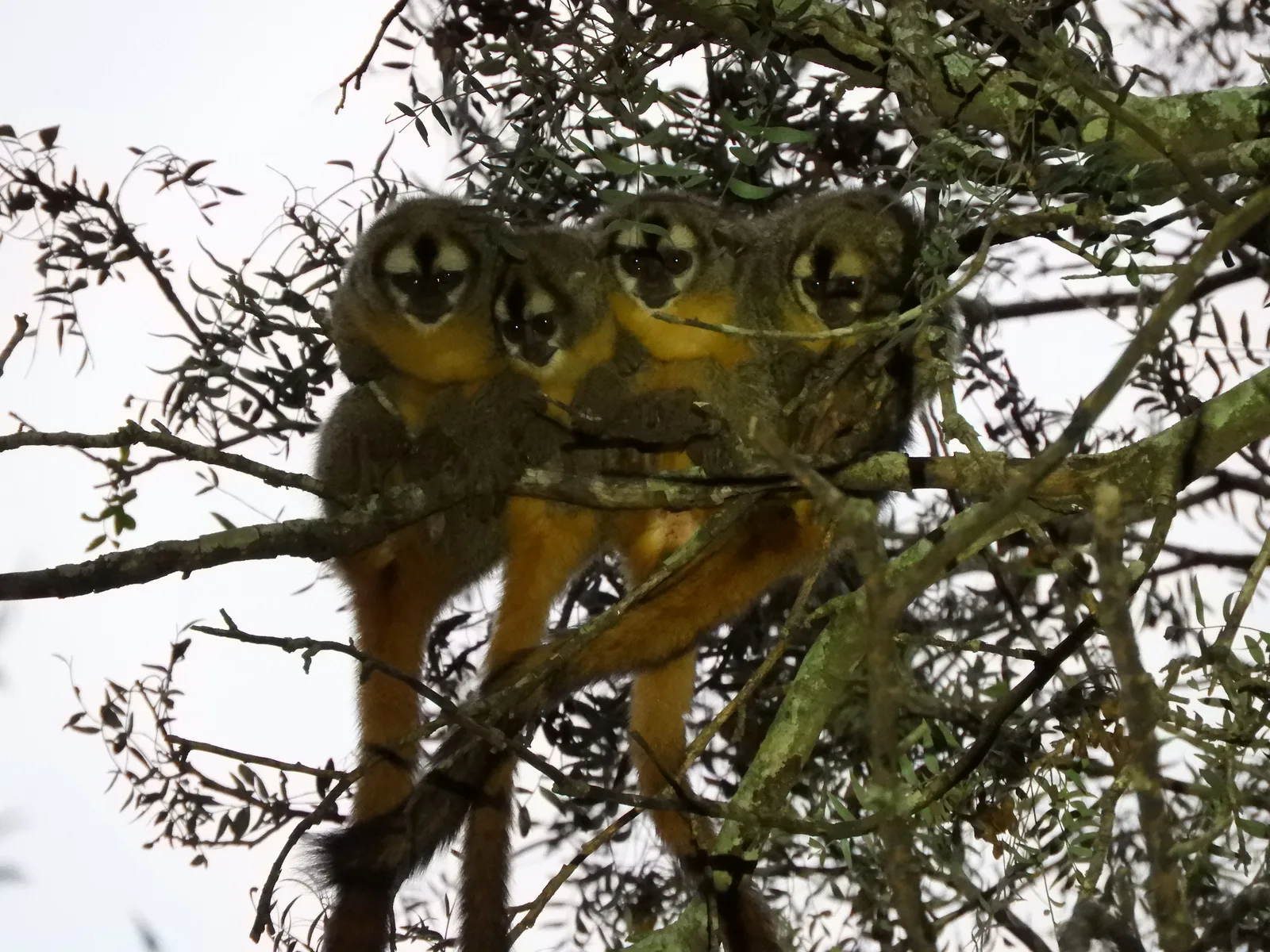
Azara's night monkey
Aotus azarae
Mammals — Primates (Aotidae)
Azara's night monkey is one of the few strictly nocturnal primates in the world. In Brazil, it represents a refined adaptation to riparian forests, seasonal forests, and savanna-forest mosaics in the Central-West, with a social organization rare among primates: stable pairs and strong parental care.
Nocturnal primate of the Pantanal — the world's largest tropical wetland — and Central Brazil
Active at night, Azara's night monkey turns darkness to its advantage: it reduces competition with diurnal primates and forages for fruit, insects, and understory resources with great efficiency. Its family cohesion and parental care make the species a reference point for behavioral studies.
📍 Biomes it inhabits
In Brazil, it occurs mainly in the Pantanal and adjacent areas of the Cerrado — the Brazilian savanna — and in riparian forests of Central Brazil, with documented records in Mato Grosso and Mato Grosso do Sul. Beyond Brazil, the Aotus azarae complex is associated with the Chaco and seasonal formations of South America.
🌍 Conservation status (IUCN)
LC · Least ConcernAccording to the IUCN, the Aotus azarae taxonomic complex (which includes Aotus azarae infulatus) is classified as LC, Least Concern. Even so, local populations may be significantly affected by habitat loss, fragmentation, and pressure on riparian forests.
🔬 Scientific classification
- Kingdom
- Animalia
- Phylum
- Chordata
- Class
- Mammalia
- Order
- Primates
- Family
- Aotidae
- Genus
- Aotus
- Species
- Aotus azarae (Humboldt, 1812)
⚙️ Specifications and metrics
- Body mass: ~800 g (28 oz)–1.2 kg (2.6 lb).
- Body length: 24–37 cm (9.4–14.6 in) + a long, non-prehensile tail.
- Vision: Large eyes adapted to night vision.
- Locomotion: Arboreal, moving quietly through the understory and middle canopy.
- Activity: Nocturnal, with peaks of activity at dusk and during the early morning hours.
- Generation length: ~6–7 years.
Diet: Omnivorous — fruit, insects, young leaves, nectar, and seasonal resources.
📅 Life cycle
- Gestation: ~133 days.
- Litter: Usually 1 infant.
- Parental care: Strongly paternal.
- Lifespan: Up to 15–20 years (estimates under observation/favorable conditions).
🔗 Ecological ripple effect
By eating fruit and insects, Azara's night monkey contributes to seed dispersal and the balance of arthropod populations. Its persistence depends on the integrity of riparian forests and connectivity between fragments, especially in landscapes undergoing agricultural and livestock expansion.
🤔 Why it matters
- One of the few truly nocturnal primates in the Americas.
- A social organization built on stable pairs and strong family cohesion.
- Males assume much of the care of the infant.
- Dependent on riparian forests and functional forest fragments.
🧪 Did you know?
- The genus Aotus is known as the night monkeys or owl monkeys.
- It lacks the trichromatic vision typical of many diurnal primates.
- It communicates through subtle vocalizations and scent marking.
- The group's taxonomy is complex and continues to be revised — which is why its name may vary among sources.
Small discoveries
- Aotus azarae infulatus
- A widely used treatment for populations in Central Brazil and the Pantanal. In taxonomic revisions, this taxon may be treated as Aotus azarae infulatus (a subspecies) or elevated to species status as Aotus infulatus.
- Nocturnal
- A species that is active predominantly at night, with vision adapted to low light.
- IUCN
- International Union for Conservation of Nature — the global authority on extinction-risk assessments.
- Night vision
- Vision specialized for low-light environments.
- Paternal
- Among night monkeys, the male commonly carries the infant most of the time, returning it to the female for nursing.