.webp&w=1920&q=82)
.webp&w=1920&q=82)
.webp&w=1920&q=82)
.webp&w=1920&q=82)
Blue-and-yellow Macaw
Ara ararauna
Birds — Psittaciformes (Psittacidae)
Before it appears in the sky, the Blue-and-yellow Macaw often announces its arrival: a harsh call cuts through forest or city, and then blue and yellow rise above the canopy. With a bill able to open resilient seeds and a social life built around pairs and flocks, it links palms, forests, and savannas wherever it travels. In Brazil, it is a striking presence, though its range also reaches other South American countries and eastern Panama.
Blue across the back, gold on the breast, and a voice that carries across the landscape.
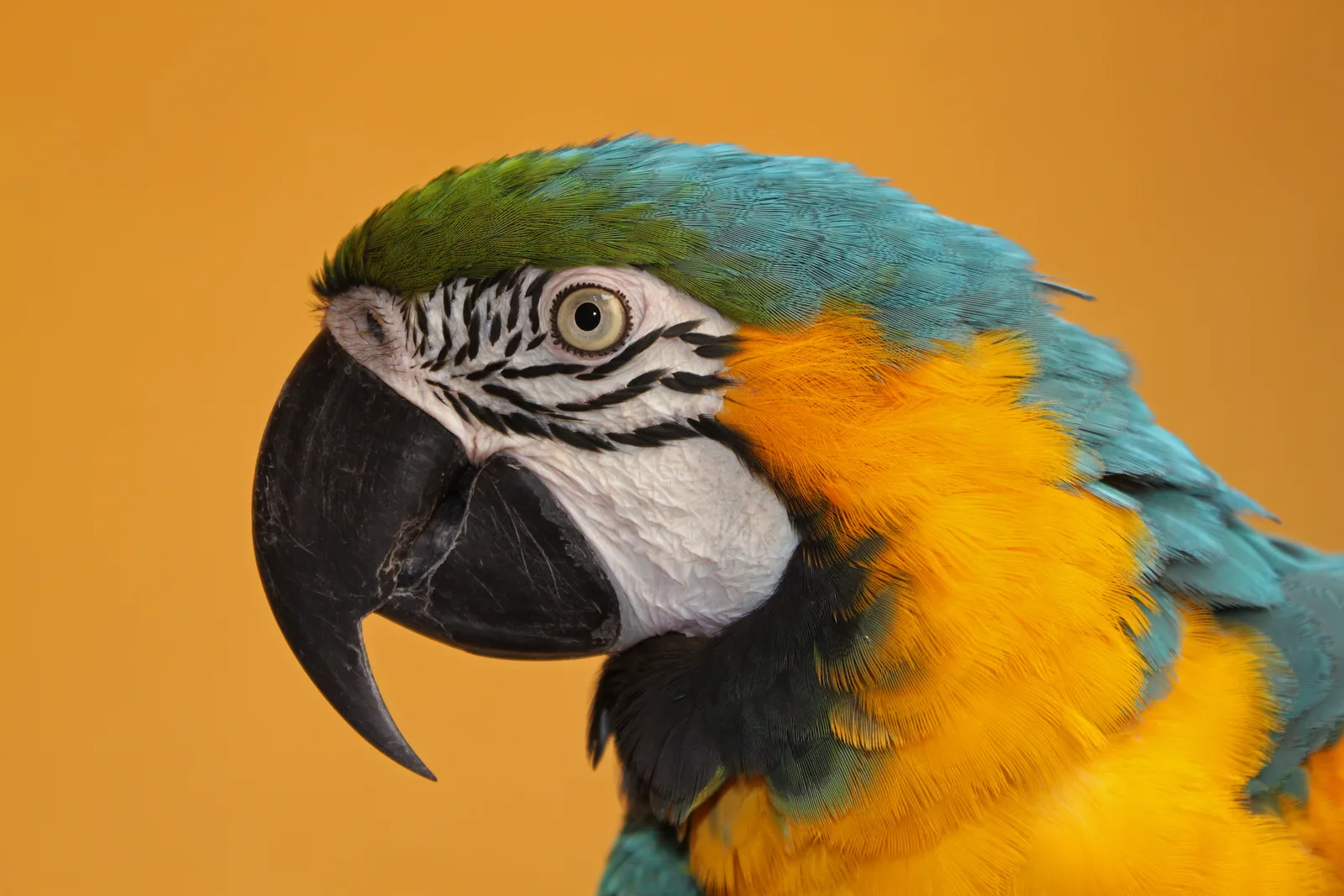
The Blue-and-yellow Macaw is a large Neotropical parrot with unmistakable colors. Blue dominates its back and wings; yellow lights up its breast; a white face marked by fine black lines gives its head a singular expression. It is a diurnal, arboreal, social bird, seen in pairs or noisy flocks. When a pair flies together, the two birds may keep so close that their wings nearly touch.
📍 Biomes it inhabits
In Brazil, the species occurs in the Amazon, the Atlantic Forest, the Cerrado — Brazil’s savanna — and the Pantanal. Its preferred setting combines tall trees for perching and nesting with plants that provide fruit and seeds, so it occupies habitats ranging from humid and riparian forests to wetlands, savannas, and semiopen landscapes. Palms are especially important in many places, both as a food source and as shelter for nest cavities.
🌍 Conservation status (IUCN)
LC · Least ConcernGlobally, the IUCN Red List classifies the Blue-and-yellow Macaw as Least Concern. That category does not erase local risks: deforestation, habitat degradation, and fragmentation reduce food and nest trees, while capture for trafficking removes birds from the wild. Maintaining large trees, palm groves, and corridors between foraging areas is vital if flocks are to keep finding food and safe places to breed.
🔬 Scientific classification
- Kingdom
- Animalia
- Phylum
- Chordata
- Class
- Aves
- Order
- Psittaciformes
- Family
- Psittacidae
- Genus
- Ara
- Species
- Ara ararauna (Linnaeus, 1758)
⚙️ Specifications and metrics
- Length: About 81–91 cm (32–36 in), from bill tip to tail.
- Body mass: About 0.9–1.8 kg (2.0–4.0 lb); varies among individuals.
- Plumage: Blue back and wings; yellow breast and underparts; greenish forehead; black throat and bill. The bare white face is crossed by rows of small black feathers; the sexes look alike.
- Vocalization: It gives loud, harsh, strident contact calls, especially in flight and when danger is near. Pairs and flocks can be heard before they appear above the canopy.
Diet: It is frugivorous and granivorous. It climbs into the canopy to reach fruit, seeds, and nuts, using its powerful bill to break shells and crush large seeds; it also eats pulp, arils, nectar, flowers, and leaves. Its diet shifts with fruiting cycles: in a study in central Brazil, palms such as Syagrus oleracea and Acrocomia aculeata provided food throughout the year, while pequi and cashew seeds became more important in the rainy season. This flexibility allows it to range across a mosaic of trees fruiting at different times.
📅 Life cycle
- Reproduction: It forms monogamous social pairs, and both adults protect the young. In Brazil, breeding activity has been recorded from July to December, sometimes through February, with clutches of two to four eggs; timing may vary by region and local conditions.
- Nest: It uses cavities in tall trees. In buriti palm groves studied in Peru, it nested in dead emergent palms with natural cavities; a shortage of suitable hollows may limit breeding.
- Incubation: About 24–28 days.
- Lifespan: A confirmed record documents 43 years in captivity. There are reports of individuals older than 50, but the database consulted has not confirmed them.
🔗 Ecological ripple effect
The disappearance of the Blue-and-yellow Macaw would alter the fate of many large seeds. By opening fruit, consuming seeds, and moving among patches of vegetation, it takes part in relationships that shape the regeneration of forest and Cerrado; studies identify it as a pre-dispersal seed predator. Without this bill at work in the canopy and without its movements across the landscape, pressure on certain plants and the transport of propagules would no longer occur in the same way.
🤔 Why it matters
- Takes part in the fate of large fruit and seeds, influencing ecological relationships in forests and savannas.
- Depends on tall trees and nest cavities, making the importance of conserving mature trees and palm groves plain.
- Serves as a flagship species for combating wildlife trafficking and protecting connected landscapes.
- Its colorful flight, calls, and presence in cities and natural areas make it a cultural symbol and an ambassador for birdwatching.
🧪 Did you know?
- In a study in Três Lagoas, Mato Grosso do Sul, the Blue-and-yellow Macaw was recorded foraging in every month of the year, following the availability of fruit from native and exotic trees.
- In buriti palm groves in Peru, Blue-and-yellow Macaws used cavities in dead palms rising above the surrounding vegetation; PVC nest boxes did not attract the species in that experiment.
- A confirmed record documents 43 years for an individual in captivity. Stories of Blue-and-yellow Macaws living beyond 50 exist, but the longevity database consulted has not yet confirmed them.
- When flying as a pair, the species may keep its two individuals so close that their wings almost touch.
Small discoveries
- Canopy
- The layer formed by tree crowns in the upper part of the vegetation.
- Várzea
- A floodplain near rivers, periodically inundated by high water.
- Frugivorous
- Feeding mainly on fruit.
- Granivorous
- Feeding on seeds and grains.
- Pre-dispersal predation
- The consumption of seeds before they are carried or fall away from the parent plant.
📚 References
- Lista Vermelha da IUCN: Ara ararauna
- Animal Diversity Web: Ara ararauna
- Instituto Arara Azul: Arara-canindé, biologia e ameaças
- Santos et al. (2014), Plant food resources exploited by Blue-and-Yellow Macaws at an urban area in Central Brazil
- Brightsmith e Bravo (2006), Ecology and management of nesting blue-and-yellow macaws in Mauritia palm swamps
- AnAge: Blue-and-yellow macaw, longevidade e história de vida
- GBIF — Ara ararauna