.webp&w=1920&q=82)
.webp&w=1920&q=82)
.webp&w=1920&q=82)
.webp&w=1920&q=82)
Red-and-green Macaw
Ara chloropterus
Birds — Psittaciformes (Psittacidae)
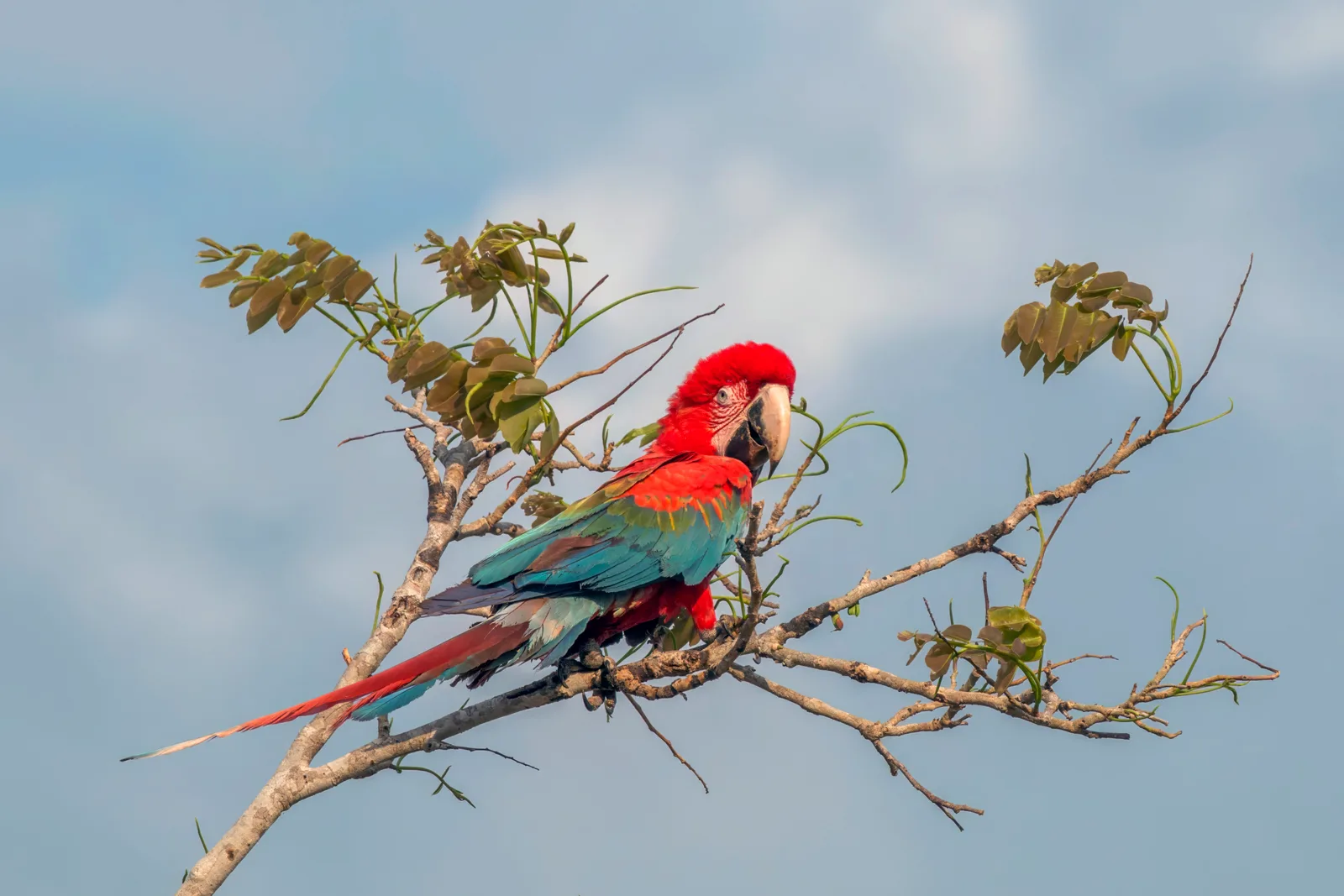
When it crosses the sky, the Red-and-green Macaw is often heard before it is seen: its deep, harsh calls carry across the distance as pairs or flocks pass over the canopy. Its intense red, streaked with the green of its wings, is the signature of a bird that opens large seeds and travels through South America’s varied landscapes. In Brazil, its presence links the Amazon, the Cerrado — Brazil’s savanna — the Pantanal, and other vegetation mosaics to one of the most powerful voices in the avifauna.
Red in the canopy, green in the wings, and a bill made for large seeds.
The Red-and-green Macaw is one of the largest Neotropical parrots and a widely distributed South American species, found from Panama to Bolivia and Paraguay as well as in Brazil. It lives chiefly in trees, where its strong, curved bill turns hard fruit into food. Its plumage is mostly red, but the green in the middle of the wings and the delicate red lines on the face make it easy to recognize. Outside the breeding season, it usually moves in pairs, family groups, or flocks, always with a vocal presence that is impossible to ignore.
📍 Biomes it inhabits
In Brazil, records from the national assessment place it in the Amazon, the Caatinga — Brazil’s dry thorn-scrub biome — the Cerrado, the Atlantic Forest, and the Pantanal. It seeks the upper levels of humid and deciduous forests, but also occupies gallery forests, cerradão woodlands, and wooded formations in more open landscapes. The availability of fruiting trees and nest cavities shapes its distribution; that is why vegetation corridors, large old trees, and preserved riverbanks are especially valuable. In the Atlantic Forest, the species has disappeared from much of the area where it historically occurred, persisting in sites with reintroduction in Espírito Santo.
🌍 Conservation status (IUCN)
LC · Least ConcernOn the global IUCN Red List, Ara chloropterus is classified as Least Concern. This global status does not erase local risks: Brazil’s national assessment by ICMBio considers it Near Threatened because of habitat loss and degradation and illegal capture for the wildlife trade. The species depends on large trees for nesting and on areas with a diverse supply of fruit and seeds; as the landscape fragments, these resources become scarcer and more isolated.
🔬 Scientific classification
- Kingdom
- Animalia
- Phylum
- Chordata
- Class
- Aves
- Order
- Psittaciformes
- Family
- Psittacidae
- Genus
- Ara
- Species
- Ara chloropterus G.R.Gray, 1859
⚙️ Specifications and metrics
- Length: 90–95 cm (35–37 in).
- Body mass: 1.05–1.7 kg (2.3–3.7 lb).
- Plumage: Predominantly red, with striking green across the middle of the wings, blue at the tips, and fine lines of red feathers over the pale facial skin.
- Vocalization: It gives very loud, deep, harsh calls described as rowaark; in flight, it uses screeches to keep in touch and alert the group.
Diet: It feeds mainly on fruit and large seeds, which it opens with its robust bill; it also takes pulp, leaves, arils, and other plant parts. Its choices track local availability: in a Cerrado mosaic in Mato Grosso do Sul, foraging concentrated more heavily in dry habitats during the dry season, while fruit from palms in riparian vegetation was used in both seasons. Food variety and abundance influence where groups gather.
📅 Life cycle
- Reproduction: It forms monogamous pairs; nesting may occur from October to May, depending on the region, and clutches usually contain two to four eggs.
- Nest: It uses natural cavities in tall trees and also cavities or excavations in rocky cliff faces, and may reuse the same site in successive years.
- Incubation: About 23–28 days, chiefly the female’s responsibility; during this period, the male feeds her by regurgitation.
- Lifespan: In captivity, compiled records indicate an average of about 50 years and a maximum of just over 63 years; average longevity in the wild is still not well documented.
🔗 Ecological ripple effect
The disappearance of the Red-and-green Macaw would remove from the landscape a major consumer of fruit and seeds and a participant in the interactions that connect birds and plants. By opening fruit, moving among feeding areas, and at times transporting diaspores, it influences the fate of plant resources and is part of the dynamics of the canopy, riparian forests, and wooded savannas. Its absence would also signal the loss of mature trees, nest cavities, and food sources that sustain many other forms of life.
🤔 Why it matters
- Processes large fruit and seeds, taking part in the ecological relationships between plants and fauna in the canopy.
- Its dependence on mature trees and cavities makes it an indicator of the quality of forests and wooded corridors.
- It is a symbol species for conserving Cerrado, Pantanal, and Amazon landscapes and for fighting wildlife trafficking.
- Its size, colors, and vocalizations draw birdwatchers and strengthen the cultural and tourism value of natural areas.
- Studies of diet and population genetics help guide restoration, connectivity, and reintroduction efforts.
🧪 Did you know?
- The narrow lines of red feathers on the pale facial skin and the green in the middle of the wings are useful features for identifying it.
- During incubation, the male feeds the female by regurgitation; after hatching, both adults feed and protect the young.
- It may return to the same nest cavity in successive years, whether in a tall tree or a rocky cliff face.
- In a study in the Cerrado of Mato Grosso do Sul, 20 native and five exotic plant species were recorded in its diet.
- In areas with clay banks, it may gather with other macaws during the day; noise from boats and people can make it stop the activity and disperse.
Small discoveries
- Canopy
- The upper layer of vegetation formed by tree crowns.
- Diaspore
- A plant unit, such as a seed or fruit, capable of giving rise to or carrying a new plant.
📚 References
- ICMBio — Ara chloropterus: avaliação do risco de extinção da fauna brasileira
- IUCN Red List — Ara chloropterus, avaliação global
- Ragusa-Netto, J. 2024. Feeding ecology of the Red-and-green Macaw in a habitat mosaic from Cerrado
- Animal Diversity Web — Ara chloropterus
- WikiAves — Arara-vermelha
- BirdLife International DataZone — Red-and-green Macaw Ara chloropterus
- GBIF — Ara chloropterus