.webp&w=1920&q=82)
.webp&w=1920&q=82)
.webp&w=1920&q=82)
.webp&w=1920&q=82)
Scarlet Macaw
Ara macao
Birds — Psittaciformes (Psittacidae)
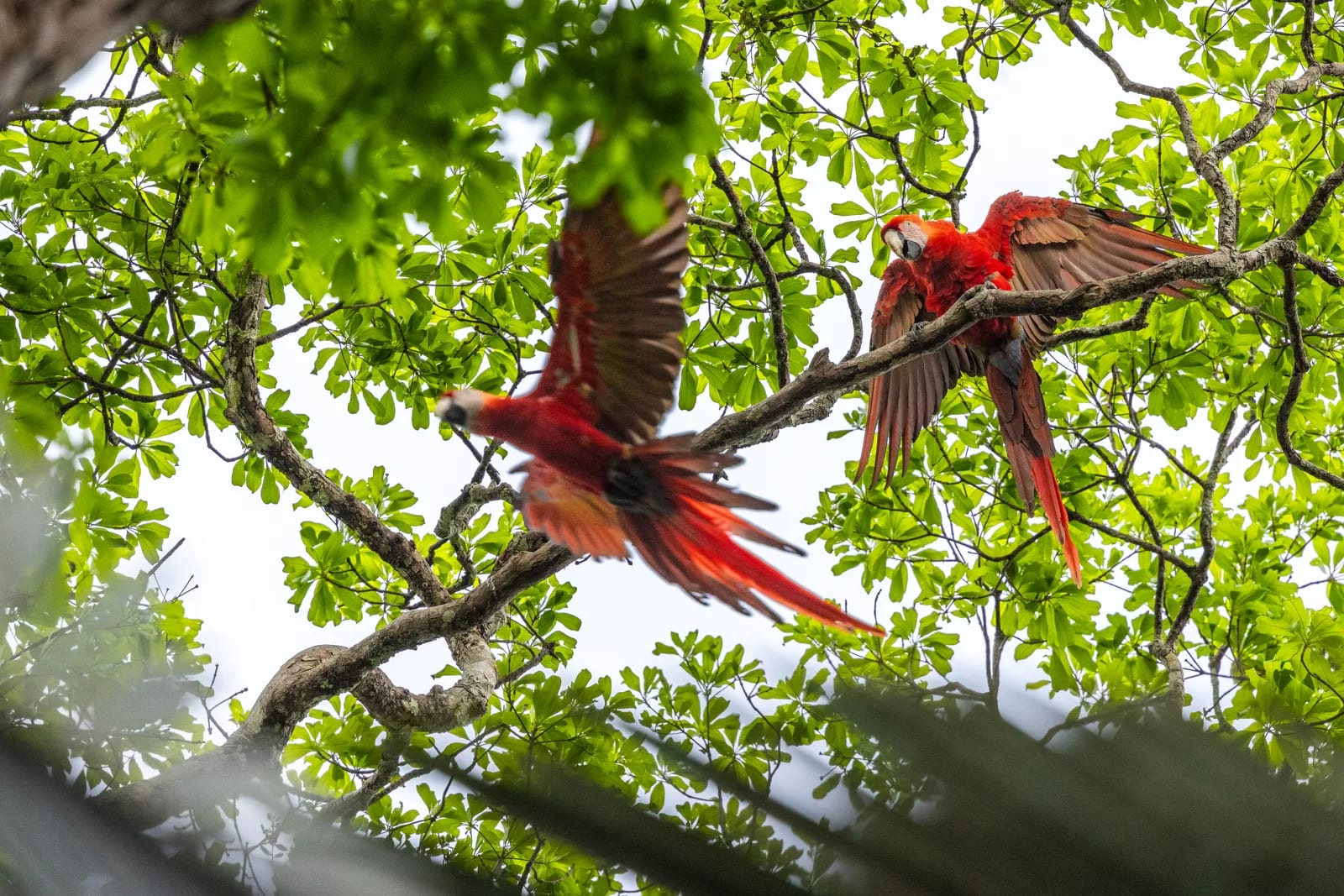
When a scarlet macaw crosses the canopy, its red arrives before its cry: a rip of color and sound above the trees. Ara macao lives in Brazil's Amazon and in forests across many other American countries, where pairs and family groups travel through the canopy in search of fruit. Its bill cracks hard seeds and nuts; its presence signals the living scale of a forest able to sustain large birds.
The scarlet macaw that brings color and voice to the Amazonian canopy.
The scarlet macaw is a large macaw, predominantly red with yellow and blue wings, made for life high in the trees. Rather than pass unnoticed, it announces its movements with harsh cries and flies in pairs or family groups. In Brazil, it belongs to Amazonian wildlife; its natural range, however, stretches across tropical America from southern Mexico to Bolivia.
📍 Biomes it inhabits
In Brazil, the scarlet macaw occurs in the Amazon, especially in tall-canopy rainforests and forests associated with rivers. The species depends on trees that offer fruit, seeds, and nesting cavities, moving through the canopy where it finds food and shelter. Beyond Brazil, it occupies a broad but discontinuous belt of tropical forest across Central America and northern South America.
🌍 Conservation status (IUCN)
LC · Least ConcernThe IUCN's global assessment classifies Ara macao as Least Concern. That category, however, does not guarantee safety in every locality: forest clearing and fragmentation, the loss of large cavity-bearing trees, and the illegal capture of birds are pressures that may reduce local populations. Protecting the scarlet macaw means keeping standing both the trees that feed it and those that give it a nest.
🔬 Scientific classification
- Kingdom
- Animalia
- Phylum
- Chordata
- Class
- Aves
- Order
- Psittaciformes
- Family
- Psittacidae
- Genus
- Ara
- Species
- Ara macao (Linnaeus, 1758)
⚙️ Specifications and metrics
- Length: About 89 cm (35 in), including its long tail.
- Body mass: About 1.0–1.2 kg (2.2–2.6 lb), based on reference values compiled for the species.
- Plumage: Predominantly scarlet red, with yellow on the middle wing feathers and deep blue on the wing tips and tail; its face is pale and bare.
- Vocalization: Loud, harsh calls, often given in flight; its flight call is described as a grating raah, often repeated twice.
Diet: It eats fruits, seeds, nuts, pods, shoots, and flowers, with insects taken occasionally. In the canopy, it grips food with its feet and uses its strong bill to crack hard shells and seeds; the importance of each item shifts with fruiting cycles and the resources available in the region. In South America, it may gather with other parrots on riverbanks to ingest clay, a behavior called geophagy.
📅 Life cycle
- Reproduction: It forms stable pairs; the breeding season varies with latitude, rainfall patterns, and fruit availability. Species summaries report an average clutch of 1–2 eggs.
- Nest: It uses natural cavities in living or dead trees, usually high in the canopy; it may use hollows created by broken branches or by other birds.
- Incubation: On average, about 28 days.
- Lifespan: Reference information rather than an average specific to Brazilian populations: compiled sources cite about 40–50 years; in captivity, large macaws may reach 75 years.
🔗 Ecological ripple effect
If the scarlet macaw disappears from an area, the canopy loses a large consumer and handler of fruits and seeds. By opening hard foods, carrying fruit to perches, and discarding parts it does not eat, the species participates in relationships involving plants, seeds, and other animals high in the forest. The likely result is poorer interactions and local changes in the arrival and fate of seeds, with their intensity depending on the plant species available.
🤔 Why it matters
- It helps keep canopy ecological relationships active by consuming, handling, and moving fruits and seeds.
- It depends on large trees with cavities, linking its conservation to the protection of mature forests and their riparian corridors.
- Its stable pairs, extended care of young, and learning after fledging make it valuable for behavioral and conservation studies.
- It is a striking presence in Brazil's visual culture: the scarlet macaw was drawn as an ornament on a map of Brazil made in 1502.
- Its color, flight, and voice make the species an entry point to understanding Amazonian biodiversity and the need to protect it.
🧪 Did you know?
- The scarlet macaw's pale, bare face has no lines of red feathers, a useful detail for identification.
- Its flight call is a loud, harsh, grating cry that can be heard before the bird appears above the canopy.
- In South America, scarlet macaws may form mixed flocks with other parrots to ingest clay on riverbanks.
- Young birds may remain in the nest for about three to four months and stay with their parents for nearly a year.
- The scarlet macaw lives in Brazil but is not exclusive to the country: its natural range reaches several countries in tropical America.
Small discoveries
- Canopy
- The upper layer of the forest, formed by the crowns of trees.
- Riparian forest
- Vegetation associated with the banks of rivers and other waterways.
- Geophagy
- The deliberate ingestion of soil or clay by an animal.