.webp&w=1920&q=82)
.webp&w=1920&q=82)
.webp&w=1920&q=82)
.webp&w=1920&q=82)
Golden-capped Parakeet
Aratinga auricapillus
Birds — Psittaciformes (Psittacidae)
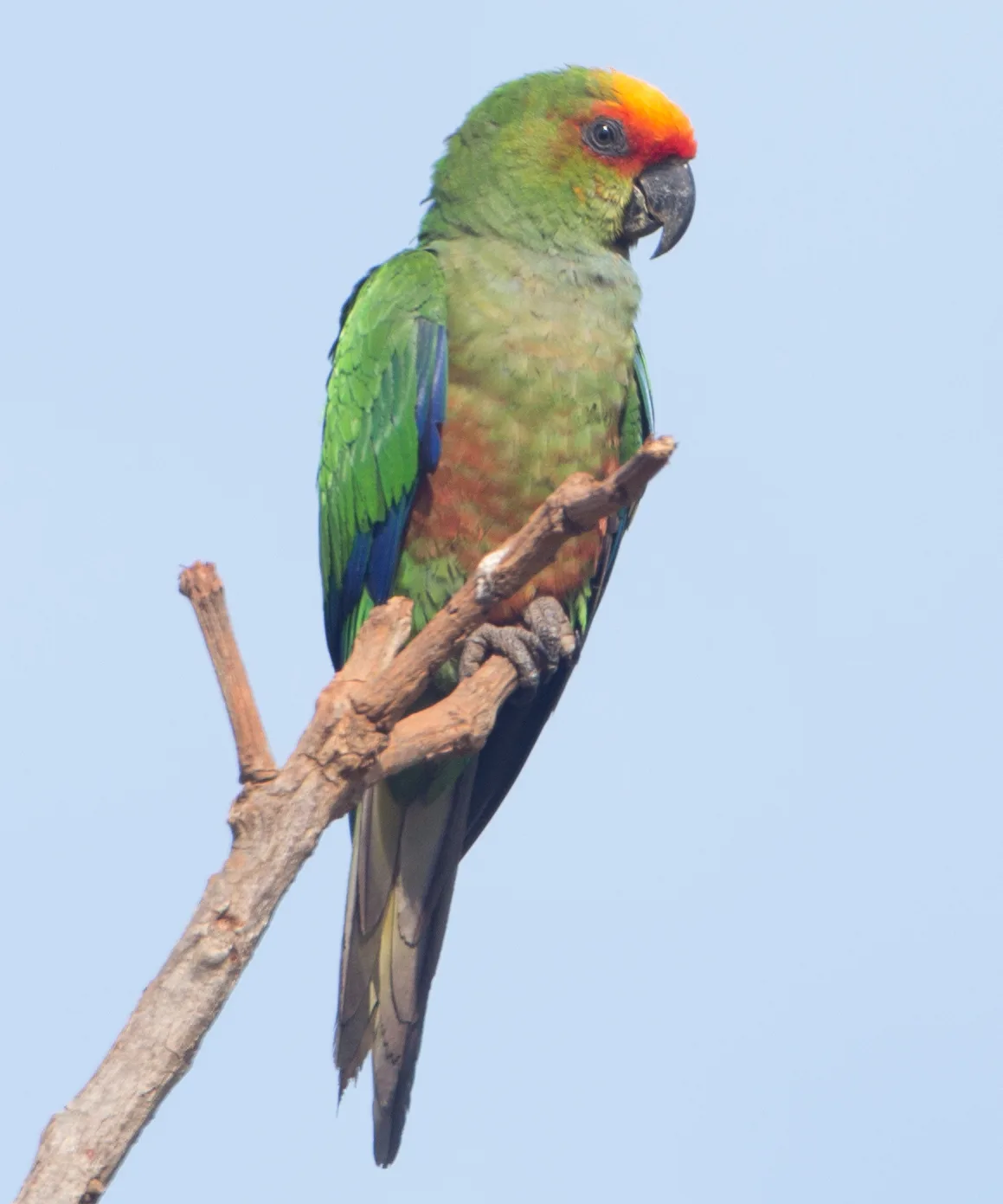
A flash of red at the forehead, gold at the crown, and deep green across the body gives the Golden-capped Parakeet away as its flock cuts through the forest, calling loudly. Endemic to Brazil, it brings together the beauty of a forest bird and the adaptability of one that also finds food in altered landscapes. Yet its bill does more than gather fruit: it makes its way to the seed.
The Brazilian parakeet that colors the canopy and cracks seeds before they fall.
The Golden-capped Parakeet is a bird endemic to Brazil, meaning it occurs naturally only in the country. From a distance it may look entirely green; up close, the head reveals the contrast behind its name, with a red forehead and yellow crown. It is often seen in flocks, flying actively and noisily, and its vivid colors and piercing calls make it hard to overlook wherever tree cover remains.
📍 Biomes it inhabits
The species occurs in the Atlantic Forest and the Cerrado, the Brazilian savanna, chiefly in semideciduous forests and transition zones between inland forest formations. Its range extends from Brazil's Northeast and Center-West to the South, always within the country's borders. Though it depends mainly on forest environments, it can use fragments, edges, orchards, and areas with cultivated vegetation; that does not make continuous forest dispensable, but it shows how the bird seeks resources in an already heavily fragmented landscape.
🌍 Conservation status (IUCN)
LC · Least ConcernIn BirdLife International's 2022 assessment for the IUCN Red List, the Golden-capped Parakeet was classified as Least Concern. The assessment itself, however, indicates a declining population trend. Agricultural expansion, conversion of vegetation to croplands and pasture, and intentional capture are among the pressures recorded for the species. Because it is found only in Brazil, its conservation depends entirely on the persistence of Brazil's forests, transition zones, and protected areas.
🔬 Scientific classification
- Kingdom
- Animalia
- Phylum
- Chordata
- Class
- Aves
- Order
- Psittaciformes
- Family
- Psittacidae
- Genus
- Aratinga
- Species
- Aratinga auricapillus (Kuhl, 1820)
⚙️ Specifications and metrics
- Length: about 30 cm (12 in)
- Body mass: about 130–150 g (4.6–5.3 oz)
- Plumage: Mostly green, with a red forehead, lores, and eye region; a bright yellow crown; a reddish-orange belly; and bluish primaries and tail.
- Vocalization: It gives loud, sharp, piercing calls, especially noticeable when flocks are in flight or moving through the forest.
Diet: It feeds chiefly on green and ripe seeds. Using its bill, it opens fruits, removes the pulp or peel, and eats the seeds, acting as a pre-dispersal seed predator. It also takes floral resources such as nectar, petals, and buds, along with some pulp and lichens. In a study of a human-modified landscape in the interior of São Paulo State, the mix of plants it used shifted between the dry and wet seasons, and cultivated species, including non-native ones, proved important to the parakeet's local persistence.
📅 Life cycle
- Reproduction: There is evidence of breeding around October; in São Paulo, a well-developed chick was recorded in early November.
- Nest: The nest has not been described in detail in the natural environment in the open reference sources consulted.
- Incubation: The incubation period has not been confirmed in a species-specific, verifiable source consulted for this species.
- Lifespan: The sources consulted provide no reliable estimate of longevity in the wild.
🔗 Ecological ripple effect
The disappearance of the Golden-capped Parakeet would remove from the landscape a consumer that alters the fate of seeds and uses the flowers and fruits of many plants. In a field study, it opened fruits to eat their seeds, performing pre-dispersal predation; its role should therefore not automatically be mistaken for that of a seed disperser. Losing the species would reduce this interaction between bird and vegetation and erase from the patchwork of fragments a visible and audible sign of Brazil's semideciduous forests.
🤔 Why it matters
- It is endemic to Brazil, concentrating responsibility for its conservation within the country.
- It acts as a pre-dispersal seed predator, influencing the fate of fruits from many plants.
- Its flexible diet makes it useful for studying how parrots respond to forest fragmentation and agricultural landscapes.
- Its use of cultivated and non-native plants reveals both its ability to adapt and the scarcity of resources in heavily altered environments.
- Its colorful, noisy flocks hold value for birdwatching and for public awareness of Brazilian biodiversity.
🧪 Did you know?
- The forehead is red, but the crown is bright yellow: the scientific name auricapillus refers precisely to the golden appearance of the top of the head.
- In research conducted in the interior of São Paulo State, seeds were the main food item recorded, and the bird removed the fruit's peel or pulp before swallowing them.
- In the same study, the species was observed feeding on 28 plant species; 16 were cultivated non-native species.
- The composition of plants consumed shifted markedly between the dry and wet seasons, even though no detectable change occurred in the combined availability of flowers and fruits.
- Although its current global assessment is Least Concern, BirdLife indicates that its population trend is declining.
Small discoveries
- Pre-dispersal seed predation
- The consumption of seeds before they are carried away from the parent plant.
- Semideciduous forest
- A forest in which some trees shed their leaves during the driest season.
- Canopy
- The upper layer formed by the crowns of a forest's trees.
📚 References
- BirdLife International DataZone. Golden-capped Parakeet Aratinga auricapillus: avaliação da Lista Vermelha da IUCN
- Birds of the World. Golden-capped Parakeet Aratinga auricapillus
- Silva, P. A.; Melo, C. 2013. Foraging of the Golden-capped Parakeet Aratinga auricapillus in an Anthropogenic Landscape in Brazil
- WikiAves. Jandaia-de-testa-vermelha Aratinga auricapillus
- GBIF — Aratinga auricapillus