.webp&w=1920&q=82)
.webp&w=1920&q=82)
.webp&w=1920&q=82)
.webp&w=1920&q=82)
.webp&w=1920&q=82)
.webp&w=1920&q=82)
.webp&w=1920&q=82)
Silver garden spider
Argiope argentata
Arachnids — Araneae (Araneidae)
Elegant, geometric, and easy to recognize, the silver garden spider turns gardens and open country into natural galleries. In Argiope argentata, beauty is no accident: it is bound to the construction of highly efficient webs and to a visual strategy that confuses predators and fascinates human observers.
The silver architect of circular webs
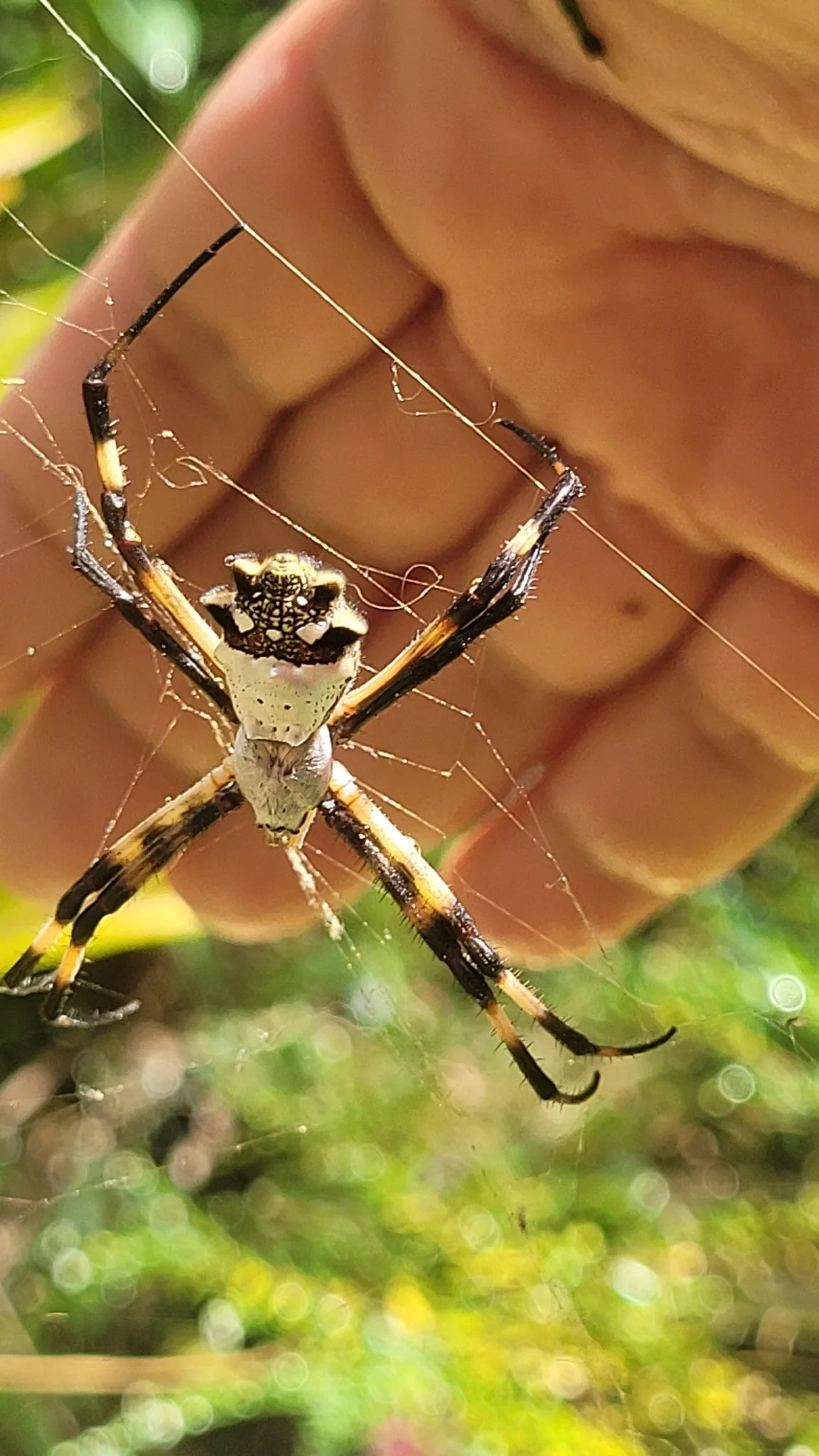
Unlike inconspicuous spiders that stay close to the ground, Argiope argentata lives in plain sight. It builds large orb webs between shrubs, fences, and tall grasses. At the web's center, it remains still, displaying a silvery body pattern that serves as both camouflage and visual signal.
📍 Range and habitat
Distribution: widely distributed across the Americas, from the southern United States to South America, including all of Brazil.
Habitat: open areas, gardens, fields, forest edges, pastures, and urban settings. It favors places with abundant flying insects and well-spaced anchor points.
⚠️ Relationship with humans
Conservation: species with no specific formal IUCN assessment. It is common, widely distributed, and shows no signs of population decline.
Relationship: harmless to humans. Bites are exceedingly rare and occur only through direct handling. It is often considered beneficial for its role in insect control.
🔬 Scientific classification
- Kingdom
- Animalia
- Phylum
- Arthropoda
- Class
- Arachnida
- Order
- Araneae
- Family
- Araneidae
- Genus
- Argiope
- Species
- Argiope argentata (Fabricius, 1775)
🔬 Morphology and adaptations
- Size: Females are larger and more robust; males are considerably smaller.
- Coloring: Silver abdomen with yellow, black, or orange markings.
- Legs: Long legs, often held in pairs, forming an "X" at rest.
- Stabilimentum: Many webs feature a stabilimentum, whose function may involve visual signaling or structural reinforcement.
Diet: A predator of flies, moths, and other flying insects caught in its web.
🔄 Life cycle and behavior
📅 Development
- Type: growth through molts.
- Oothecae: eggs protected in silk sacs, usually attached near vegetation.
🌙 Behavior
- Activity: predominantly diurnal.
- Hunting: passive — relying on prey caught in the web.
- Reconstruction: the web is rebuilt regularly, maintaining high efficiency.
🌍 Role in the Ecosystem
- Population control: a predator of flies, moths, and other flying insects.
- Environmental indicator: its presence suggests areas with rich insect diversity.
- Trophic integration: it serves as prey for birds and other arthropods.
💡 Why does it matter?
- Because not every visible spider is dangerous.
- Because beauty and function evolve together.
- Because webs are highly sophisticated biological tools.
- Because natural predators reduce the need for pesticides.
💫 What does the silver garden spider teach us?
Argiope argentata shows that nature does not hide everything: some of its most intricate feats of engineering hang in plain view, suspended in the air.
When we look at its web, we see a blend of precision, patience, and efficiency — qualities rarely associated with insects and spiders in the popular imagination.
Reflection: perhaps biodiversity need not be feared, only observed more closely.
Small discoveries
- Orb webs
- Circular webs made up of radial threads and sticky spirals.
- Anchor points
- Natural or artificial structures used to secure the web.
- IUCN
- The global list of threatened species; common spiders rarely receive individual assessments.
- Insect control
- The natural reduction of insects in agricultural and urban environments.
- Stabilimentum
- A zigzag structure made of thicker silk at the center of the web.