.webp&w=1920&q=82)
.webp&w=1920&q=82)
.webp&w=1920&q=82)
.webp&w=1920&q=82)
.webp&w=1920&q=82)
.webp&w=1920&q=82)
.webp&w=1920&q=82)
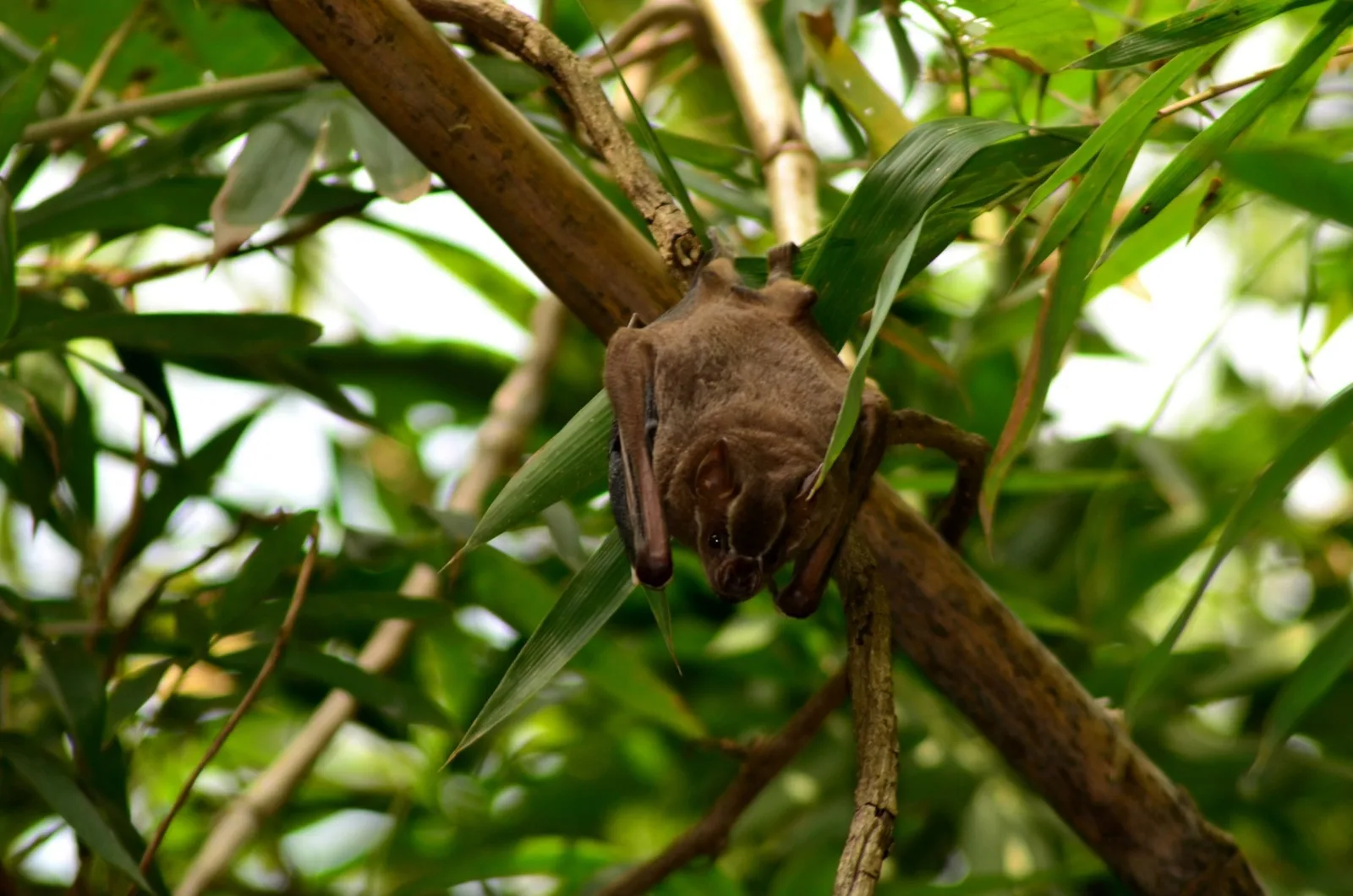
Great fruit-eating bat
Artibeus lituratus
Mammals — Bats (Phyllostomidae)
The great fruit-eating bat is one of the foremost seed dispersers in Neotropical forests. Highly adaptable, it links natural areas, forest fragments, and urban environments, playing an essential role in plant regeneration.
The invisible architect of forest regeneration
Nocturnal by habit, Artibeus lituratus specializes in fleshy fruits, especially figs. By carrying seeds over long distances, the great fruit-eating bat accelerates natural processes of ecological succession.
📍 Biomes it inhabits
It occurs in the Amazon, the Atlantic Forest, the Cerrado — the Brazilian savanna — the Caatinga's wetter areas, the Pantanal, and transitional forest formations. It is widely distributed across Brazil, including in tree-lined urban areas.
🌍 Conservation status (IUCN)
LC · Least ConcernThe species is classified as least concern, with widespread and stable populations. Its high ecological plasticity allows it to persist even in heavily fragmented landscapes.
🔬 Scientific classification
- Kingdom
- Animalia
- Phylum
- Chordata
- Class
- Mammalia
- Order
- Chiroptera
- Family
- Phyllostomidae
- Genus
- Artibeus
- Species
- Artibeus lituratus (Olfers, 1818)
⚙️ Specifications and metrics
- Body mass: 50–80 g (1.8–2.8 oz).
- Wingspan: 45–55 cm (18–22 in).
- Morphology: Robust build, short muzzle with the characteristic noseleaf of Phyllostomidae.
- Hearing: Highly developed, associated with echolocation.
- Activity: Nocturnal, traveling long distances in search of food.
- Generation length: ~3–4 years.
Diet: Frugivorous — figs (Ficus spp.) and other fleshy fruits; occasionally nectar.
📅 Life cycle
- Gestation: ~115–120 days.
- Litter: Usually 1 offspring.
- Parental care: Maternal care.
- Lifespan: Up to 10–15 years in the wild.
🔗 Ecological ripple effect
As a primary seed disperser, Artibeus lituratus speeds plant recolonization in clearings, forest edges, and degraded areas. Its nocturnal activity links fragments and strengthens landscape resilience.
🤔 Why it matters
- One of Brazil's most common fruit-eating bats.
- A key disperser for fig trees, foundational species in tropical forests.
- Able to occupy tree-lined urban areas.
- A key species for forest regeneration.
🧪 Did you know?
- It can carry seeds for kilometers before consuming them.
- It uses large leaves to build temporary shelters.
- The name Artibeus is associated with its fruit-eating diet.
- Fruit-eating bats are natural allies of forest restoration.
Small discoveries
- Nocturnal
- A species active primarily at night.