.webp&w=1920&q=82)
.webp&w=1920&q=82)
.webp&w=1920&q=82)
.webp&w=1920&q=82)
.webp&w=1920&q=82)
.webp&w=1920&q=82)
.webp&w=1920&q=82)
Striped barnacle
Balanus amphitrite
Crustaceans — Cirripedia (Balanidae)
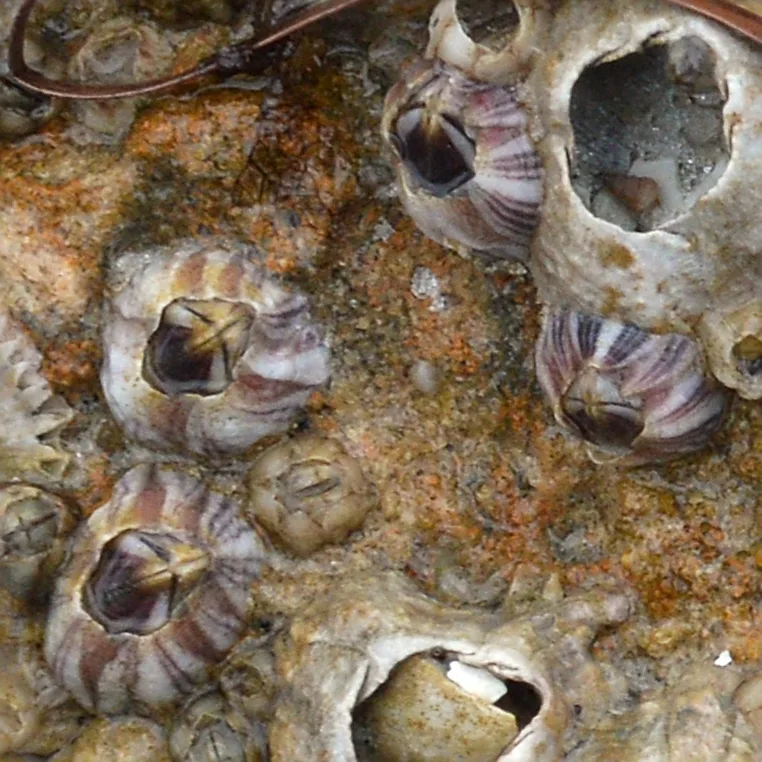
Sessile, resilient and remarkably successful, the striped barnacle is one of the most emblematic organisms of tropical coasts. In Balanus amphitrite, immobile adult life contrasts with a highly mobile beginning — a cycle that explains both its ecological success and its economic and technological importance.
The crustacean that cements itself to the world
Barnacles are highly modified crustaceans. Unlike shrimp or crabs, adults remain permanently attached to their substrate, protected by calcareous plates. Attachment occurs through a biological cement, one of the strongest natural adhesives known.
📍 Range and habitat
Distribution: Cosmopolitan across tropical and subtropical regions, including the entire Brazilian coast.
Habitat: Intertidal and shallow subtidal zones; attached to rocks, piers, vessel hulls, buoys, platforms and other artificial structures. Tolerates wide variations in salinity and temperature.
⚠️ Relationship with humans
Conservation: Not Evaluated (NE) by the IUCN, with no sign of a global threat.
Relationship: Considered a biofouling species. Its presence on ship hulls increases drag, raises fuel consumption and creates significant maintenance costs.
🔬 Scientific classification
- Kingdom
- Animalia
- Phylum
- Arthropoda
- Class
- Maxillopoda
- Order
- Sessilia
- Family
- Balanidae
- Genus
- Amphibalanus
- Species
- Amphibalanus amphitrite Darwin, 1854
🔬 Morphology and adaptations
- Size: Usually 1–2 cm (0.4–0.8 in) in diameter.
- Calcareous plates: A rigid shell that protects the soft body.
- Cirri: Feathery appendages used to filter food (filter feeding).
- Attachment: Permanent attachment through a highly durable proteinaceous cement.
Diet: Filter feeder — captures organic particles and plankton from the water with its cirri.
🔄 Life cycle and behavior
📅 Development
- Type: Indirect development — free-swimming planktonic larvae precede the attached stage.
- Larvae: Nauplius and cyprid stages; the cyprid is specialized in finding a substrate for permanent attachment.
🌙 Behavior
- Feeding: Passive filter feeder — captures particles with feathery cirri.
- Attachment: Permanent after metamorphosis; adults are immobile.
- Reproduction: Hermaphroditic, with cross-fertilization between nearby individuals.
🌍 Role in the Ecosystem
- Filter feeder: removes organic particles and plankton from the water.
- Microhabitat: barnacle colonies create shelter for small invertebrates.
- Environmental indicator: broad tolerance allows studies of pollution and marine stress.
💡 Why does it matter?
- Because barnacles are not mollusks, but highly modified crustaceans.
- Because their cement inspires research into medical and industrial adhesives.
- Because biofouling is one of naval engineering’s greatest challenges.
- Because even sessile organisms shape coastal ecosystems.
💫 What does the striped barnacle reveal?
Balanus amphitrite shows that movement is not the only successful strategy. Settling in place can be as effective as swimming — provided the right environment passes before it.
Reflection: how many innovations in human engineering have yet to emerge from observing seemingly simple organisms?
Small discoveries
- Amphibalanus amphitrite
- Also known in recent literature as Amphibalanus amphitrite, following taxonomic revisions of the group.
- Biological cement
- An exceptionally durable substance produced by the barnacle to attach itself to solid surfaces.
- Salinity
- The concentration of dissolved salts in seawater.
- IUCN
- Global conservation list; common marine invertebrates rarely receive a formal assessment.
- Biofouling
- Organisms that attach to artificial structures, causing economic losses.
- Filter feeding
- Mobile structures that capture particles suspended in the water.
- Cyprid
- A larva specialized in finding a substrate for permanent attachment.