.webp&w=1920&q=82)
.webp&w=1920&q=82)
.webp&w=1920&q=82)
.webp&w=1920&q=82)
.webp&w=1920&q=82)
.webp&w=1920&q=82)
.webp&w=1920&q=82)
.webp&w=1920&q=82)
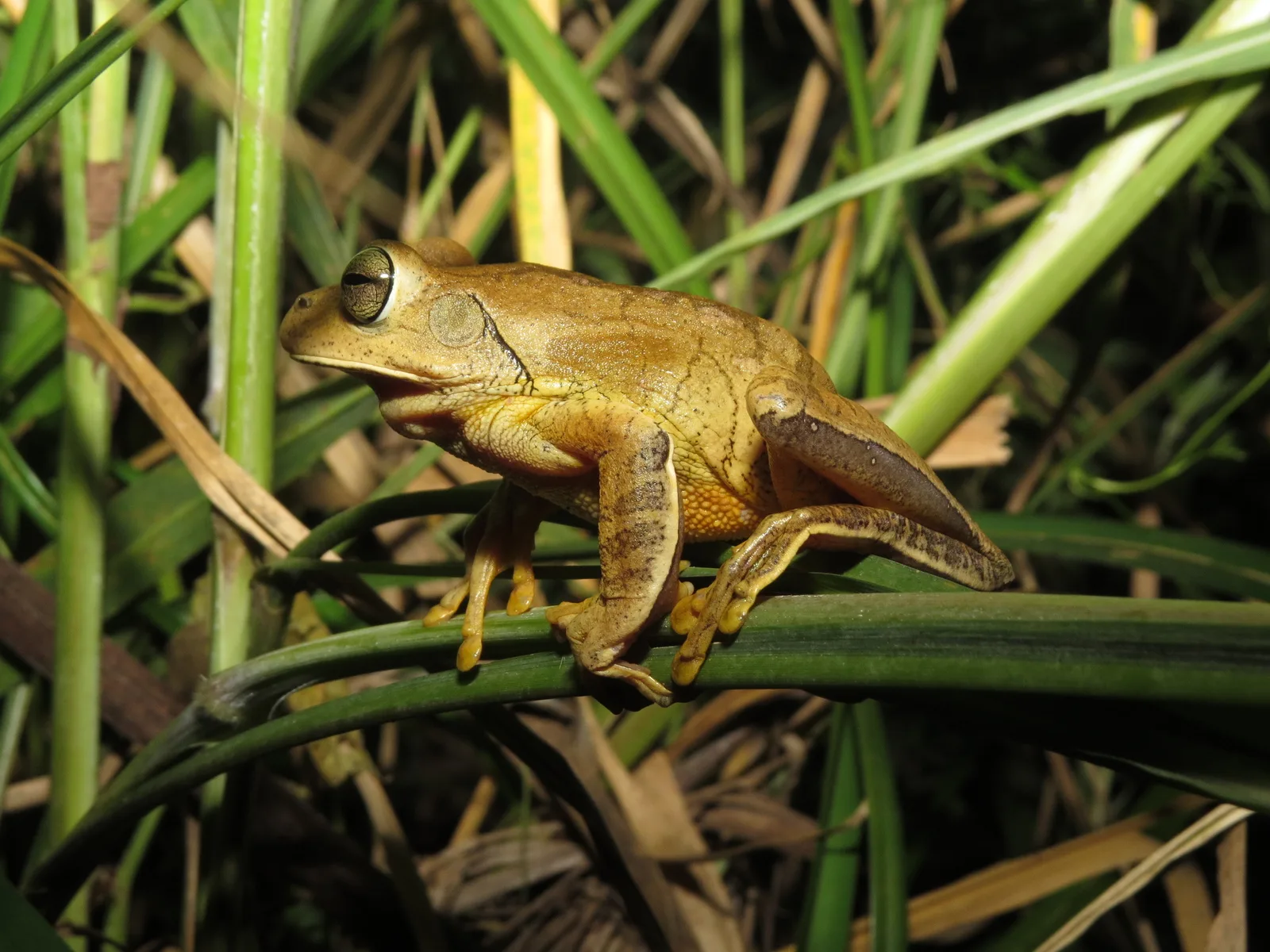
Blacksmith Treefrog
Boana faber
Amphibians — Anurans (Hylidae)
The Blacksmith Treefrog is one of the most remarkable amphibians of Brazil's Atlantic Forest, known for its nest-building behavior and reproductive strategies that are rare among anurans. Its presence reveals forest environments that remain functional, especially near water bodies.
A nest builder among Brazil's anurans
Known for its reproductive engineering, the Blacksmith Treefrog excavates and shapes mud nests along the edges of ponds and streams. This behavior increases the survival of eggs and tadpoles, representing a singular evolutionary adaptation.
📍 Biomes it inhabits
It occurs mainly in the Atlantic Forest, from southeastern to southern Brazil, including forests, forest edges, clearings and environments near water bodies. It may also occur in human-modified landscapes.
🌍 Conservation status (IUCN)
LC · Least ConcernAccording to the IUCN, the species is classified as LC (Least Concern). Even so, local populations may be affected by the degradation of aquatic habitats.
🔬 Scientific classification
- Kingdom
- Animalia
- Phylum
- Chordata
- Class
- Amphibia
- Order
- Anura
- Family
- Hylidae
- Genus
- Boana
- Species
- Boana faber (Wied-Neuwied, 1821)
⚙️ Specifications and metrics
- Body mass: Variable; a large species among treefrogs.
- Body length: 7–10 cm (2.8–3.9 in; males smaller than females).
- Behavior: Males build nests excavated in the soil.
- Digits: Well-developed adhesive discs, typical of arboreal species.
- Activity: Predominantly nocturnal.
- Generation length: ~3–4 years.
Diet: Carnivorous — insects, arachnids and other small invertebrates.
📅 Life cycle
- Reproduction: Oviparous.
- Egg-laying: Dozens to hundreds of eggs per breeding event.
- Development: Aquatic tadpoles after the nest breaks open.
- Lifespan: Up to ~8–10 years in the wild.
🔗 Ecological ripple effect
The Blacksmith Treefrog helps control insect populations and contributes to the dynamics of temporary aquatic environments. Its nest-building behavior shapes microhabitats, benefiting other species associated with wetlands.
🤔 Why it matters
- One of the few treefrogs that builds mud nests.
- Males actively defend their nests during breeding.
- A species more often heard than seen.
- An indicator of relatively intact aquatic environments.
🧪 Did you know?
- The epithet faber comes from Latin and means "artisan" or "builder."
- Its call is loud and metallic, audible over long distances.
- It can be confused with other species in the genus Boana.
- Breeding depends strongly on the availability of still water.
Small discoveries
- Reproductive engineering
- The active construction of structures in the soil for depositing and protecting eggs.
- Atlantic Forest
- The tropical and subtropical forest biome of eastern Brazil.
- Human-modified
- Environments altered by human activity, such as rural areas and forest fragments.
- IUCN
- International Union for Conservation of Nature — the global authority on assessing extinction risk.
- Excavated nests
- Circular mud depressions used as breeding chambers.
- Oviparous
- Eggs laid in excavated nests, followed by the release of tadpoles into water.