.webp&w=1920&q=82)
.webp&w=1920&q=82)
.webp&w=1920&q=82)
.webp&w=1920&q=82)
.webp&w=1920&q=82)
.webp&w=1920&q=82)
.webp&w=1920&q=82)
Blue crab
Callinectes sapidus
Crustaceans — Decapoda (Portunidae)
Agile, aggressive, and economically valuable, the blue crab is one of the Western Atlantic's most widely studied crustaceans. In Callinectes sapidus, estuarine ecology, commercial fishing, and coastal dynamics converge, making the species a living gauge of the health of estuaries and bays.
The swift swimmer of the estuaries
The blue crab belongs to the group of swimming crabs, able to move quickly through the water. It lives chiefly in estuaries, where it acts as an opportunistic predator and scavenger, playing a central role in the coastal food web.
📍 Range and habitat
Distribution: Western Atlantic — from Canada and the United States to Argentina; in Brazil, it occurs along nearly the entire coast. Introduced to the Mediterranean and Black seas, where it has become an invasive species.
Habitat: Estuaries, bays, coastal lagoons, mangrove forests, and shallow marine waters. It tolerates a broad range of salinities, using different habitats throughout its life cycle.
⚠️ Relationship with humans
Conservation: A species not formally assessed by the IUCN (NE — Not Evaluated). In some regions, it is affected by overfishing and estuarine degradation.
Relationship: A species of exceptionally high fisheries and culinary value, harvested by artisanal and industrial fisheries throughout the Western Atlantic. In Brazil, it is part of coastal artisanal fisheries and is widely eaten. In the Mediterranean and Black Sea regions, where it was introduced, it causes ecological and economic impacts as an invasive species.
🔬 Scientific classification
- Kingdom
- Animalia
- Phylum
- Arthropoda
- Class
- Malacostraca
- Order
- Decapoda
- Family
- Portunidae
- Genus
- Callinectes
- Species
- Callinectes sapidus Rathbun, 1896
🔬 Morphology and adaptations
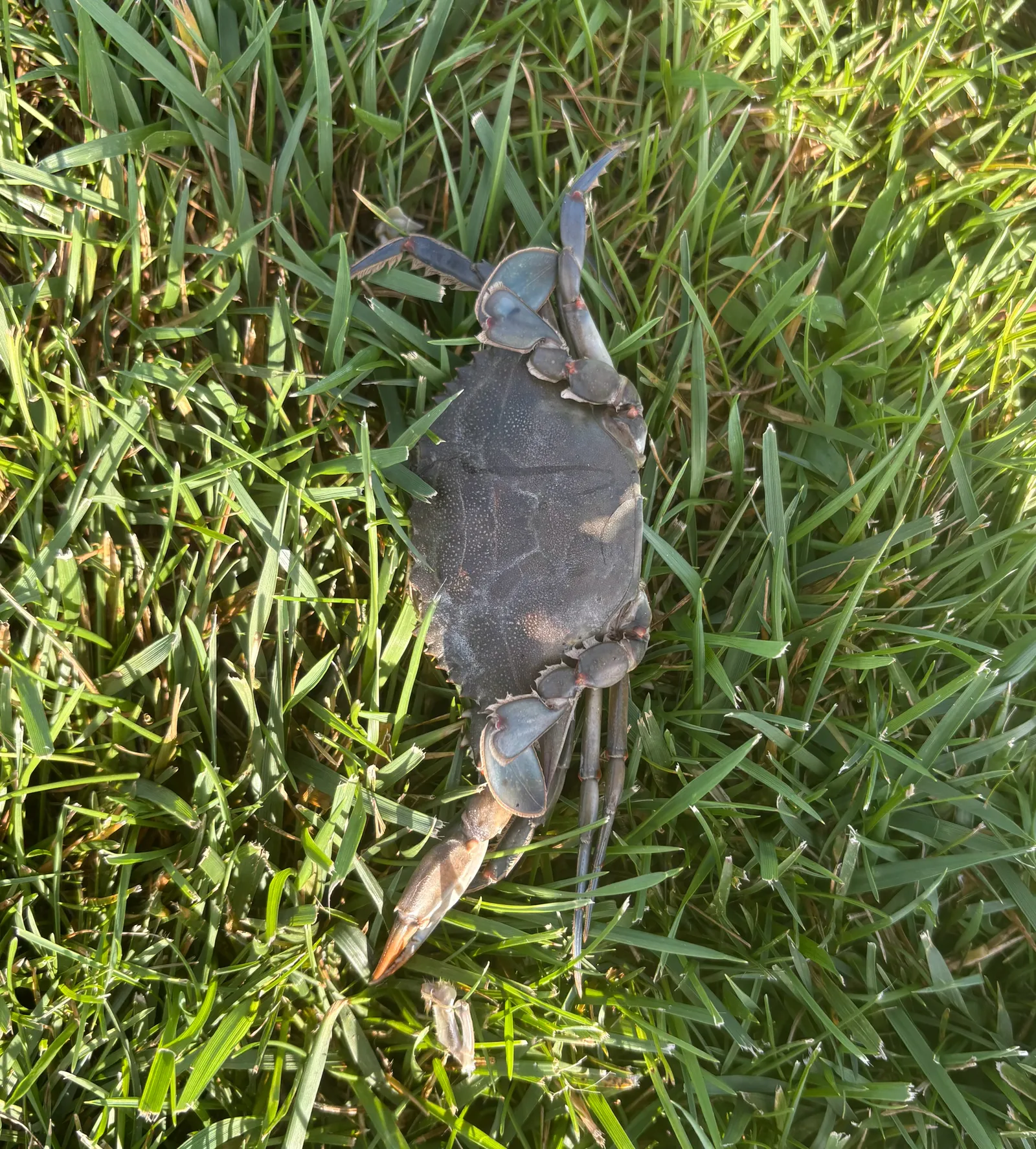
- Carapace: Broad, with pronounced lateral spines that give it an aggressive appearance.
- Coloring: Bluish green on the claws, especially in males, with paler tones on the underside.
- Hind legs: Flattened like paddles, allowing rapid swimming.
- Chelipeds: Strong and sharp, used to capture prey and for defense.
Diet: An opportunistic carnivore — fish, mollusks, other crustaceans, and organic matter.
🔄 Life cycle and behavior
📅 Development
- Reproduction: Occurs in estuaries; fertilized females migrate to saltier waters to release their eggs.
- Larval stage: Entirely marine, with juveniles returning to estuarine areas.
🌙 Behavior
- Activity: Predominantly nocturnal.
- Diet: An opportunistic carnivore — fish, mollusks, other crustaceans, and organic matter.
- Aggressiveness: High, including among individuals of the same species.
🌍 Global context
Outside its native Western Atlantic range, Callinectes sapidus has been introduced to the Mediterranean and Black seas, where it has become established as an invasive species. In these regions, the blue crab competes with native species, alters food webs, and affects local fisheries — a contrast that underscores how the same organism can be a valuable resource in its native range and an ecological problem beyond it.
🌍 Role in the ecosystem
- Key predator: regulates populations of benthic invertebrates.
- Recycling: consumes dead organisms, accelerating the decomposition of organic matter.
- Connectivity: links food webs across marine and estuarine environments.
💡 Why is it important to know?
- Because the blue crab sustains fisheries and coastal cultures.
- Because healthy estuaries are directly reflected in the species' abundance.
- Because overfishing and pollution rapidly affect local populations.
- Because sound management safeguards food and biodiversity.
💫 What does the blue crab reveal?
Callinectes sapidus mirrors its estuaries: when they thrive, blue crabs are abundant; when they decline, fisheries collapse.
Protecting the blue crab means protecting the coastal environments where sea, river, and human life meet.
A reflection: how many natural resources seem inexhaustible until ecological cycles are interrupted?
Small discoveries
- Swimming crabs
- Crustaceans with flattened rear legs adapted for swimming.
- Estuaries
- Transitional environments between rivers and the sea, with varying salinity.
- Salinity tolerance
- The ability to tolerate large variations in salinity.
- IUCN
- International Union for Conservation of Nature — the global authority on assessing extinction risk.
- Overfishing
- Excessive harvesting pressure beyond a population's capacity to replenish itself.
- Introduced
- A species transported intentionally or accidentally outside its native range.
- Mediterranean Sea
- A semi-enclosed sea between Europe, Africa, and Asia, with intense port activity.
- Black Sea
- A sea connected to the Mediterranean, with lower salinity and high ecological vulnerability.
- Invasive species
- An organism that spreads rapidly in new environments, causing ecological and economic impacts.