.webp&w=1920&q=82)
.webp&w=1920&q=82)
.webp&w=1920&q=82)
.webp&w=1920&q=82)
.webp&w=1920&q=82)
.webp&w=1920&q=82)
.webp&w=1920&q=82)
.webp&w=1920&q=82)
.webp&w=1920&q=82)
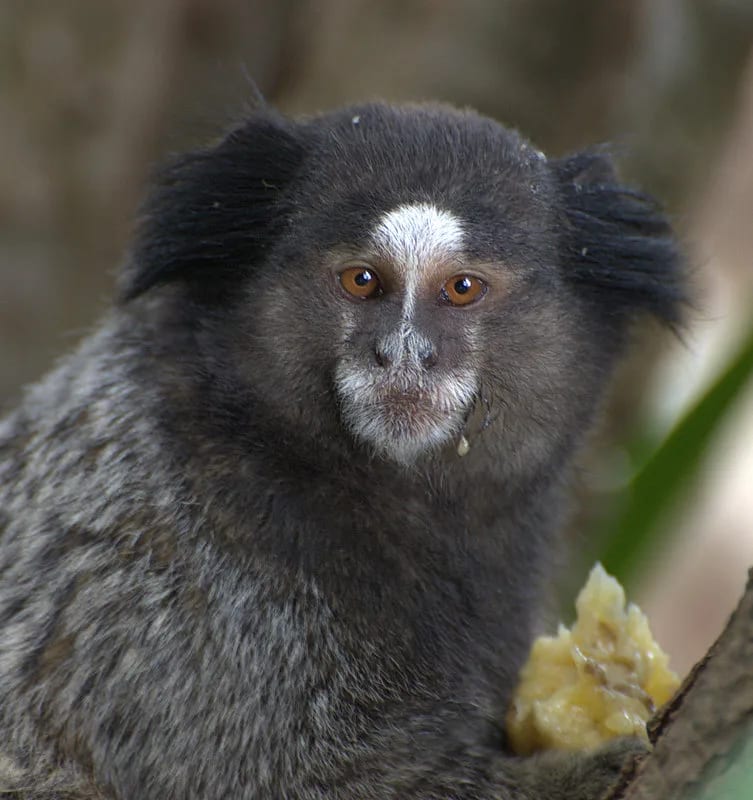
Black-tufted-ear marmoset
Callithrix penicillata
Mammals — Primates (Callitrichidae)
The black-tufted-ear marmoset is one of Brazil's most adaptable and expansive primates. Small, intelligent, and highly opportunistic, it thrives in natural and urban settings, making it key to understanding the boundaries between conservation, adaptation, and ecological conflict.
Generalist callitrichid and ecological invader
Diurnal and cooperatively social, the black-tufted-ear marmoset displays high behavioral plasticity. This flexibility has enabled it to expand beyond its original range, creating significant impacts on primates endemic to the Atlantic Forest.
📍 Biomes it inhabits
Originally associated with the Cerrado — the Brazilian savanna — and the inland Atlantic Forest, the black-tufted-ear marmoset has expanded widely across southeastern and southern Brazil, occupying urban areas, forest fragments, and urban parks. Outside its native range, it is considered an invasive species.
🌍 Conservation status (IUCN)
LC · Least ConcernAccording to the IUCN, the species is classified as LC (Least Concern). Even so, its expansion poses a direct threat to endemic primates through competition and hybridization.
🔬 Scientific classification
- Kingdom
- Animalia
- Phylum
- Chordata
- Class
- Mammalia
- Order
- Primates
- Family
- Callitrichidae
- Genus
- Callithrix
- Species
- Callithrix penicillata (É.Geoffroy Saint-Hilaire, 1812)
⚙️ Specifications and metrics
- Body mass: 300–450 g (11–16 oz).
- Body length: 20–25 cm (8–10 in), plus a long tail measuring 30–35 cm (12–14 in).
- Claws: tegulae, adapted for foraging on trunks.
- Dentition: incisors specialized for gouging.
- Cognition: high capacity for learning and exploration.
- Generation length: ~5–6 years — high reproductive rate.
Diet: Omnivorous — plant exudates (gums), insects, fruit, eggs, small vertebrates, and human-derived foods.
📅 Life cycle
- Gestation: ~140–150 days.
- Litters: usually twins.
- Parental care: cooperative, involving the entire group.
- Lifespan: 10–15 years in the wild; longer in captivity.
🔗 Ecological ripple effect
The black-tufted-ear marmoset forages for exudates and disperses small seeds, but its introduction beyond its native range causes ecological imbalances, affecting endemic primates and local genetic composition.
🤔 Why it matters
- Highly adaptable to urban environments.
- Competes with lion tamarins and endemic marmosets.
- Easily introduced through human activity.
- Population control is difficult.
🧪 Did you know?
- It is one of the most common marmosets in urban parks in southeastern Brazil.
- It forms hybrids with other Callithrix species.
- The epithet penicillata refers to its dark, brush-like tufts.
- Its presence is one of the main challenges in lion tamarin conservation.
Small discoveries
- Diurnal
- Activity concentrated during daylight hours.
- IUCN
- International Union for Conservation of Nature — the global authority on assessing extinction risk.
- Hybridization
- Crossbreeding between distinct species of the same genus.
- Tegulae
- Elongated, curved nails characteristic of callitrichids.
- Gouging
- Extraction of plant exudates by boring into bark.