.webp&w=1920&q=82)
.webp&w=1920&q=82)
.webp&w=1920&q=82)
.webp&w=1920&q=82)
.webp&w=1920&q=82)
.webp&w=1920&q=82)
.webp&w=1920&q=82)
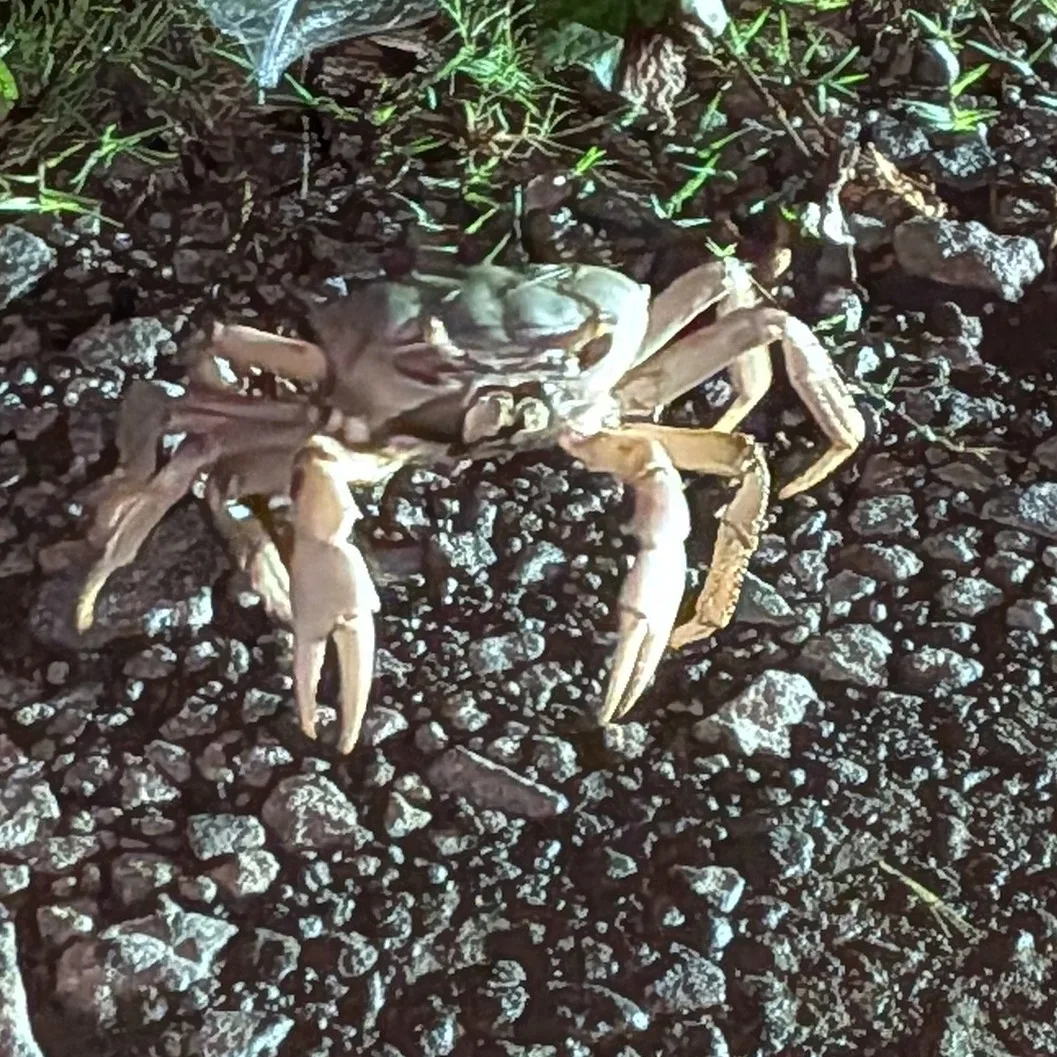
Blue land crab
Cardisoma guanhumi
Crustaceans — Decapoda (Gecarcinidae)
Strong, territorial and deeply tied to mangroves and restinga, the guaiamum — a blue land crab — is one of Brazil’s most emblematic land crabs. In Cardisoma guanhumi, traditional culture, coastal ecology and conservation converge — now under intense human pressure.
The great land crab of the mangroves
Known popularly as guaiamum, Cardisoma guanhumi is a land crab associated with mangroves, restinga and coastal areas. Unlike strictly aquatic crabs, it excavates deep burrows in moist soil, maintaining an indirect connection with the marine environment.
📍 Range and habitat
Distribution: Western Atlantic — from the southeastern United States, the Caribbean and Central America to southern Brazil; in Brazil, it is found mainly from the North to the Southeast.
Habitat: Areas adjoining mangroves, restinga, forest edges and well-drained coastal soils. It lives in underground burrows, often far from surface water.
⚠️ Relationship with humans
Conservation: In Brazil, classified as CR (Critically Endangered) by ICMBio, with severe declines associated with overharvesting and habitat loss. Globally, no formal assessment is recorded by the IUCN (NE, according to GBIF). Subject to a federal closed season (October to March).
Relationship: Historically harvested as a food resource of high cultural value, especially in northeastern Brazil. Overharvesting, together with the degradation of mangroves and restinga, has led to regional population collapses. It is covered by federal protective legislation and sustainable management plans.
🔬 Scientific classification
- Kingdom
- Animalia
- Phylum
- Arthropoda
- Class
- Malacostraca
- Order
- Decapoda
- Family
- Gecarcinidae
- Genus
- Cardisoma
- Species
- Cardisoma guanhumi Latreille, 1828
🔬 Morphology and adaptations
- Size: A large land crab with a robust carapace and highly developed claws.
- Coloring: Variable — bluish, purplish or grayish, a distinctive feature of the species.
- Legs: Strong and adapted for movement on firm ground.
- Respiration: Uses adapted gill structures, requiring constant moisture in its burrows.
Diet: Omnivorous — plant matter, fruit, seeds and organic detritus.
🔄 Life cycle and behavior
📅 Development
- Reproduction: Females migrate to aquatic areas to release larvae into the marine environment.
- Larval development: Takes place at sea, with juveniles returning to the terrestrial environment.
🌙 Behavior
- Activity: Predominantly nocturnal.
- Territoriality: Individuals defend their burrows.
- Feeding: Omnivorous — plant matter, fruit, seeds and organic detritus.
🌍 Role in the Ecosystem
- Soil engineering: burrowing promotes bioturbation, influencing drainage and nutrient cycling.
- Recycling: consumes and redistributes terrestrial organic matter.
- Connectivity: links terrestrial, estuarine and marine environments throughout its life cycle.
💡 Why does it matter?
- Because guaiamum is part of Brazil’s coastal cultural heritage.
- Because its loss signals severe degradation of coastal ecosystems.
- Because conservation must also encompass species historically exploited by people.
- Because sustainable management is more effective than prohibition without knowledge.
💫 What does guaiamum warn us about?
Cardisoma guanhumi is a living warning: when human pressure exceeds the capacity for recovery, even large species that were once abundant can collapse.
Protecting guaiamum means protecting the ecological and cultural memory of Brazil’s coastal zones.
Reflection: how many species must disappear before we learn to use resources responsibly?
Small discoveries
- Terrestrial
- A species that lives predominantly on land, returning to water only during specific stages of its life cycle.
- Underground galleries
- Deep burrows excavated in the soil, used for shelter and moisture control.
- ICMBio
- The Chico Mendes Institute for Biodiversity Conservation — the Brazilian federal agency responsible for assessing species’ extinction risk.
- IUCN
- The International Union for Conservation of Nature — the global authority on extinction-risk assessment.
- Bioturbation
- The churning and aeration of soil by living organisms.
- Adapted gill structures
- Modified gills that function in moist environments, enabling terrestrial life.
📚 References
- GBIF — Cardisoma guanhumi (usageKey 2225832)
- ICMBio — Livro Vermelho dos Crustáceos do Brasil: Avaliação 2010–2014
- Livro Vermelho dos Crustáceos do Brasil (PDF — Sociedade Brasileira de Carcinologia)
- Barros-Alves et al. (2012) — Capture and commercialization of blue land crabs (guaiamum) along the coast of Bahia State, Brazil: an ethnoecological approach
- Mota Alves & Madeira (2021) — Conservation of Cardisoma guanhumi in Brazil: optimal habitats and environmental factors (Journal of Crustacean Biology)
- ICMBio — Revista CEPSUL: Manejo da pesca do guaiamum
- IMA Alagoas — Guaiamum e Uçá: Proibições, prazos e legislação (defeso)