.webp&w=1920&q=82)
.webp&w=1920&q=82)
.webp&w=1920&q=82)
.webp&w=1920&q=82)
Turkey Vulture
Cathartes aura
Birds — Accipitriformes (Cathartidae)
Before the eyes find a carcass, the Turkey Vulture may already have read the scent of death in the air. Soaring economically over grasslands, forests, and cities, it turns remains into nutrient movement and makes the landscape a cleaner system.
The Americas’ great winged scent-finder.
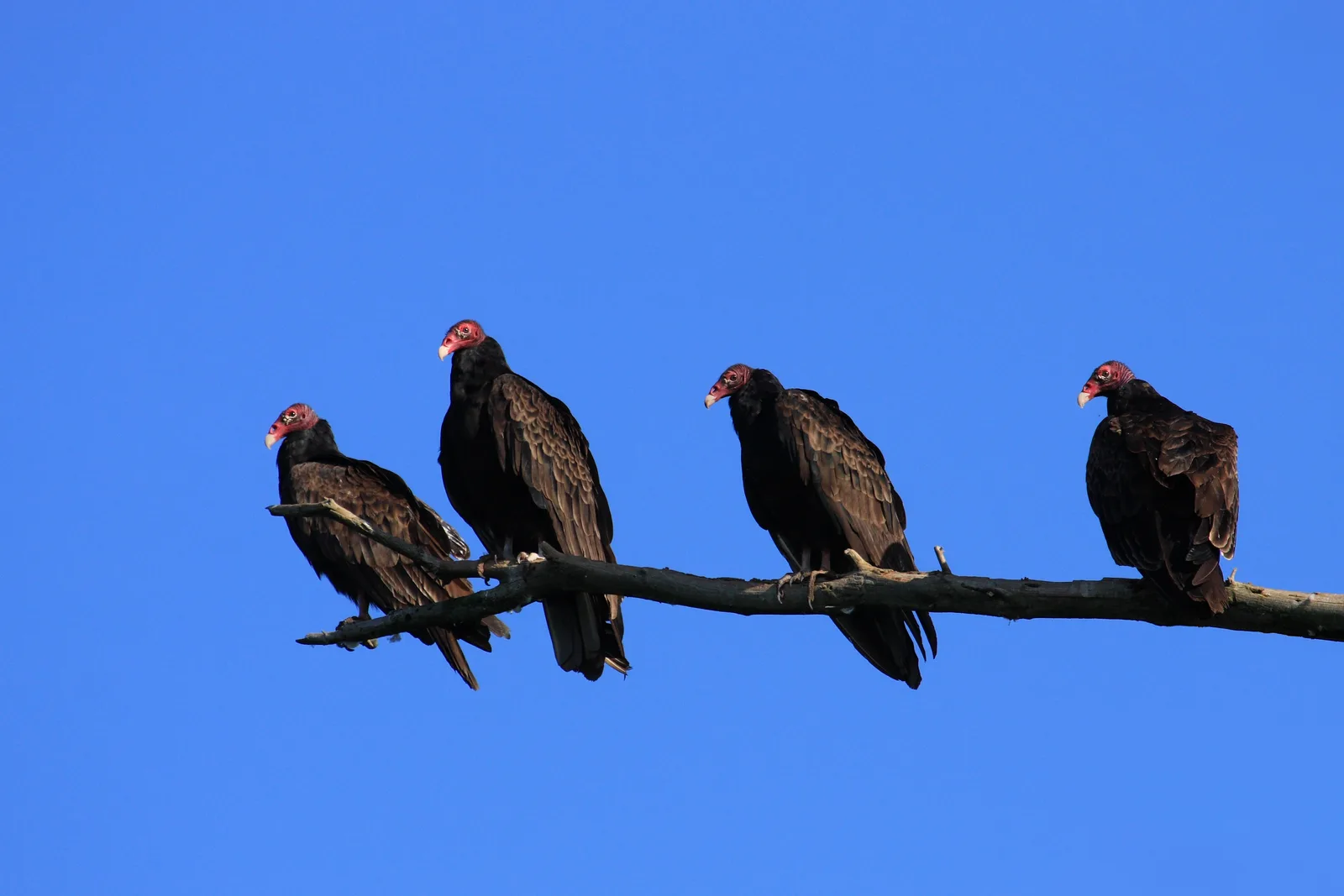
The Turkey Vulture, Cathartes aura, is a widely distributed vulture of the Americas, found from southern Canada to the far south of South America, including throughout Brazil. With its dark body, bare reddish head, and broad flight, it is a carrion specialist: it does not seek only what is visible but uses smell to discover remains hidden beneath vegetation. Although it may gather in communal roosts, it usually searches its territory alone by day, sustained by rising warm-air currents.
📍 Biomes it inhabits
In Brazil, the species is recorded in the Amazon, Atlantic Forest, Cerrado — Brazil’s savanna — Caatinga — Brazil’s dry thorn-scrub biome — Pantanal, and Pampa. This presence across all biomes does not mean attachment to a single landscape: it crosses open areas, pastures, grasslands, roadsides, cities, and forests, wherever it finds food and safe places to perch and shelter. Forests and tall trees offer perches and resting places; open spaces make soaring and the search for carrion more efficient.
🌍 Conservation status (IUCN)
LC · Least ConcernGlobally, Cathartes aura is classified as Least Concern by the IUCN because of its very wide distribution and an apparently stable population trend. Even so, this status does not eliminate local risks: collisions with vehicles, fences, power lines, and aircraft; human persecution; the destruction of communal roosts; and the ingestion of carcasses contaminated by pesticides, lead, or other compounds can cause deaths. Conserving the species includes reducing these sources of mortality and recognizing that vultures are not a health hazard because they eat carrion; they are part of the ecological solution to it.
🔬 Scientific classification
- Kingdom
- Animalia
- Phylum
- Chordata
- Class
- Aves
- Order
- Accipitriformes
- Family
- Cathartidae
- Genus
- Cathartes
- Species
- Cathartes aura (Linnaeus, 1758)
⚙️ Specifications and metrics
- Length: Between 64 and 81 cm (25–32 in).
- Body mass: Between 0.85 and 2 kg (1.9–4.4 lb), varying among subspecies and individuals.
- Plumage: Predominantly brownish-black; the head and neck are bare, ranging from pink to vivid red, and the flight feathers show a grayish tone on the underside of the wing.
- Vocalization: It has no elaborate song, giving chiefly hoarse grunts, hisses, and bark-like sounds, especially when threatened.
Diet: A scavenging bird, it feeds chiefly on carcasses. It locates food by combining sight with an exceptionally developed sense of smell, capable of detecting remains hidden beneath vegetation. In rural landscapes, it mainly uses dead domestic animals; near cities, it consumes much roadkill; in less altered areas, it turns to wildlife. It prefers smaller carcasses but may use other available sources, such as spoiled fruit and, occasionally, small animals. Its diet does not follow a single seasonal pattern throughout its range: it tracks local carrion availability, land use, and the movements of migratory populations.
📅 Life cycle
- Reproduction: Forms monogamous pairs and generally breeds once a year. The clutch contains 1–3 eggs, most often 2; both adults take part in caring for the young.
- Nest: Builds almost no nest. It lays its eggs on the ground in dark shelters, such as cavities in trees and logs, rock crevices, caves, piles of branches, or abandoned buildings.
- Incubation: About 30–40 days, with the adults taking turns. The young leave the nest site about 70–80 days after hatching.
- Lifespan: Data from the wild are limited; one banded individual was recorded living 16 years and 10 months, and a natural-history source cites up to 17 years in the wild.
🔗 Ecological ripple effect
Without the Turkey Vulture, carcasses would remain longer in the environment, and the return of organic matter to food chains would be less efficient. Other scavengers could occupy part of that space, but an animal especially adept at finding remains hidden by scent and removing them across extensive areas would be lost. The result would be a slower cleansing of the landscape, greater availability of decomposing matter, and altered relationships among microorganisms, insects, mammals, and other birds that use this resource.
🤔 Why it matters
- Removes carcasses and speeds nutrient recycling among dead animals, soil, and food chains.
- It can reduce how long remains persist on roads, in grasslands, and in rural areas, where carrion also concentrates health risks.
- Its highly developed sense of smell is a rare adaptation among birds and helps explain how it finds food beneath vegetation.
- It is a useful indicator species for tracking environmental changes and risks that also affect other Neotropical vultures.
- Its presence in urban and rural landscapes brings people closer to an ecological service that nearly always works out of sight.
🧪 Did you know?
- The Turkey Vulture is among the few birds that use smell intensively to find food, including carcasses hidden beneath the canopy.
- It may spend the day searching for food alone and gather with many other vultures in communal roosts at dusk.
- When threatened at the nest, it can regurgitate partially digested food: the strong smell serves as a defense against intruders.
- Its silhouette in flight usually shows wings held in a shallow V as it rides thermals to stay aloft with little energy expenditure.
- Where it lives alongside the Black Vulture, the latter may follow the Turkey Vulture to a carcass and then compete for the food as a group.
Small discoveries
- Carrion
- The decomposing body of a dead animal, used as food by scavengers.
- Scavenger
- An animal that feeds chiefly on dead animals.
- Canopy
- The layer formed by the crowns of trees in a forest.
- Thermal
- A rising current of warm air used by soaring birds.