.webp&w=1920&q=82)
.webp&w=1920&q=82)
.webp&w=1920&q=82)
.webp&w=1920&q=82)
.webp&w=1920&q=82)
.webp&w=1920&q=82)
.webp&w=1920&q=82)
.webp&w=1920&q=82)
Brazilian horned frog / Wied's frog
Ceratophrys aurita
Amphibians — Anurans (Ceratophryidae)
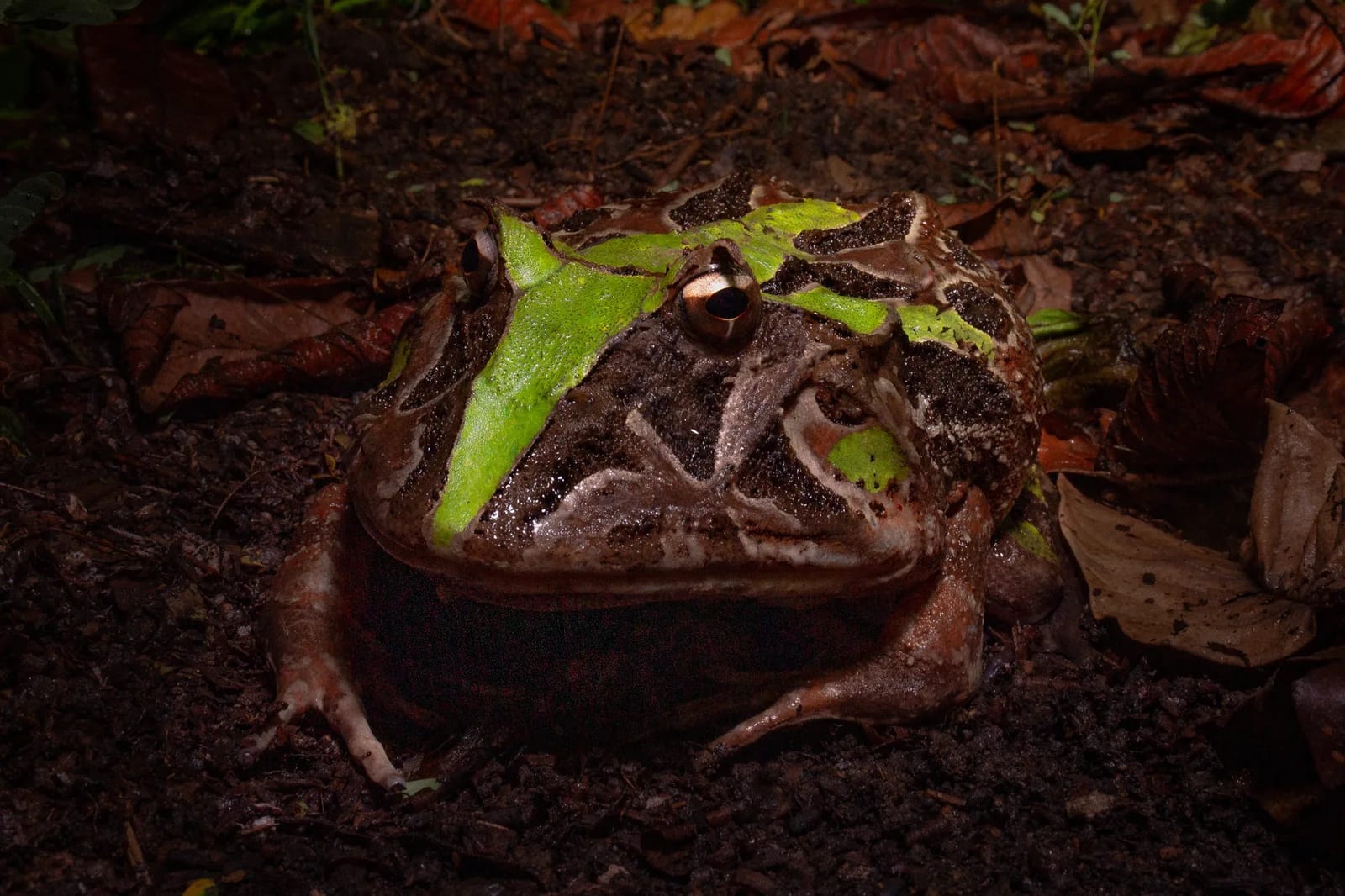
Ceratophrys aurita is one of the Atlantic Forest’s most striking amphibians, known for its robust body, disproportionately large mouth, and ambush-hunting strategy. It is an extreme example of adaptation to consuming relatively large prey.
Ambush predator of the forest floor
An ambush predator, the Brazilian horned frog remains partly buried in leaf litter, swiftly striking any animal that fits in its mouth. Its morphology favors explosive, efficient attacks.
📍 Biomes it inhabits
It occurs exclusively in the Atlantic Forest, with a fragmented distribution across southeastern Brazil, including the states of São Paulo, Rio de Janeiro, Espírito Santo, and parts of southern Bahia. It inhabits low- to mid-elevation humid forests associated with soils rich in organic matter.
🌍 Conservation status (IUCN)
LC · Least ConcernAccording to the IUCN, the species is classified as LC (Least Concern). Loss and fragmentation of the Atlantic Forest represent the main threat to wild populations.
🔬 Scientific classification
- Kingdom
- Animalia
- Phylum
- Chordata
- Class
- Amphibia
- Order
- Anura
- Family
- Ceratophryidae
- Genus
- Ceratophrys
- Species
- Ceratophrys aurita (Raddi, 1823)
⚙️ Specifications and metrics
- Body mass: Up to ~500 g (18 oz) (exceptionally large females).
- Body length: Up to 20 cm (8 in).
- Mouth: Extremely broad, allowing it to swallow large prey.
- Morphology: Flattened body, with short, muscular limbs.
- Camouflage: Cryptic coloration that mimics dry leaves.
- Generation length: ~3–4 years.
Diet: Carnivorous — other amphibians, small reptiles, rodents, and occasionally birds.
📅 Life cycle
- Reproduction: Oviparous.
- Egg-laying: Hundreds to thousands of eggs.
- Development: Fast-growing aquatic tadpoles.
- Lifespan: Up to ~10 years in the wild.
🔗 Ecological ripple effect
As a top predator among leaf-litter amphibians, Ceratophrys aurita regulates populations of other small vertebrates. Its presence is associated with forests whose structure remains intact and whose soil moisture regime is favorable.
🤔 Why it matters
- One of the largest anurans of the Atlantic Forest.
- Capable of swallowing prey nearly its own size.
- A highly efficient sedentary predator.
- Extremely dependent on well-preserved humid forests.
🧪 Did you know?
- The genus name Ceratophrys means “horn-shaped eyebrow.”
- It may bite as a defensive mechanism when handled.
- It spends long periods almost completely still.
- It is highly sensitive to the loss of soil moisture.
Small discoveries
- Ambush predation
- A hunting strategy based on remaining still while waiting for prey to approach.
- Leaf litter
- A layer of leaves and organic matter accumulated on the forest floor.
- Atlantic Forest
- A highly biodiverse tropical and subtropical forest biome of eastern Brazil.
- Fragmented
- Isolated populations along the coastal belt and associated mountain ranges.
- IUCN
- International Union for Conservation of Nature — the global authority on extinction-risk assessment.
- Large prey
- Prey proportionally large in relation to the predator.
- Birds
- Rare, opportunistic events recorded in the literature.
- Oviparous
- Eggs laid directly in water, with an aquatic larval stage.