.webp&w=1920&q=82)
.webp&w=1920&q=82)
.webp&w=1920&q=82)
.webp&w=1920&q=82)
.webp&w=1920&q=82)
.webp&w=1920&q=82)
.webp&w=1920&q=82)
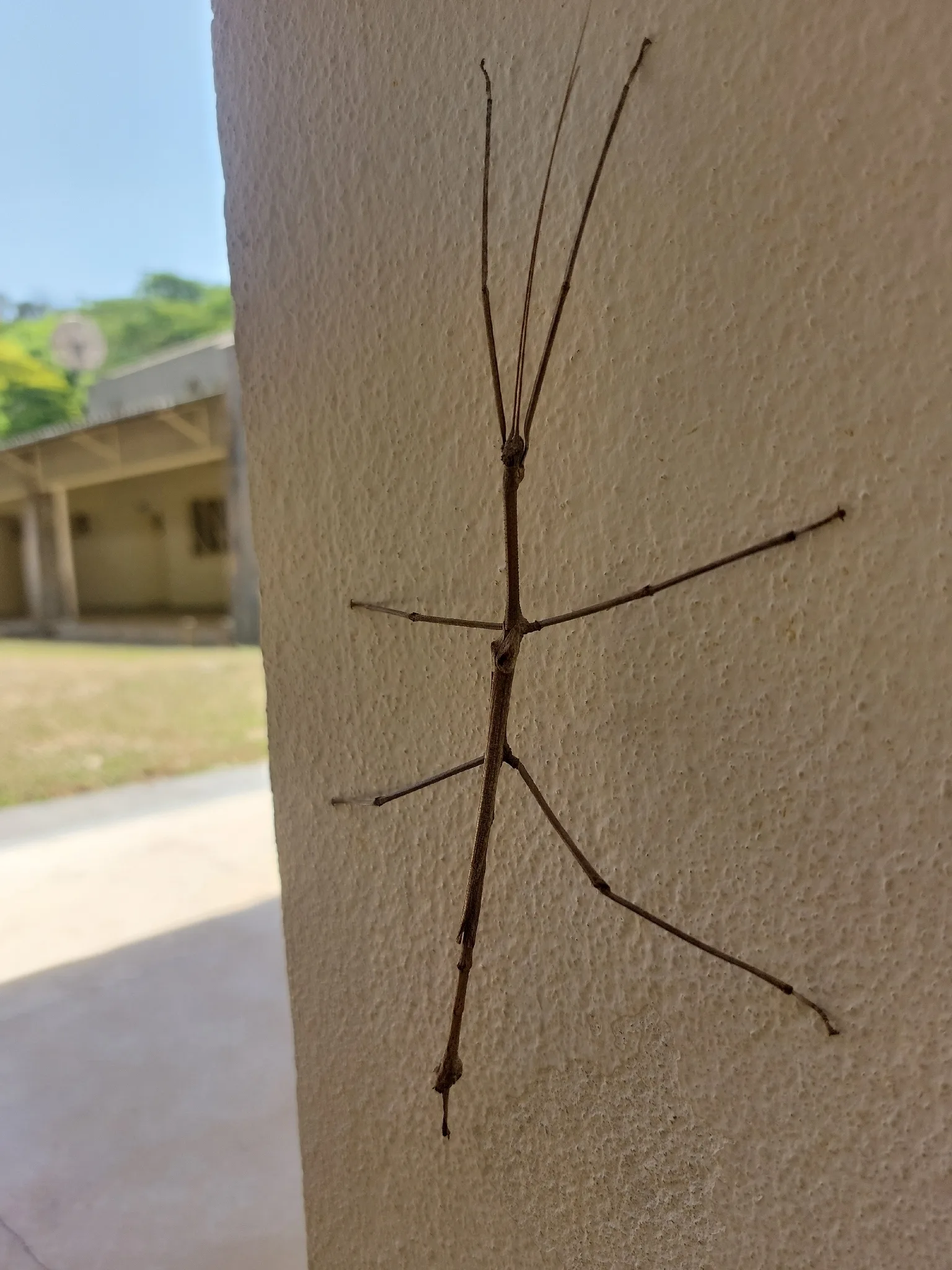
Brazilian giant stick insect
Cladomorphus phyllinus
Insects — Phasmida (Phasmatidae)
A master of camouflage, the Brazilian giant stick insect is among the most remarkable insects in Brazil’s fauna. For Cladomorphus phyllinus, looking like a twig is no trick—it is a refined survival strategy, honed over millions of years.
When vanishing is the best defense
The stick insect neither flees, attacks, nor hides—it simply blends into its surroundings. At rest, Cladomorphus phyllinus can go unnoticed even from inches away, mistaken for a dry twig or broken branch. The illusion is so effective that it protects the insect throughout virtually its entire life.
📍 Range and habitat
Distribution: South America, with records in Brazil.
Habitat: Tropical and subtropical forests, forest edges, and wooded areas. It lives among woody vegetation, where its camouflage is most effective.
⚠️ Relationship with humans
Conservation: Species without a specific formal IUCN assessment. It is considered rarely observed because of its camouflage, not necessarily because it is scarce.
Relationship: Entirely harmless to people and occasionally reared in controlled environments for educational and scientific purposes.
🔬 Scientific classification
- Kingdom
- Animalia
- Phylum
- Arthropoda
- Class
- Insecta
- Order
- Phasmida
- Family
- Phasmatidae
- Genus
- Cladomorphus
- Species
- Cladomorphus phyllinus Gray, 1835
🔬 Morphology and adaptations
- Size: One of Brazil’s largest insects, it can exceed 20 cm (8 in) in length.
- Body shape: An elongated, segmented body, strikingly similar to dry twigs.
- Camouflage: Coloration ranging from brown to green, with irregularities that mimic knots and cracks in wood.
- Movement: It moves slowly, minimizing any visual cue that might betray its presence.
Diet: Herbivorous—leaves from a variety of shrubs and trees.
🔄 Life cycle and behavior
📅 Development
- Type: Incomplete metamorphosis (egg → nymph → adult, with no pupal stage).
- Eggs: Dropped individually onto the ground, resembling small seeds.
🌙 Behavior
- Activity: Predominantly nocturnal.
- Feeding: Herbivorous—leaves from a variety of shrubs and trees.
- Defense: Extreme stillness as its primary response to threats.
🌍 Role in the Ecosystem
- Moderate herbivory: contributes to the balance of plant growth.
- Food source: serves as prey for birds, reptiles, and small mammals.
- Functional diversity: represents extreme strategies of evolutionary adaptation.
💡 Why does it matter?
- Because not every defense involves strength or venom.
- Because camouflage is one of evolution’s greatest innovations.
- Because many organisms go unnoticed even when they are present.
- Because protecting forests also means protecting what we scarcely see.
💫 Why does this stick insect fascinate us?
Cladomorphus phyllinus challenges our perception. It proves that survival is not always about running or fighting—sometimes it is simply about not being noticed.
In a world that prizes the visible and conspicuous, the stick insect reminds us that nature is also sustained by silence, patience, and perfect illusion.
Reflection: how many forms of life disappear not because they are gone, but because we never learned to see them?
Small discoveries
- Survival
- A set of adaptations that reduces the likelihood of an organism being detected by predators.
- Blends into its surroundings
- A strategy in which an organism visually merges with elements of its environment.
- Woody vegetation
- The upper layer of vegetation, where leaves and branches are abundant.
- IUCN
- The global list of threatened species; most camouflaged insects have no individual assessment.
- Incomplete metamorphosis
- A life cycle with no pupal stage: egg → nymph → adult.