.webp&w=1920&q=82)
.webp&w=1920&q=82)
.webp&w=1920&q=82)
.webp&w=1920&q=82)
Blue-eyed Ground Dove
Columbina cyanopis
Birds — Columbiformes (Columbidae)
For about 75 years, the Blue-eyed Ground Dove lived on the border between museum memory and the absence of confirmed records. When it reappeared in the Brazilian savanna of Minas Gerais in 2015, its soft call and blue eyes restored to Brazil a bird found naturally in no other country.
The small blue-eyed dove that returned to challenge the silence of the Brazilian savanna.
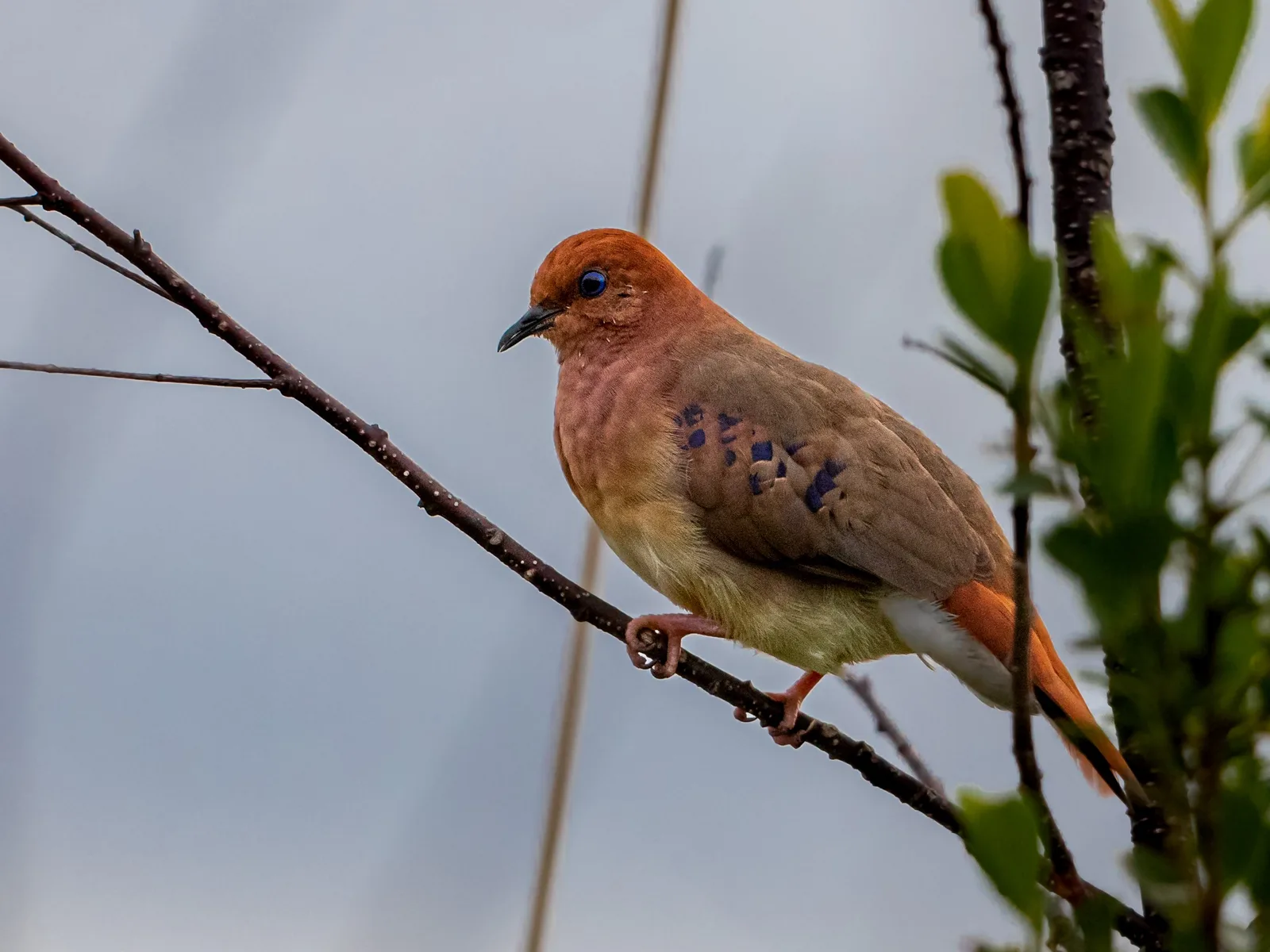
The Blue-eyed Ground Dove is a small dove, endemic to Brazil and associated with the Brazilian savanna. Its cinnamon-colored body is marked by two features that aid identification: its dark blue eyes and the cobalt-blue spots on its wings. Rare and inconspicuous, its natural history remains only partly known, but its rediscovery opened a continuing front of research and protection.
📍 Biomes it inhabits
The species occurs naturally only in Brazil’s savanna. The known contemporary population is tied to the Botumirim region of northern Minas Gerais, where it uses open savanna, white-sand grasslands, and rocky-grassland environments with sandy, stony soil and shrubby vegetation. Its association with such a particular microhabitat helps explain why protecting the biome in a broad sense alone is not enough: the exact vegetation structure occupied by the bird must be conserved.
🌍 Conservation status (IUCN)
CR · Critically EndangeredThe Blue-eyed Ground Dove is listed as Critically Endangered on the IUCN Red List. Loss and degradation of the Brazilian savanna, compounded by the isolation of a very small population, place the species at extreme risk. The response brings together habitat protection in Botumirim, monitoring of individuals and nests, searches for new areas of occurrence, and the establishment of an assurance population in human care; in 2025, the first chick produced by parents in such care was born.
🔬 Scientific classification
- Kingdom
- Animalia
- Phylum
- Chordata
- Class
- Aves
- Order
- Columbiformes
- Family
- Columbidae
- Genus
- Columbina
- Species
- Columbina cyanopis (Pelzeln, 1870)
⚙️ Specifications and metrics
- Length: Between 15.5 and 17 cm (6.1 to 6.7 in).
- Body mass: No published estimate of body mass for the species is available from an accessible, reliable source.
- Plumage: Predominantly chestnut or cinnamon, with a reddish-brown head and nape, paler underparts, white vent and undertail coverts, and metallic cobalt-blue spots on the wing coverts. Its dark blue eyes are conspicuous.
- Vocalization: Its song repeats soft notes, transcribed as wah-wha-wha. No recording of its vocalization was known before the species was rediscovered.
Diet: The species is considered granivorous and has been observed foraging in pairs on the ground. Published studies have yet to detail which seeds it eats, how it selects food, and how its diet changes through the year; these particulars therefore cannot be stated with confidence.
📅 Life cycle
- Reproduction: Field monitoring has already recorded copulations, four active nests in 2020, and at least one chick fed by its parents, expanding knowledge that had remained almost nonexistent for decades.
- Nest: Active nests have been recorded in the wild, but the nest’s structure and typical placement have not yet been described in an accessible source with sufficient detail for this species.
- Incubation: The duration of natural incubation has not been published in an accessible, reliable source. Nest monitoring has made it possible to observe incubation behavior.
- Lifespan: No published estimate of lifespan for the species is available from an accessible, reliable source.
🔗 Ecological ripple effect
No studies have yet quantified the ecological role of the Blue-eyed Ground Dove, and that gap is part of the problem: losing the species would also mean losing the chance to understand its relationships with the seeds and vegetation of the Brazilian savanna where it forages. At a local scale, one component of the bird fauna that uses the ground in rare, open environments would disappear; at an evolutionary scale, Brazil would lose a singular lineage confined to its territory.
🤔 Why it matters
- It is endemic to Brazil: its survival depends entirely on conservation decisions made within the country.
- It signals the urgency of protecting open vegetation types and specialized microhabitats in the Brazilian savanna, not just large remnants of the biome.
- Its rediscovery, after decades without confirmed records, became a landmark for Brazilian ornithology and conservation.
- Recent genetic research reinforces its value as a singular evolutionary lineage among Neotropical ground doves.
- The integrated management of a reserve, a state park, researchers, and conservation institutions shows how field science and care under human responsibility can complement one another.
🧪 Did you know?
- Before its rediscovery, there was no photograph, video, or recording of the Blue-eyed Ground Dove’s song in the wild.
- The last confirmed record before its rediscovery was in 1941; the species was found again in 2015.
- Its wah-wha-wha song helped turn a bird previously known chiefly from museum specimens into a species monitored in the wild.
- In 2020, field teams recorded four active nests, copulations, and a chick being fed by its parents.
- In July 2025, the first Blue-eyed Ground Dove chick produced by parents in human care was born, a milestone in building an assurance population.
Small discoveries
- Endemic
- Occurring naturally only within a particular geographic area.
- Granivorous
- Having seeds as the predominant part of the diet.
- Microhabitat
- A highly specific set of soil, vegetation, and landform conditions used by a species within a larger environment.
- Assurance population
- A group kept in human care to reduce the risk of extinction and support future conservation action.
📚 References
- Lista Vermelha da UICN — Columbina cyanopis, avaliação de BirdLife International
- Birds of the World — Blue-eyed Ground Dove
- eBird — rolinha-do-planalto
- WikiAves — rolinha-do-planalto
- SAVE Brasil — Nascimento inédito de rolinha-do-planalto no Parque das Aves
- Vogeley et al. — Phylogenetic analysis of the Blue-eyed Ground Dove
- GBIF — Columbina cyanopis