.webp&w=1920&q=82)
.webp&w=1920&q=82)
.webp&w=1920&q=82)
.webp&w=1920&q=82)
.webp&w=1920&q=82)
.webp&w=1920&q=82)
.webp&w=1920&q=82)
.webp&w=1920&q=82)
Jumping Spider
Corythalia sp.
Arachnids — Araneae (Salticidae)
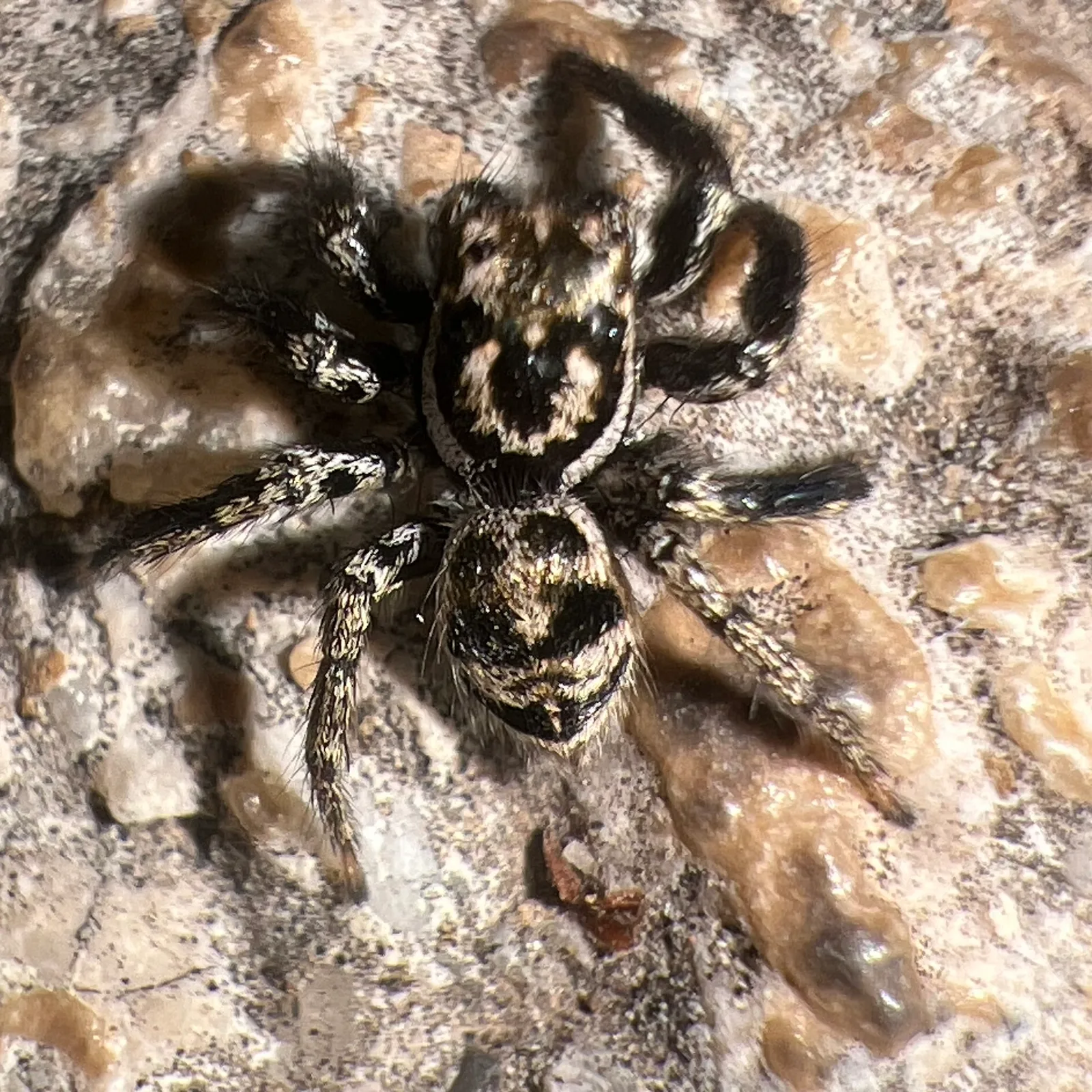
Small, curious, and with an almost human-like gaze, the jumping spider is one of the most charismatic predators of the microworld. In Corythalia, hunting does not rely on a web: it relies on vision, calculation, and precise jumps — a form of embodied intelligence that often fascinates even people who fear spiders.
The hunter that sees, takes aim, and jumps
Jumping spiders (family Salticidae) are famous for their exceptional vision. Rather than wait for prey to fall into a web, they hunt actively: they watch, approach slowly, and jump at just the right moment. To avoid falling, they use a silk safety belt — a strand anchored to the substrate that acts as a safety line.
📍 Range and habitat
Distribution: Neotropical, with occurrences in Brazil.
Habitat: Forest edges, shrub vegetation, grasses, trunks, walls, and gardens. It often appears in well-lit places, where visual hunting is more efficient.
⚠️ Relationship with humans
Conservation: A group without a specific formal IUCN assessment. Many species are locally common but may be sensitive to the loss of microhabitats.
Relationship: Harmless to humans. It has no medical significance. Bites are extremely rare and occur only through direct handling.
🔬 Scientific classification
- Kingdom
- Animalia
- Phylum
- Arthropoda
- Class
- Arachnida
- Order
- Araneae
- Family
- Salticidae
- Genus
- Corythalia
- Species
- Corythalia sp. C. L. Koch, 1850
🔬 Morphology and adaptations
- Size: Small (generally ranging from a few millimeters to ~1 cm (0.4 in), depending on the species).
- Forward-facing eyes: Large and forward-facing, providing excellent perception of detail and depth.
- Jumps: Made with the hind legs, with precise control of direction and distance.
- Silk: Used more for safety and shelter than as a capture trap.
- Coloring: Variable; in many salticids, body patterns serve as visual signals.
Diet: An active predator of small insects; it hunts by sight, without a capture web.
🔄 Life cycle and behavior
📅 Development
- Type: Growth through molts.
- Oothecae: Eggs protected in small silk refuges, in crevices, curled leaves, or sheltered corners.
🌙 Behavior
- Hunting: Slow approach + final leap, like a miniature sharpshooter.
- Exploration: It tends to inspect its surroundings, turning its body and tracking movement.
- Communication: It combines body postures and brief movements, especially in courtship rituals.
🌍 Role in the Ecosystem
- Natural control: a predator of small insects, including potential pests.
- Local balance: it helps regulate populations at the vegetation's micro scale.
- Environmental education: an excellent gateway species for overcoming fear of spiders.
💡 Why is it important to know?
- Because spiders are not enemies: they are predators that help regulate insects.
- Because behavior is biodiversity, too — and here it is easy to observe.
- Because nature has precision hunters on a millimeter scale.
- Because understanding reduces fear and deepens curiosity.
💫 Why do jumping spiders fascinate?
Corythalia sp. shows that the extraordinary need not be large. In a few millimeters, there is strategy, perception, and a kind of presence that makes many people stop, look, and smile.
When you watch a jumping spider, it can almost feel as though it is watching back. And that changes the reader's relationship with the unseen world around them.
Reflection: how many spectacles of Brazilian biodiversity go unnoticed because they are too small for our habitual way of looking?
Small discoveries
- Exceptional vision
- The capacity to perceive detail, depth, and movement with great precision, unusual among spiders.
- Active hunting
- A strategy in which the predator actively searches for, approaches, and captures its prey.
- Safety line
- A silk strand secured before a jump, reducing the risk of falling.
- Visual hunting
- Hunting that depends on seeing prey and judging the distance.
- Visual signals
- Signals used in communication between individuals, especially in reproduction.
- Courtship rituals
- Courtship and recognition interactions between male and female before mating.