.webp&w=1920&q=82)
.webp&w=1920&q=82)
.webp&w=1920&q=82)
.webp&w=1920&q=82)
Banded Cotinga
Cotinga maculata
Birds — Passeriformes (Cotingidae)
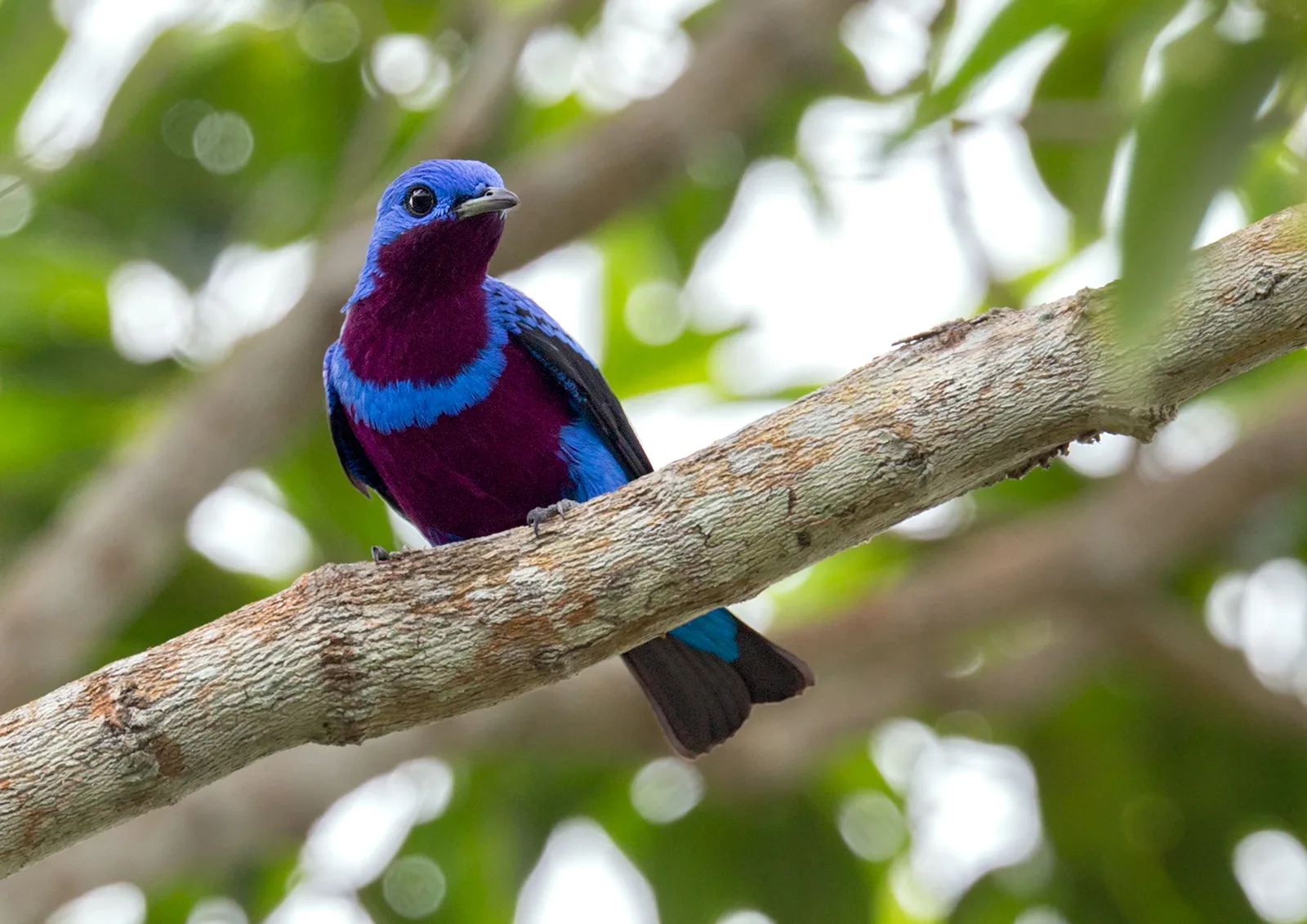
High in the humid forest, the male Banded Cotinga seems to ignite a blaze of cobalt blue and purple among the leaves. Its visual impact contrasts with its discretion: the species is usually silent and spends much of its time in the canopy. Finding it also means finding one of the most fragile remnants of Brazil's Atlantic Forest.
A silent jewel of the Atlantic Forest canopy, found nowhere but Brazil.
The Banded Cotinga, Cotinga maculata, is a bird endemic to Brazil: it occurs naturally only in the country. It belongs to the family Cotingidae and shows pronounced sexual dimorphism, meaning males and females look very different. While the male brings together cobalt blue, purple, and black, the female's spotted brown plumage lets her blend more easily into the canopy. The species is often seen at high, exposed perches or near fruiting trees.
📍 Biomes it inhabits
The Atlantic Forest is the only Brazilian biome associated with the Banded Cotinga. The species lives in the canopy of humid, primary lowland forests between 0 and 270 m (0–890 ft) in elevation, with recent records concentrated mainly in southern and southeastern Bahia and the far northeast of Minas Gerais. In Espírito Santo, once easier to observe, it has become exceedingly rare; in Rio de Janeiro, all known records are historical. This patchy distribution mirrors the dismantling of the lowland forest, where the species depends on continuous canopies and fruiting trees.
🌍 Conservation status (IUCN)
CR · Critically EndangeredThe Banded Cotinga is globally classified as Critically Endangered in the 2019 IUCN Red List assessment conducted by BirdLife International. Its main risk is the loss and fragmentation of humid lowland forests through clearing, fire, agriculture, pasture, and urban expansion; illegal capture for the bird trade is also a recorded threat. The species is protected by law in Brazil, listed in CITES Appendix I, and included in the National Action Plan for the Conservation of Atlantic Forest Birds. Protecting the remaining habitat, restoring degraded areas, and reconnecting fragments are decisive measures to keep it from vanishing from still more places.
🔬 Scientific classification
- Kingdom
- Animalia
- Phylum
- Chordata
- Class
- Aves
- Order
- Passeriformes
- Family
- Cotingidae
- Genus
- Cotinga
- Species
- Cotinga maculata (Statius Muller, 1776)
⚙️ Specifications and metrics
- Length: 18.8–22 cm (7.4–8.7 in).
- Body mass: No value has been reliably published in the sources consulted.
- Plumage: The male combines cobalt blue and purple with black areas; the female is brown, with white spotting on the back and buff and dark-brown markings on the belly.
- Vocalization: Usually silent; no documented vocalization is known, but males produce a mechanical sound with their wings in flight.
Diet: It is frugivorous and forages in the canopy, especially in fruiting trees. Byrsonima sericea and species of Ficus are among its recorded resources. The sources consulted do not document seasonal variation in the Banded Cotinga's diet; historical records of local movements do not allow an inference about a feeding calendar.
📅 Life cycle
- Reproduction: Still poorly known: a female was found incubating in October. The sources consulted provide no reliable data on clutch size.
- Nest: A fragile cup of small twigs, set in the fork of an almost horizontal branch in the canopy.
- Incubation: A female has been recorded incubating in October, but the incubation period is not documented in the sources consulted.
- Lifespan: No reliably published longevity estimate is available in the sources consulted.
🔗 Ecological ripple effect
By consuming the fruits of Byrsonima sericea and Ficus species in the canopy, the Banded Cotinga is part of the Atlantic Forest's network of frugivorous birds. When a bird in this group disappears, the forest loses a potential route for moving seeds between trees and fragments; with it, it loses an indicator that its tall, humid canopies still function as a continuous environment. For the Banded Cotinga, local disappearance also reduces the chance that the species will recolonize areas where it has already been recorded.
🤔 Why it matters
- It is endemic to Brazil and represents an irreplaceable part of Atlantic Forest biodiversity.
- By seeking fruit in the canopy, it takes part in the frugivorous bird network linked to seed movement through the forest.
- Its presence points to remnants of humid lowland forest still able to support species with very demanding habitat requirements.
- Its few recent records guide research, monitoring, and decisions about which fragments need urgent protection.
- The contrast between the striking male and its unobtrusive habits has made the Banded Cotinga a symbol of threatened Atlantic Forest birdlife.
🧪 Did you know?
- Despite the male's intense colors, the Banded Cotinga is usually silent; in flight, males may produce a mechanical sound with their wings.
- The species has one confirmed nest, described as a fragile cup of twigs supported in the fork of an almost horizontal branch, high in the canopy.
- At first glance, males and females look like different birds: he is cobalt blue and purple, while she is brown and white-marked on the back.
- The fruits of Byrsonima sericea and of fig trees in the genus Ficus are among the foods documented for the Banded Cotinga.
- Although it was once easier to observe in Espírito Santo, the species is now known chiefly from a few protected remnants in eastern Brazil.
Small discoveries
- Canopy
- The upper layer of vegetation formed by the branches and leaves of trees.
- Sexual dimorphism
- A difference in appearance between males and females of the same species.
- Frugivorous
- An animal whose diet consists mainly of fruit.
- Forest fragmentation
- The division of a continuous forest into smaller, isolated areas.
- Local extirpation
- The disappearance of a species from an area where it occurred, without its being extinct worldwide.
📚 References
- BirdLife International — Banded Cotinga Cotinga maculata Species Factsheet
- Birds of the World — Banded Cotinga (Cotinga maculata)
- eBird Brasil / Merlin — crejoá (Cotinga maculata)
- Bonfim et al. (2020) — New records of threatened cotingas (Aves, Cotingidae) in fragments of Atlantic Forest in southeastern Bahia, Brazil
- GBIF — Cotinga maculata