.webp&w=1920&q=82)
.webp&w=1920&q=82)
.webp&w=1920&q=82)
.webp&w=1920&q=82)
Spix's Macaw
Cyanopsitta spixii
Birds — Psittaciformes (Psittacidae)
The blue of Spix's Macaw seems made to streak across the dry sky of the Caatinga—the dry thorn-scrub biome of Brazil—following the green threads of riparian forest between streams that run only part of the year. After vanishing from the wild, it has flown again in its native sertão—the semiarid Brazilian backlands—not as a ready-made happy ending, but as one of the most demanding efforts to repair Brazilian conservation.
The Brazilian macaw learning again to live where it nearly vanished.
Spix's Macaw is endemic to Brazil: its natural range belongs to that country alone. Medium-sized, long-tailed, and cloaked in understated blue plumage, it is the only species in the genus Cyanopsitta. Known from exceptionally rare records in the wild, it has become an emblem of what wildlife trafficking and the destruction of a specialized habitat can do—and of the patient work needed to return a species to the environment from which it was removed.
📍 Biomes it inhabits
Its biome is the Caatinga, though not just any stretch of it. Spix's Macaw was tied to gallery and riparian forests that follow seasonal streams in the sertão of Bahia and Pernambuco, especially where caraibeira trees form a wooded ribbon across the dry landscape. In those trees, it found food, nesting cavities, and resting places; at dusk, tall facheiro cacti also served as roosts. This dependence on narrow green corridors helps explain its extreme vulnerability.
🌍 Conservation status (IUCN)
EW · Extinct in the WildOn the global IUCN Red List, Spix's Macaw is classified as Extinct in the Wild, in an assessment published in 2019. In Brazil, the 2024 national assessment listed it as Critically Endangered, possibly extinct. The difference between the two formulations does not lessen the urgency: the last known wild individual disappeared in 2000, and the species only flew again in the Curaçá region after the release of birds bred under management, beginning in 2022. Wildlife trafficking, the clearing and degradation of riparian forests, fire, overgrazing, and competition for nest cavities continue to make reintroduction a delicate process, dependent on territorial protection, population reinforcement, and continuous monitoring.
🔬 Scientific classification
- Kingdom
- Animalia
- Phylum
- Chordata
- Class
- Aves
- Order
- Psittaciformes
- Family
- Psittacidae
- Genus
- Cyanopsitta
- Species
- Cyanopsitta spixii (Wagler, 1832)
⚙️ Specifications and metrics
- Length: 55–57 cm (22–22.5 in).
- Body mass: In captive adults, the recorded mean was 348.2 g (12.3 oz); this figure should not be treated as a fixed body mass for the entire population.
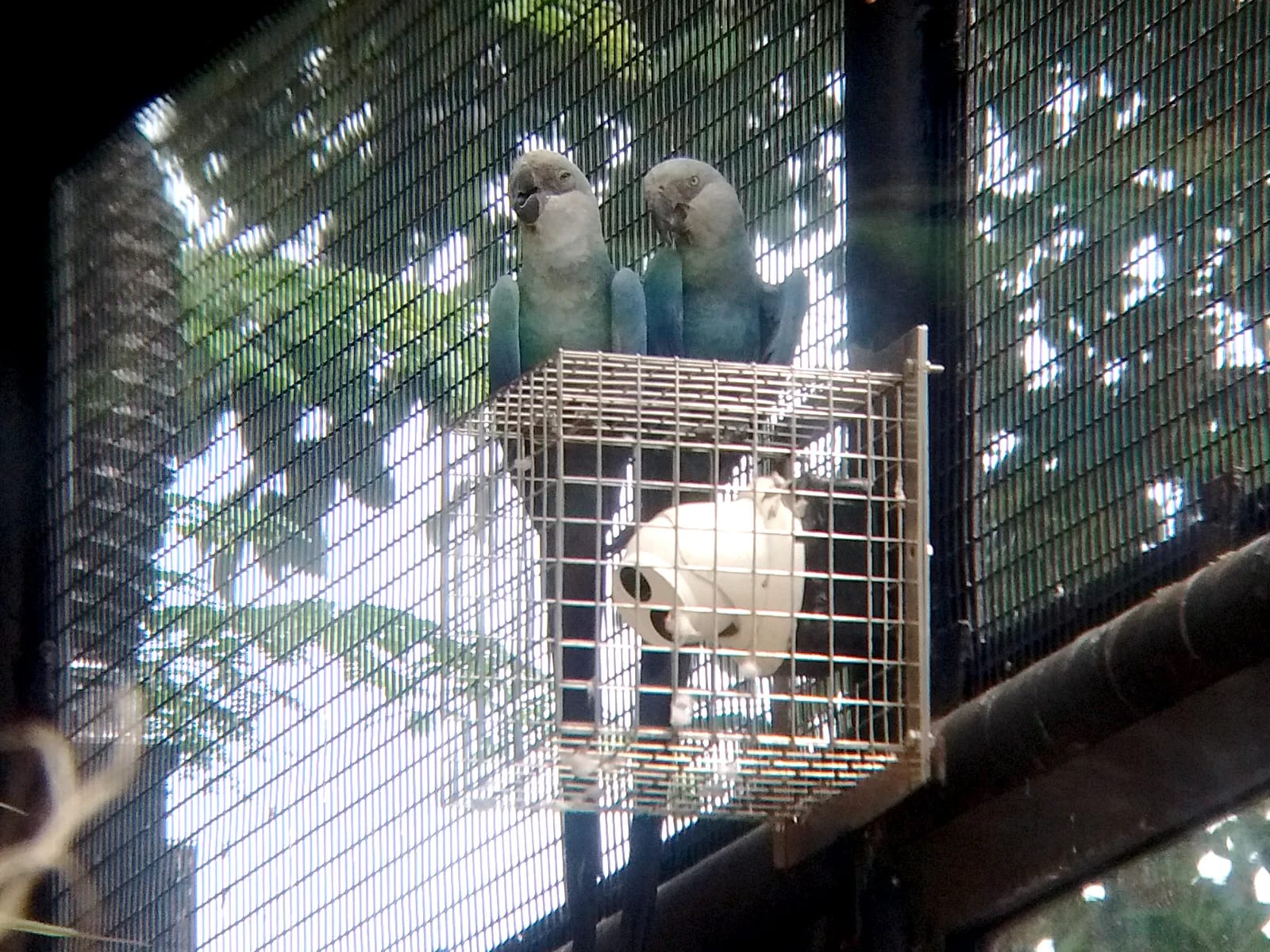
- Plumage: Predominantly blue, with darker wings and tail; the sides of the head below the eyes are pale gray, the area around the eyes is bare, and the iris is mustard yellow.
- Vocalization: Gives a resonant call described as kraaa, softer and more wavering than that of the Hyacinth Macaw; early accounts also noted its thin voice.
Diet: Feeds chiefly on the seeds of pinhão-bravo, faveleira, baraúna, and marizeiro, along with fruits and other plant resources available with the seasons. During reintroduction, Spix's Macaws followed flocks of Blue-winged Macaws and gradually added to their diet the fruits those birds recognized in the local landscape.
📅 Life cycle
- Reproduction: The breeding season follows the rainfall pattern and generally runs from October to March. In captive breeding, clutches of two to four eggs have been recorded; in the wild, the typical clutch is reported as two to three eggs.
- Nest: Uses natural hollows or cavities abandoned by woodpeckers, especially in caraibeira trees of riparian forests.
- Incubation: Captive-breeding records indicate 26–27 days. In the reintroduced population, nest boxes have been occupied, eggs laid, and incubation undertaken—decisive steps toward restoring the species to the wild.
- Lifespan: Estimated at 20–30 years in the wild. In captivity, the oldest known bird lived for approximately 40 years.
🔗 Ecological ripple effect
When a bird that eats seeds and fruit disappears, it is not merely a color that vanishes from the sky: the relationships between wildlife and the plants it visits also weaken. In the case of Spix's Macaw, the historically tiny population makes it impossible to measure its distinct ecological role precisely, but its absence removes from riparian forests a consumer and potential disperser of propagules. Restoring the species, then, also restores an interaction between the Caatinga and its own vegetation—without claiming that one bird can resolve the imbalance of an entire ecosystem.
🤔 Why it matters
- It is endemic to Brazil and represents a unique evolutionary lineage, as Cyanopsitta spixii is the only species in its genus.
- It helps draw attention to the conservation of Caatinga riparian forests, vegetation belts essential in a region of irregular rainfall.
- Its history reveals the combined impact of wildlife trafficking and habitat loss on species with extremely restricted ranges.
- Its reintroduction tests conservation techniques that combine breeding under human care, area protection, telemetry monitoring, and the participation of local communities.
- It has become a cultural symbol of Brazilian biodiversity and has inspired public debate about environmental responsibility.
🧪 Did you know?
- The species was collected by the naturalist Johann Baptist von Spix in 1819, in the Juazeiro region, and received its scientific description in 1832.
- Caraibeira trees were not merely way stations: they provided food, resting places, and cavities used for nesting.
- The reintroduced macaws flew alongside Blue-winged Macaws, a species that acted as a mentor by pointing them toward local fruits and aiding adaptation after release.
- The last known wild individual formed a bond with a Blue-winged Macaw and disappeared in 2000, after a decade as the final confirmed representative of its species in the wild.
- The first breeding in the wild after reintroduction included fertile eggs and chicks that hatched, an important milestone even though those first young did not survive afterward.
Small discoveries
- Gallery forest
- A band of tree vegetation that follows watercourses and forms green corridors in the landscape.
- Endemic
- Said of a species that occurs naturally only in a particular geographic area.
- Reintroduction
- The planned release of individuals in an area where the species disappeared, with monitoring to reestablish a free-living population.
📚 References
- IUCN Red List — Cyanopsitta spixii
- ICMBio/SALVE — Cyanopsitta spixii, avaliação nacional de 2025
- Lugarini et al. (2021) — A conservação da Ararinha-azul, Cyanopsitta spixii: desafios e conquistas
- Purchase et al. (2024) — Reintroduction of the Extinct-in-the-Wild Spix’s Macaw in the Caatinga Forest Domain of Brazil
- Sharpe et al. (2022) — Spix’s Macaw, Birds of the World
- Silva (1994) — Breeding the Spix’s macaw Cyanopsitta spixii at Loro Parque, Tenerife
- GBIF — Cyanopsitta spixii