.webp&w=1920&q=82)
.webp&w=1920&q=82)
.webp&w=1920&q=82)
.webp&w=1920&q=82)
.webp&w=1920&q=82)
.webp&w=1920&q=82)
.webp&w=1920&q=82)
.webp&w=1920&q=82)
.webp&w=1920&q=82)
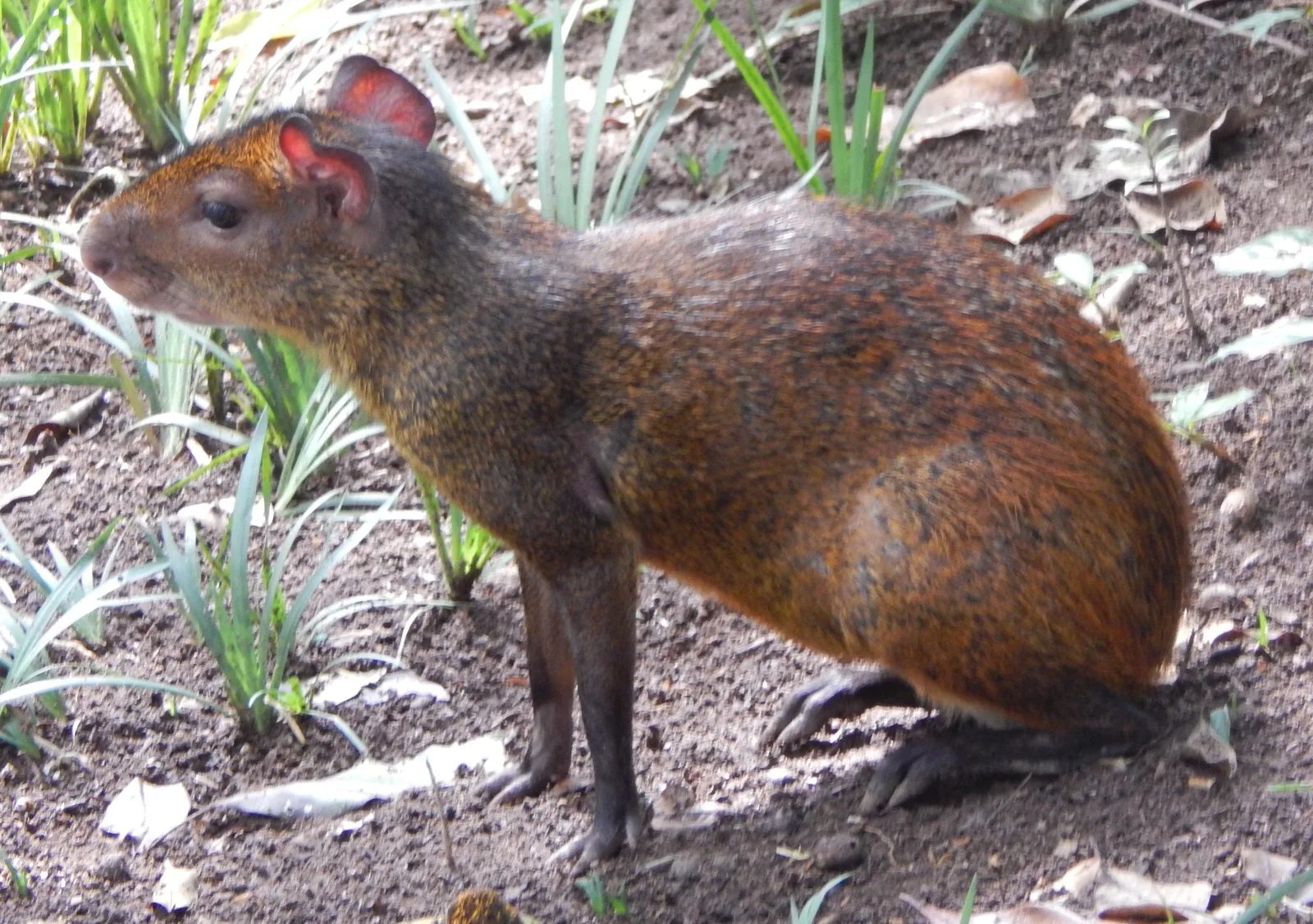
Red-rumped agouti
Dasyprocta leporina
Mammals — Rodents (Dasyproctidae)
The red-rumped agouti is one of the most important rodents in Brazil’s tropical forests. Active, alert, and territorial, it serves as both seed disperser and “planter,” directly shaping forest regeneration and structure.
Engineer of forest regeneration
A specialist in storing food, the red-rumped agouti practices scatter-hoarding, burying seeds that often go unrecovered. This behavior makes it one of the principal agents of large-tree regeneration in Neotropical forests.
📍 Biomes it inhabits
It occurs mainly in the Amazon, as well as in areas of the Cerrado—the Brazilian savanna—and the northern Atlantic Forest. In Brazil, it is associated with well-structured forests, upland forests, and areas with an abundance of large, hard-shelled fruits.
🌍 Conservation status (IUCN)
LC · Least ConcernAccording to the IUCN, the species is classified as LC (Least Concern). In some regions, populations face pressure from hunting and forest fragmentation.
🔬 Scientific classification
- Kingdom
- Animalia
- Phylum
- Chordata
- Class
- Mammalia
- Order
- Rodentia
- Family
- Dasyproctidae
- Genus
- Dasyprocta
- Species
- Dasyprocta leporina (Linnaeus, 1758)
⚙️ Specifications and metrics
- Body mass: 2–4 kg (4–9 lb).
- Body length: 45–60 cm (18–24 in).
- Dentition: Strong, sharp incisors adapted to opening hard seeds.
- Locomotion: Long hind limbs specialized for quick leaps.
- Behavior: Diurnal, with constant vigilance against predators.
- Generation length: ~4–5 years—a moderate rate of population recovery.
Diet: A frugivorous herbivore that feeds on fruits, large seeds (nuts), roots, and occasionally shoots.
📅 Life cycle
- Gestation: ~104–120 days; usually 1–2 young.
- Development: Young are born well developed and active.
- Parental care: Maternal care, with young rapidly becoming independent.
- Lifespan: 10–12 years in the wild.
🔗 Ecological ripple effect
The red-rumped agouti is one of the main dispersers of large seeds, including those of tree species that do not germinate unless buried. Its absence reduces forest regeneration and simplifies plant structure.
🤔 Why it matters
- Essential to the regeneration of large trees.
- A specialist in large, hard seeds.
- Active chiefly during the day.
- A keystone species in tropical forests.
🧪 Did you know?
- It buries hundreds of seeds over the course of a year.
- It is one of the few species capable of dispersing large nuts.
- The epithet leporina refers to its hare-like locomotion.
- Its decline directly affects forest composition.
Small discoveries
- Scatter-hoarding
- The behavior of burying seeds and fruits for later consumption.
- IUCN
- International Union for Conservation of Nature—the global authority on extinction-risk assessment.
- Quick leaps
- Rapid movement through short, explosive jumps.