.webp&w=1920&q=82)
.webp&w=1920&q=82)
.webp&w=1920&q=82)
.webp&w=1920&q=82)
.webp&w=1920&q=82)
.webp&w=1920&q=82)
.webp&w=1920&q=82)
.webp&w=1920&q=82)
.webp&w=1920&q=82)
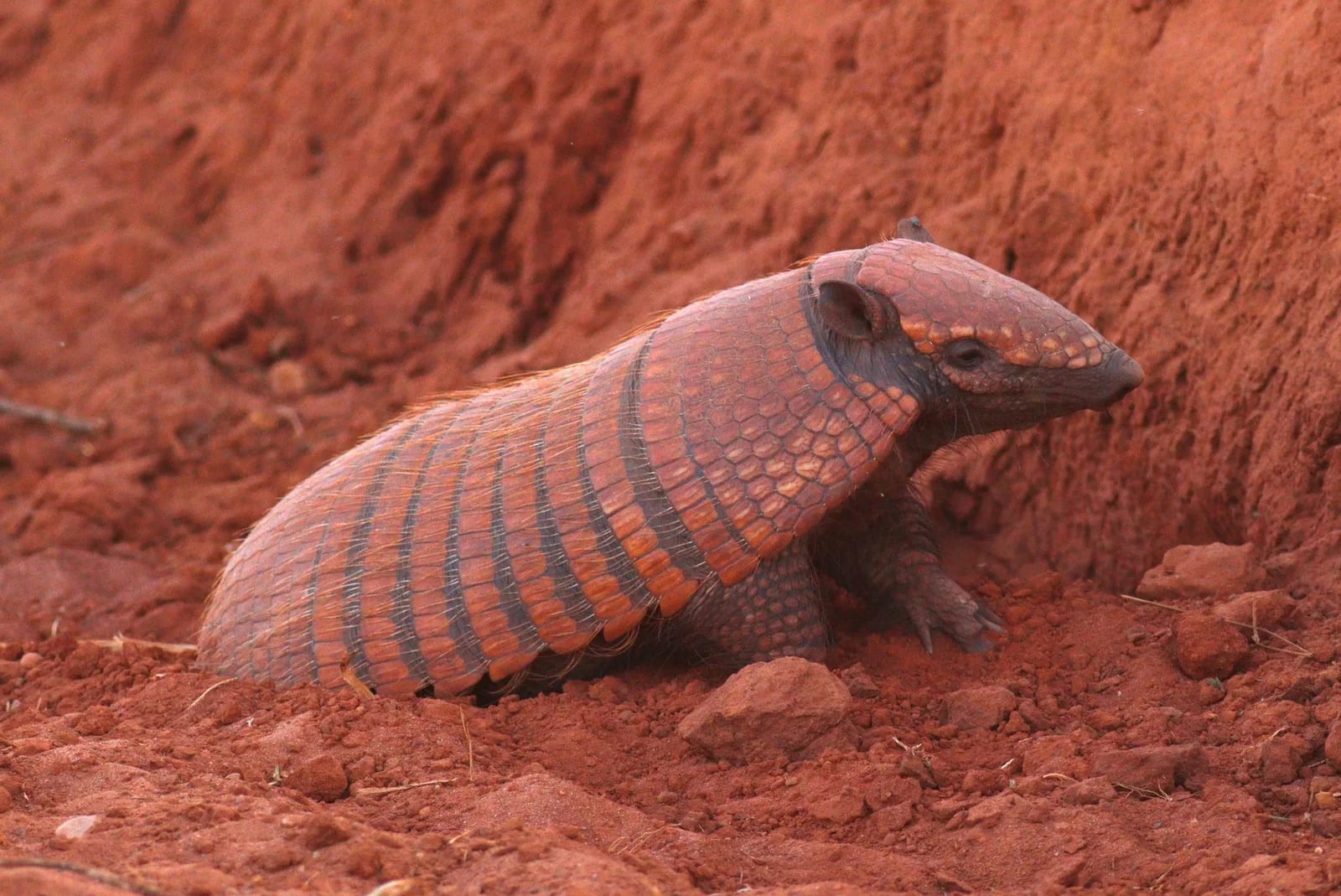
Six-banded armadillo
Euphractus sexcinctus
Mammals — Cingulata (Dasypodidae)
The six-banded armadillo is a highly adaptable mammal and one of the most generalist armadillos in South America. In Brazil, its presence is associated with open environments and transition zones, where it acts as an important soil engineer and recycler of organic matter.
A resilient generalist of open environments
Cathemeral in its activity, the six-banded armadillo has a broad diet and high tolerance for environmental disturbance. Its ecology reflects an ability to persist in both natural and human-altered landscapes, linking underground processes to the surface.
📍 Biomes it inhabits
It occurs in the Caatinga — Brazil's dry thorn-scrub biome —, the Cerrado — the Brazilian savanna —, the Pantanal, the Atlantic Forest (in open areas), the Pampa, and the edges of the Amazon. It favors open, dry, or seasonally flooded habitats, including grasslands, agricultural areas, and human-modified mosaics.
🌍 Conservation status (IUCN)
LC · Least ConcernAccording to the IUCN, the species is classified as LC (Least Concern). Even so, it faces local pressure from hunting, roadkill, and habitat loss.
🔬 Scientific classification
- Kingdom
- Animalia
- Phylum
- Chordata
- Class
- Mammalia
- Order
- Cingulata
- Family
- Dasypodidae
- Genus
- Euphractus
- Species
- Euphractus sexcinctus (Linnaeus, 1758)
⚙️ Specifications and metrics
- Body mass: 3–7 kg (6.6–15.4 lb).
- Body length: 40–50 cm (16–20 in) + a 20–25 cm (8–10 in) tail.
- Carapace: Articulated bony plates with six movable bands.
- Claws: Strong forelimbs adapted for digging and foraging.
- Sense of smell: Highly developed for locating food in the soil.
- Generation length: ~5–6 years.
Diet: Opportunistic omnivore — insects, larvae, small vertebrates, eggs, fruit, roots, and carrion.
📅 Life cycle
- Gestation: ~60–65 days.
- Litters: Usually 1–2 young.
- Parental care: Maternal.
- Lifespan: Up to 12–15 years in the wild.
🔗 Ecological ripple effect
The six-banded armadillo's excavations increase soil porosity, promote water infiltration, and create refuges used by a variety of species. Its scavenging habit contributes to nutrient recycling.
🤔 Why it matters
- One of Brazil's most generalist armadillos.
- Highly tolerant of human-altered environments.
- An important ecological engineer of the soil.
- A species often associated with conflicts involving human activities.
🧪 Did you know?
- The name Euphractus sexcinctus means "well armed with six belts."
- It may vocalize when captured or threatened.
- It is active by day and night, depending on temperature.
- Hunting is one of the main local pressures on the species.
Small discoveries
- Cathemeral
- A species active both by day and by night, according to environmental conditions.
- IUCN
- International Union for Conservation of Nature — the global authority on extinction-risk assessments.
- Six movable bands
- Typically six movable bands along the dorsal region.