.webp&w=1920&q=82)
.webp&w=1920&q=82)
.webp&w=1920&q=82)
.webp&w=1920&q=82)
Golden Parakeet
Guaruba guarouba
Birds — Psittaciformes (Psittacidae)
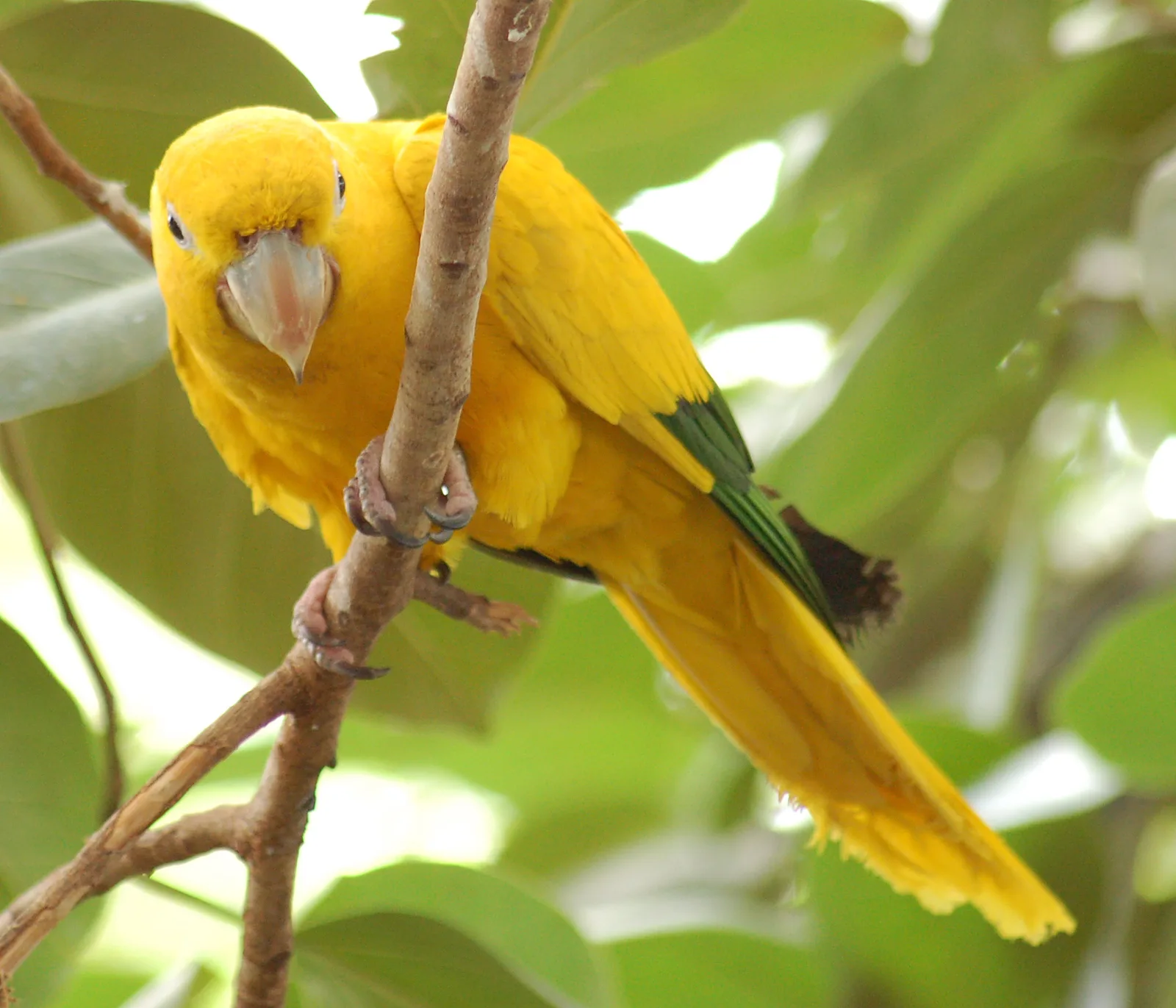
A yellow flash crosses the canopy of Brazil’s Amazon and announces its passage with sharp calls: the Golden Parakeet. Endemic to Brazil, it lives in flocks, seeks out cavities in tall trees, and makes its exuberant color one of the most striking emblems of the country’s birdlife.
The yellow jewel found naturally only in Brazil.
The Golden Parakeet, Guaruba guarouba, is a parrot with predominantly yellow plumage, edged in green on the wings, that occurs naturally only in Brazil. High in the trees, it moves and feeds in groups, exchanges contact calls, and retains its communal life even during the breeding season. Its presence joins two uncommon traits: an unmistakable appearance and a sociability that extends to the care of its young.
📍 Biomes it inhabits
Its biome is the Amazon. The Golden Parakeet is closely associated with the humid, nonflooded forests of Brazil’s Amazon, especially the canopy and lowland landscapes. Tall trees with cavities are an essential part of this setting: flocks can roost in them and, when the breeding season arrives, establish a nest. The species is endemic to Brazil, meaning that its natural range extends to no other country.
🌍 Conservation status (IUCN)
VU · VulnerableIn the IUCN Red List’s global assessment, the Golden Parakeet is classified as Vulnerable, with a declining population trend. Forest clearing and fragmentation reduce both food resources and the large trees that provide cavities; selective logging can remove precisely those sites used for shelter and nesting. Capture for the illegal trade has also been part of the pressure on the species. Protecting it, therefore, means conserving connected forest tracts, mature trees, and vigilance against wildlife trafficking.
🔬 Scientific classification
- Kingdom
- Animalia
- Phylum
- Chordata
- Class
- Aves
- Order
- Psittaciformes
- Family
- Psittacidae
- Genus
- Guaruba
- Species
- Guaruba guarouba (Gmelin, 1788)
⚙️ Specifications and metrics
- Length: about 34 cm (13 in)
- Body mass: about 240 g (8.5 oz)
- Plumage: In adults, bright yellow, with dark-green primaries, secondaries, and outer wing surfaces.
- Vocalization: A piercing, ringing call, heard as “greh” or “kray”; another published transcription is “gra, gra, gra.”
Diet: It feeds mainly on fruit and seeds in the canopy, including berries and nuts, but may also take buds and floral parts. In a study of reintroduced birds in the Amazon, most feeding observations occurred in the rainy season, when the plants most frequently used were bearing fruit; 23 plant species were recorded in that monitoring effort.
📅 Life cycle
- Reproduction: Breeding is recorded mainly from late November to early April. Even then, the species remains social, and other flock members have been recorded helping to care for the young.
- Nest: A deep cavity in a tall tree; the same cavity may also serve as a roost.
- Incubation: About 28–30 days. Field records cite clutches of two to three eggs and the participation of flock helpers in incubation and chick care.
- Lifespan: In human care, records document 20 years or more; longevity in the wild is poorly documented.
🔗 Ecological ripple effect
When a Golden Parakeet disappears from a landscape, the forest loses a consumer of fruit, seeds, buds, and flowers that travels through the canopy in a group. This alters a feeding relationship intrinsic to the forest and may locally change pressure on seeds and the movement of propagules between trees. It also loses a user of cavities in tall trees, a sign that the forest’s mature structure is being diminished. The loss is not only one of color: it is the loss of a living interaction among canopy, old trees, and flocks of parrots.
🤔 Why it matters
- It is endemic to Brazil and one of the most recognizable symbols of Amazonian birdlife.
- It depends on tall trees with cavities, underscoring the importance of retaining mature trees in the forest.
- Its varied diet connects it to fruit, seeds, buds, and flowers in the Amazonian canopy.
- Its sociability during breeding offers a valuable case for studying cooperative care in parrots.
- Its conservation brings together central Amazonian challenges: deforestation, logging, fragmentation, and wildlife trafficking.
🧪 Did you know?
- The name ararajuba has Indigenous origins and is interpreted as “yellow macaw.”
- The Golden Parakeet is endemic to Brazil: in the wild, it occurs only in the country.
- The same hollow in a tall tree can serve as both roost and nest.
- During breeding, other flock members may help incubate the eggs and care for the chicks.
- Over three years of monitoring reintroduced birds, researchers recorded the consumption of 23 plant species, 13 of which had not been cited in earlier studies of the species’ diet.
Small discoveries
- Canopy
- The layer formed by tree crowns in the upper part of the forest.
- Terra firme forest
- An Amazonian forest that is not seasonally flooded by large rivers.
- Cavity
- A natural or excavated hollow in a tree, used by birds as shelter or a nest.
- Endemic
- A species whose natural range is restricted to a geographic area.
- Propagule
- A unit capable of giving rise to a new plant, such as a seed or a fruit containing a seed.
📚 References
- Lista Vermelha da IUCN — busca taxonômica para Aves, incluindo Guaruba guarouba
- BirdLife International — Golden Parakeet Guaruba guarouba Species Factsheet
- Laranjeiras, T. O. (2020). Golden Parakeet (Guaruba guarouba), Birds of the World
- Vilarta et al. (2024). Feeding Ecology of Reintroduced Golden Parakeets (Guaruba guarouba, Psittacidae) in a Protected Area in the Amazon Forest
- WikiAves — ararajuba (Guaruba guarouba)
- United Parks & Resorts — Golden Conure Facts and Information
- GBIF — Guaruba guarouba