.webp&w=1920&q=82)
.webp&w=1920&q=82)
.webp&w=1920&q=82)
.webp&w=1920&q=82)
Harpy Eagle
Harpia harpyja
Birds — Accipitriformes (Accipitridae)
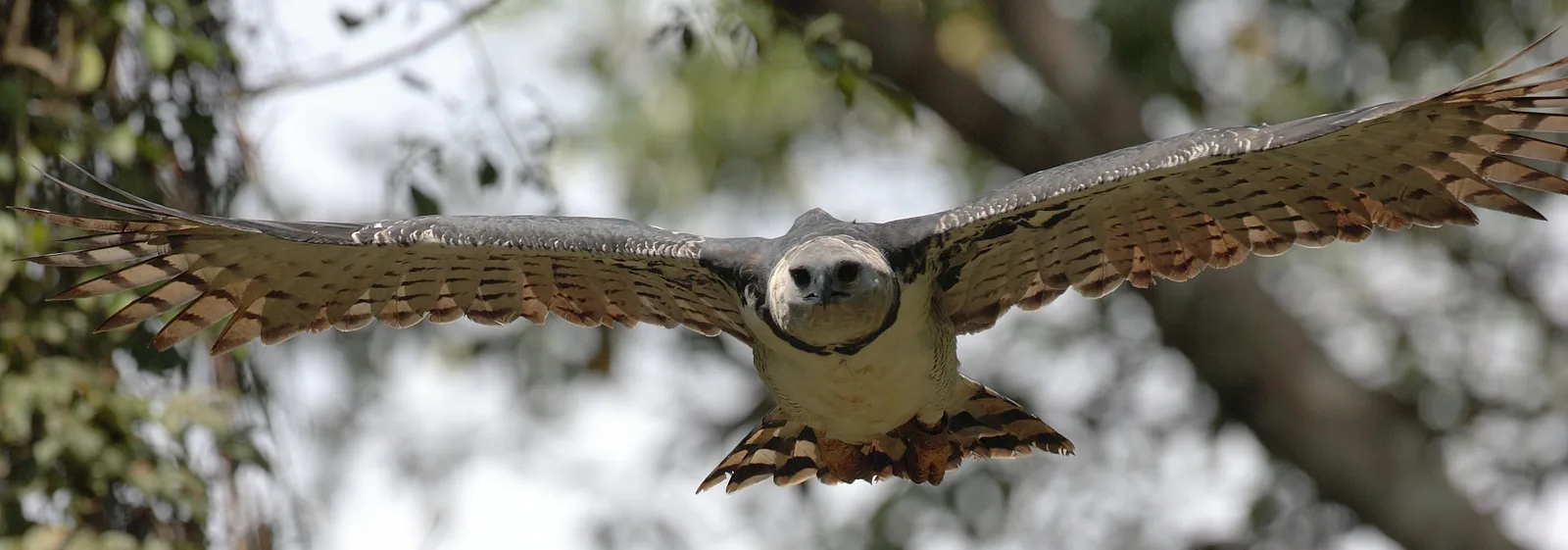
Almost always concealed among the leaves, the Harpy Eagle turns the forest canopy into its lookout and hunting ground. When it opens its wings or releases a whistle that carries for hundreds of meters, it reveals why the survival of a great forest may also depend on a rare bird.
The silent force of the Neotropical canopy.
The Harpy Eagle, also known in Brazil as gavião-real, is a large bird of prey of the forests of Central and South America. Its range stretches from southern Mexico to northern Argentina and includes Brazil, where it is concentrated chiefly in broad forest landscapes. Rather than soaring over open areas, it usually remains perched amid vegetation, and its anatomy has been shaped to capture prey in the forest’s upper strata.
📍 Biomes it inhabits
In Brazil, the Harpy Eagle occurs in the Amazon and protected remnants of the Atlantic Forest, with records also in the Cerrado—the Brazilian savanna—and the Pantanal—the world’s largest tropical wetland—. It favors lowland and highland forests, where emergent trees support nests and the canopy shelters arboreal mammals. Fragments may still be occupied where food remains, but the species depends on forest continuity to sustain territories and breeding.
🌍 Conservation status (IUCN)
VU · VulnerableThe most recent global assessment available on BirdLife International’s IUCN Red List page classifies the Harpy Eagle as Vulnerable. Forest loss and degradation, hunting, and direct persecution reduce populations, while its slow breeding rate makes each loss harder to replace. In Brazil, ICMBio’s 2018 Red Book of Brazilian Fauna Threatened with Extinction also listed it as Vulnerable.
🔬 Scientific classification
- Kingdom
- Animalia
- Phylum
- Chordata
- Class
- Aves
- Order
- Accipitriformes
- Family
- Accipitridae
- Genus
- Harpia
- Species
- Harpia harpyja (Linnaeus, 1758)
⚙️ Specifications and metrics
- Length: Up to about 1.05 m (3 ft 5 in).
- Body mass: Males: about 3.5–4.5 kg (7.7–9.9 lb); females: about 5.5–7 kg (12.1–15.4 lb).
- Plumage: In adults, the head and throat are pale gray, the crest has two longer feathers, the neck bears a black band, and the back is dark; juveniles are paler and take about 5–7 years to acquire adult plumage.
- Vocalization: It gives loud whistles; one can be heard at about 300 m (985 ft).
Diet: The Harpy Eagle feeds chiefly on arboreal mammals, especially sloths and primates, but also takes porcupines, coatis, anteaters, young deer and peccaries, as well as armadillos and birds, depending on the region. Concealed among the foliage, it uses its powerful bill and talons to seize this prey in the forest. In studied breeding territories along the Xingu River, the composition of its diet shifted in association with the seasonal flood pulse, indicating that its menu follows local availability.
📅 Life cycle
- Reproduction: Breeding is slow: a pair usually returns to use the breeding territory at intervals of about 2–3 years. The clutch consists of two white eggs, but only one chick is generally raised.
- Nest: A large platform of branches built in the fork of emergent trees, such as Brazil nut, kapok, rose jequitibá, and imbiruçu trees. The pair rebuilds and repairs the structure when reusing it.
- Incubation: About 56 days.
- Lifespan: The consulted sources provide no estimate of longevity in the wild that can be presented with confidence.
🔗 Ecological ripple effect
As an apex predator, the Harpy Eagle takes part in the relationships connecting arboreal mammals, vegetation, and other levels of the forest. Its disappearance does not yield a single, simple consequence, but the loss of large predators tends to disrupt trophic interactions, favoring imbalances between consumers and plants. Protecting the Harpy Eagle, then, also preserves the ecological complexity of the canopy it patrols.
🤔 Why it matters
- As an apex predator, it regulates part of the feeding relationships between arboreal mammals and the forest.
- Protecting its territories and nests requires large areas of native vegetation and benefits other species that depend on the same landscape.
- Nest monitoring shows how prey availability and seasonal changes affect a specialized forest raptor.
- Its presence helps make visible the need to conserve the canopy, a forest layer rarely observed from the ground.
🧪 Did you know?
- The Harpy Eagle is the only living species in the genus Harpia.
- Juveniles may take about 5–7 years to acquire adult plumage.
- A pair may reuse the same nest, repairing the branch platform with each new breeding cycle.
- One of its loud whistles can be heard at about 300 m (985 ft).
- Females are, on average, heavier than males.
Small discoveries
- Canopy
- The layer formed by tree crowns that covers the forest.
- Emergent tree
- A tree whose crown rises above the forest canopy.
- Apex predator
- An animal that occupies the highest levels of a food chain and has few or no natural predators as an adult.
📚 References
- BirdLife International DataZone — Harpy Eagle Harpia harpyja Species Factsheet
- ICMBio — Livro Vermelho da Fauna Brasileira Ameaçada de Extinção: Volume III — Aves
- Projeto Harpia — Gavião-real, Harpia harpyja
- Aguiar-Silva et al. — Resource availability and diet in Harpy Eagle breeding territories on the Xingu River, Brazilian Amazon
- Lerner et al. — It's not too Late for the Harpy Eagle: High Levels of Genetic Diversity and Differentiation Can Fuel Conservation Programs
- Schulenberg — Harpy Eagle, Birds of the World
- GBIF — Harpia harpyja