.webp&w=1920&q=82)
.webp&w=1920&q=82)
.webp&w=1920&q=82)
.webp&w=1920&q=82)
.webp&w=1920&q=82)
.webp&w=1920&q=82)
.webp&w=1920&q=82)
.webp&w=1920&q=82)
.webp&w=1920&q=82)
Amazon river dolphin
Inia geoffrensis
Mammals — Cetaceans (Iniidae)
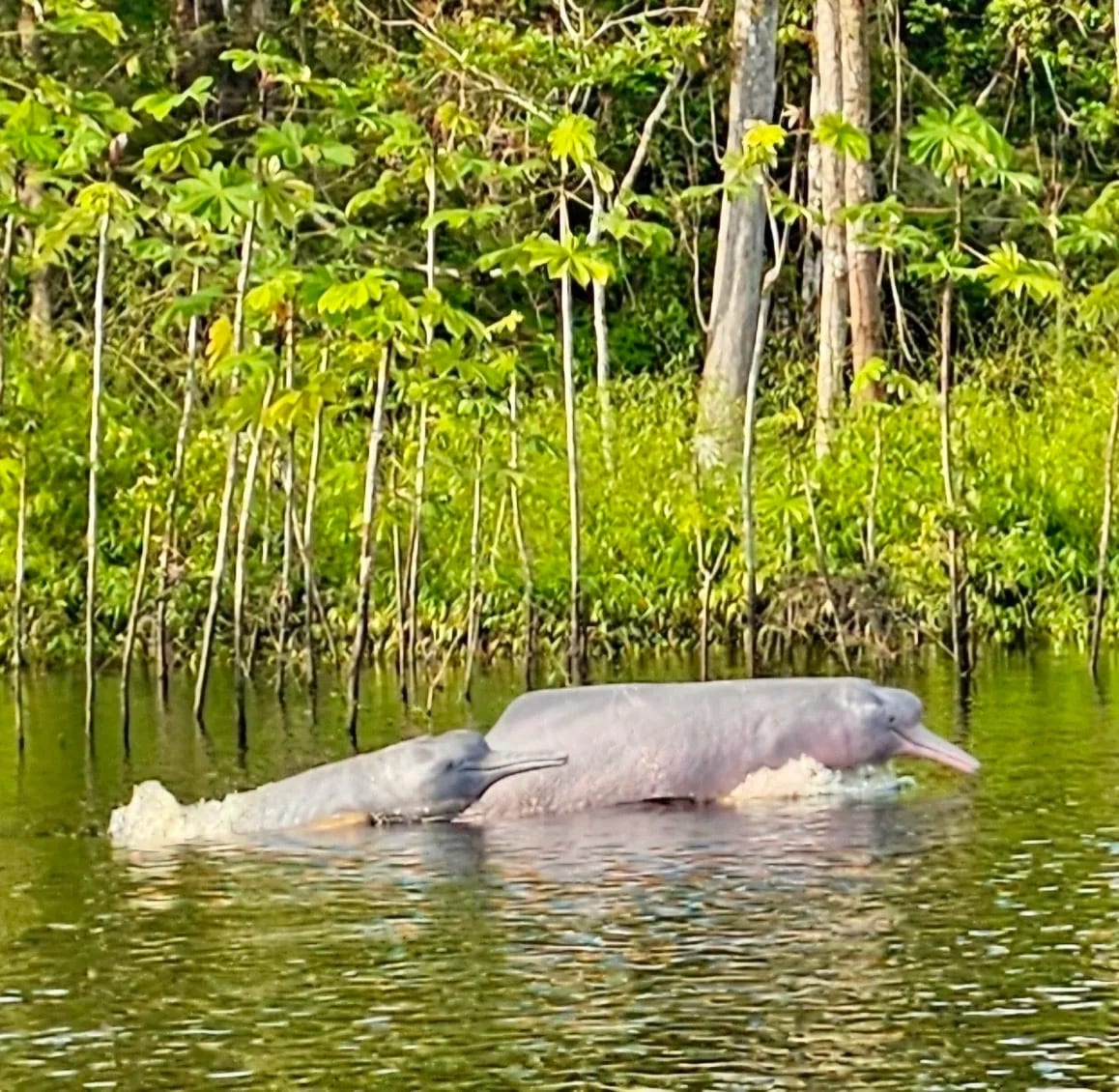
The Amazon river dolphin is the world's largest freshwater dolphin and one of the Amazon's most emblematic mammals. Adapted to rivers, lakes, and flooded forests, it embodies the deep connection among biodiversity, traditional culture, and the conservation of South American river systems.
Sentinel of Amazonian rivers
Adapted exclusively to freshwater environments, the Amazon river dolphin has remarkable bodily flexibility, allowing it to maneuver precisely among submerged trunks and flooded vegetation. Its life cycle is closely tied to the annual pulse of Amazonian floods.
📍 Biomes it inhabits
Native to the Amazon and Orinoco basins, this species occurs in Brazil, Peru, Colombia, Ecuador, Bolivia, and Venezuela. In Brazil, it is widely distributed across Amazonian rivers, várzea — seasonally flooded Amazonian forest — lakes, and flooded forest areas.
🌍 Conservation status (IUCN)
EN · EndangeredAccording to the IUCN, the species is classified as EN (Endangered). Threats include bycatch, targeted hunting, river degradation, dams, and mercury contamination.
🔬 Scientific classification
- Kingdom
- Animalia
- Phylum
- Chordata
- Class
- Mammalia
- Order
- Cetacea
- Family
- Iniidae
- Genus
- Inia
- Species
- Inia geoffrensis (Blainville, 1817)
⚙️ Specifications and metrics
- Body mass: 85–185 kg (187–408 lb; males are larger).
- Body length: 2.0–2.6 m (6.6–8.5 ft).
- Neck: highly flexible.
- Dentition: heterodont dentition, adapted to catching a wide variety of fish.
- Coloring: gray to pink, becoming more intense with age, sex, and physical activity.
- Generation length: ~15–20 years — slow population recovery.
Diet: Carnivorous — fish, crustaceans, and small aquatic organisms, with a broad trophic range.
📅 Life cycle
- Gestation: ~11–13 months.
- Litters: usually 1 calf.
- Parental care: maternal care only.
- Lifespan: up to 35–40 years.
🔗 Ecological ripple effect
The Amazon river dolphin serves as an apex predator in river ecosystems, regulating fish populations and maintaining ecological balance. Its presence indicates functional, connected rivers; its decline signals environmental collapse on a broad scale.
🤔 Why it matters
- Able to swim among trees during floods.
- Moves with precision through complex environments.
- Highly diverse diet.
- Closely tied to the hydrological cycle.
🧪 Did you know?
- A central figure in traditional Amazonian legends.
- Males tend to be pinker than females.
- It has no typical dorsal fin, only a ridge.
- Its conservation depends on the full protection of Amazonian rivers.
Small discoveries
- IUCN
- International Union for Conservation of Nature — the global authority on assessing extinction risk.
- Highly flexible
- Unfused cervical vertebrae allow extensive head mobility.