.webp&w=1920&q=82)
.webp&w=1920&q=82)
.webp&w=1920&q=82)
.webp&w=1920&q=82)
Buff-throated Purpletuft
Iodopleura pipra
Birds — Passeriformes (Cotingidae)
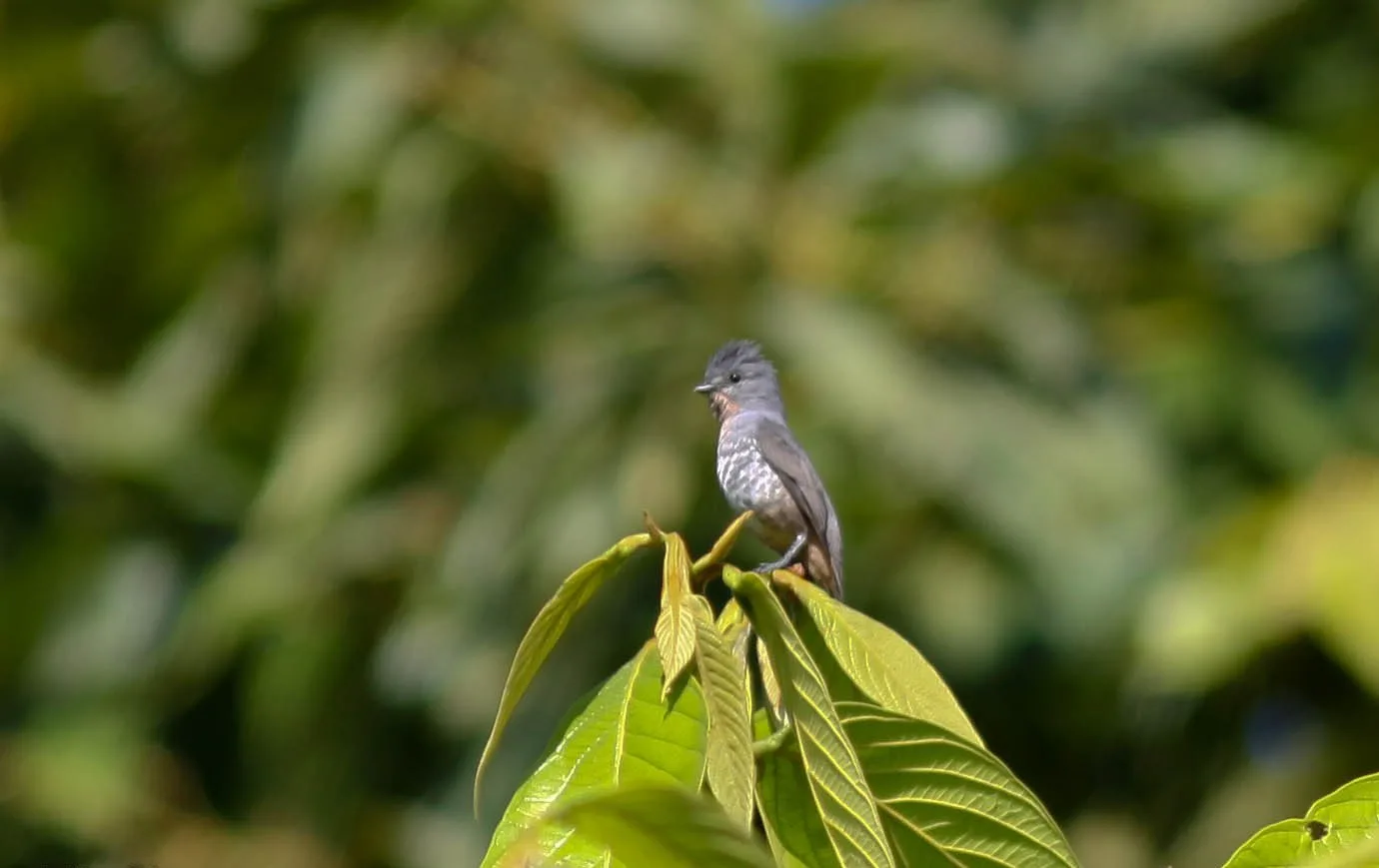
High in the Atlantic Forest, the Buff-throated Purpletuft may seem no more than a motionless gray speck on a slender branch. Then a sharp whistle—suíí-si—betrays its presence, and the male reveals beneath its wing a violet flash that is almost never seen from below.
A discreet jewel of the canopy, found only in Brazil’s forests.
The Buff-throated Purpletuft, Iodopleura pipra, is a tiny bird endemic to Brazil: it occurs naturally only in the country. It lives in the canopy, where it sits quietly on exposed branches and blends into the forest backdrop; its delicate voice is therefore often the best clue to finding it. The cinnamon-colored throat and, in males, the concealed violet tuft beside the breast distinguish the species.
📍 Biomes it inhabits
The species belongs to the Atlantic Forest, with records from separate populations in northeastern Brazil and the country’s eastern-southeastern region. It favors humid forests, especially coastal areas, foothills, and lowlands, and uses the vegetation’s uppermost stratum. It may appear in wooded restinga—coastal sandbank vegetation—, clearings, and forest edges, but its life unfolds chiefly in the canopy, where slender branches offer both singing perches and access to fruit and insects.
🌍 Conservation status (IUCN)
EN · EndangeredGlobally, the Buff-throated Purpletuft is listed as Endangered on the IUCN Red List. Its population is small and distributed across separate areas of Atlantic Forest; forest loss and fragmentation reduce the continuity of the habitat on which it depends. Protecting forest remnants, their canopies, and the connections among fragments is decisive if this Brazilian endemic is to continue calling above the forest.
🔬 Scientific classification
- Kingdom
- Animalia
- Phylum
- Chordata
- Class
- Aves
- Order
- Passeriformes
- Family
- Cotingidae
- Genus
- Iodopleura
- Species
- Iodopleura pipra (Lesson, 1831)
⚙️ Specifications and metrics
- Length: Between 8.7 and 10.5 cm (3.4–4.1 in).
- Body mass: About 10 g (0.35 oz).
- Plumage: Dark-gray upperparts, a cinnamon throat, and pale underparts barred with gray. The male bears a tuft of long violet feathers, concealed beneath the wings, that it can raise; females lack this tuft.
- Vocalization: It gives a faint, high, two-syllable whistle transcribed as suíí-si. Males use it when defending territory and may also give rapid sequences of descending notes.
Diet: It eats small fruits from Atlantic Forest trees and shrubs, including plants in the families Lauraceae, Euphorbiaceae, Loranthaceae, Rubiaceae, Urticaceae, Solanaceae, and Myrsinaceae. It also catches insects and larvae among branches or during brief aerial sallies. Available observations show foraging in the canopy and along edges; no published description has yet quantified seasonal variation in its diet.
📅 Life cycle
- Reproduction: In southeastern Brazil, breeding activity has been recorded from autumn through spring, with nests observed in winter. The male sings and defends the territory; the female takes part in construction. Known clutches contain one egg.
- Nest: A small, shallow cup set high in a tree, on a branch or fork. Its construction uses lichens, bryophytes, plant fibers, and fungal filaments; spider webs help hold the structure together. The lichens camouflage the nest among the branches.
- Incubation: The incubation period was not found in a specific consulted source.
- Lifespan: The consulted sources contain no published estimate of species-specific longevity.
🔗 Ecological ripple effect
Because it consumes small fruits as well as invertebrates, the Buff-throated Purpletuft takes part in the canopy’s feeding relationships. Its absence may reduce one pathway for the dispersal of seeds from plants fruiting in the canopy and alter interactions between insect-eating birds and their prey. This effect has not been quantified specifically for the species, but the loss of such a restricted fruit-and-insect-eating bird impoverishes the ecological network of already fragmented Atlantic Forest remnants.
🤔 Why it matters
- It is endemic to Brazil and represents an irreplaceable part of Atlantic Forest biodiversity.
- By eating small fruits, it may contribute to the movement of seeds between trees and forest edges.
- It also captures insects and larvae, linking plant and animal resources in the canopy food web.
- Its nest, camouflaged with lichens and bryophytes, is among the most singular discoveries in the natural history of the genus Iodopleura.
- Because it is rare and threatened, its presence gives visibility to the urgent need to conserve continuous Atlantic Forest.
🧪 Did you know?
- The male’s violet tuft lies concealed beneath the wings and can be raised when the bird is excited; females lack this ornament.
- Its best-known song is a very fine, high, short whistle transcribed as suíí-si.
- A 2024 study confirmed that, among Iodopleura species, only the Buff-throated Purpletuft has confirmed use of lichens and bryophytes in its nest so far.
- Although it measures less than 11 cm (4.3 in), it builds its nest high in the forest, often tens of meters above the ground (tens of yards).
- The species occurs naturally only in Brazil, in now-separated portions of the Atlantic Forest.
Small discoveries
- Canopy
- The upper layer formed by the crowns of trees in a forest.
- Bryophytes
- A group of plants without conducting vessels, such as mosses, that grow in humid places.
- Frugivorous-insectivorous
- Feeding on both fruits and insects and other small invertebrates.
📚 References
- IUCN Red List of Threatened Species — Iodopleura pipra
- BirdLife International DataZone — Buff-throated Purpletuft Iodopleura pipra
- Crozariol et al. (2024) — The nest of Buff-throated Purpletuft Iodopleura pipra leucopygia
- Birds of the World — Buff-throated Purpletuft Iodopleura pipra
- WikiAves — anambezinho Iodopleura pipra
- eBird — anambezinho Iodopleura pipra
- GBIF — Iodopleura pipra