.webp&w=1920&q=82)
.webp&w=1920&q=82)
.webp&w=1920&q=82)
.webp&w=1920&q=82)
.webp&w=1920&q=82)
.webp&w=1920&q=82)
.webp&w=1920&q=82)
.webp&w=1920&q=82)
.webp&w=1920&q=82)
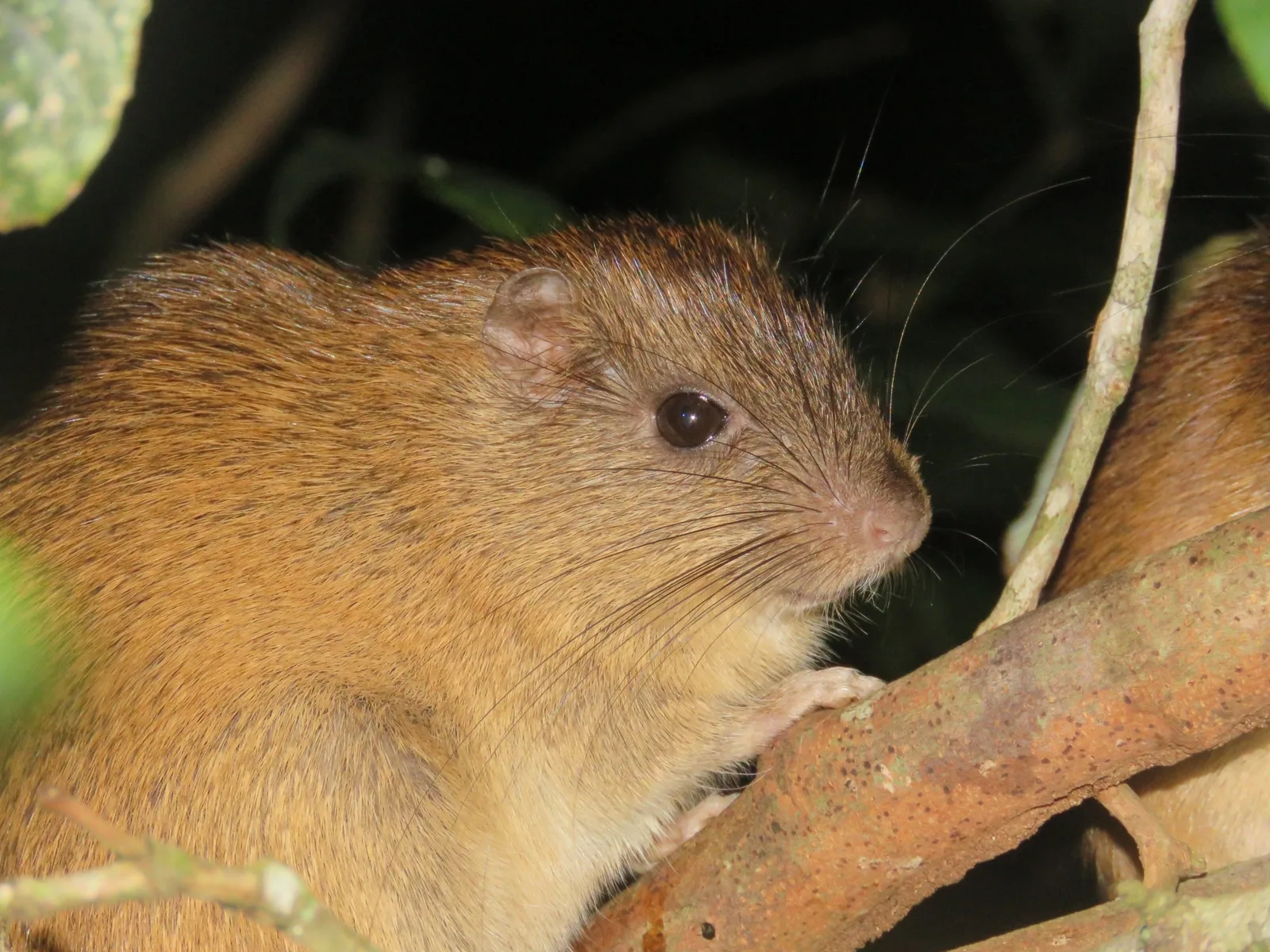
Atlantic bamboo rat
Kannabateomys amblyonyx
Mammals — Rodents (Echimyidae • Dactylomyinae)
The Atlantic bamboo rat is a highly specialized rodent of the Atlantic Forest, closely associated with stands of taquara — a native Brazilian bamboo — and other native bamboos. Nocturnal, elusive, and strictly arboreal, it is a classic example of extreme ecological specialization among Brazilian mammals.
A bamboo-stand specialist of the Atlantic Forest
Strictly associated with bamboo stands, the Atlantic bamboo rat depends on the physical structure and growth cycle of these plants. Its presence signals well-conserved forest environments with vertical continuity and access to specific resources.
📍 Biomes it inhabits
A species endemic to the Atlantic Forest. In Brazil, it occurs in dense and mixed humid forests, especially in areas rich in taquara and native bamboo, from the country's Southeast to its South.
🌍 Conservation status (IUCN)
LC · Least ConcernAccording to the IUCN, the species is classified as LC (Least Concern). The loss and fragmentation of the Atlantic Forest, along with the decline of native bamboo stands, are its main threats.
🔬 Scientific classification
- Kingdom
- Animalia
- Phylum
- Chordata
- Class
- Mammalia
- Order
- Rodentia
- Family
- Echimyidae
- Genus
- Kannabateomys
- Species
- Kannabateomys amblyonyx (Wagner, 1845)
⚙️ Specifications and metrics
- Body mass: 300–450 g (11–16 oz).
- Body length: 25–30 cm (10–12 in) + a long 30–40 cm (12–16 in) tail.
- Tail: Long and semiprehensile, essential for arboreal locomotion.
- Dentition: Robust incisors adapted for cutting bamboo culms.
- Locomotion: Elongated, gripping digits specialized for climbing vertical stems.
- Generation length: ~3–4 years — slow population dynamics for a rodent.
Diet: Specialist herbivore — shoots, leaves, and inner tissues of bamboo and taquara.
📅 Life cycle
- Gestation: ~40–45 days.
- Litters: Usually 1–2 young.
- Behavior: Solitary and strictly nocturnal.
- Lifespan: Poorly documented; estimated at up to 8–10 years.
🔗 Ecological ripple effect
The Atlantic bamboo rat influences the growth dynamics of bamboo stands and forms part of specialized food webs, serving as prey for owls, snakes, and small arboreal carnivores. Its conservation is directly tied to preserving specific microhabitats.
🤔 Why it matters
- Depends almost exclusively on native bamboo stands.
- Rarely descends to the ground.
- Highly sensitive to forest fragmentation.
- Naturally restricted distribution.
🧪 Did you know?
- The genus name Kannabateomys means "cane/bamboo-eating rat."
- Its broad digits help it clasp vertical culms.
- Synchronous bamboo flowering can affect its food availability.
- It is considered one of Brazil's most specialized rodents.
Small discoveries
- Bamboo stands
- Plant formations dominated by native bamboo and taquara species.
- IUCN
- International Union for Conservation of Nature — the global authority on extinction-risk assessments.
- Semiprehensile
- A tail adapted for balance and movement across vertical structures.