.webp&w=1920&q=82)
.webp&w=1920&q=82)
.webp&w=1920&q=82)
.webp&w=1920&q=82)
.webp&w=1920&q=82)
.webp&w=1920&q=82)
.webp&w=1920&q=82)
.webp&w=1920&q=82)
.webp&w=1920&q=82)
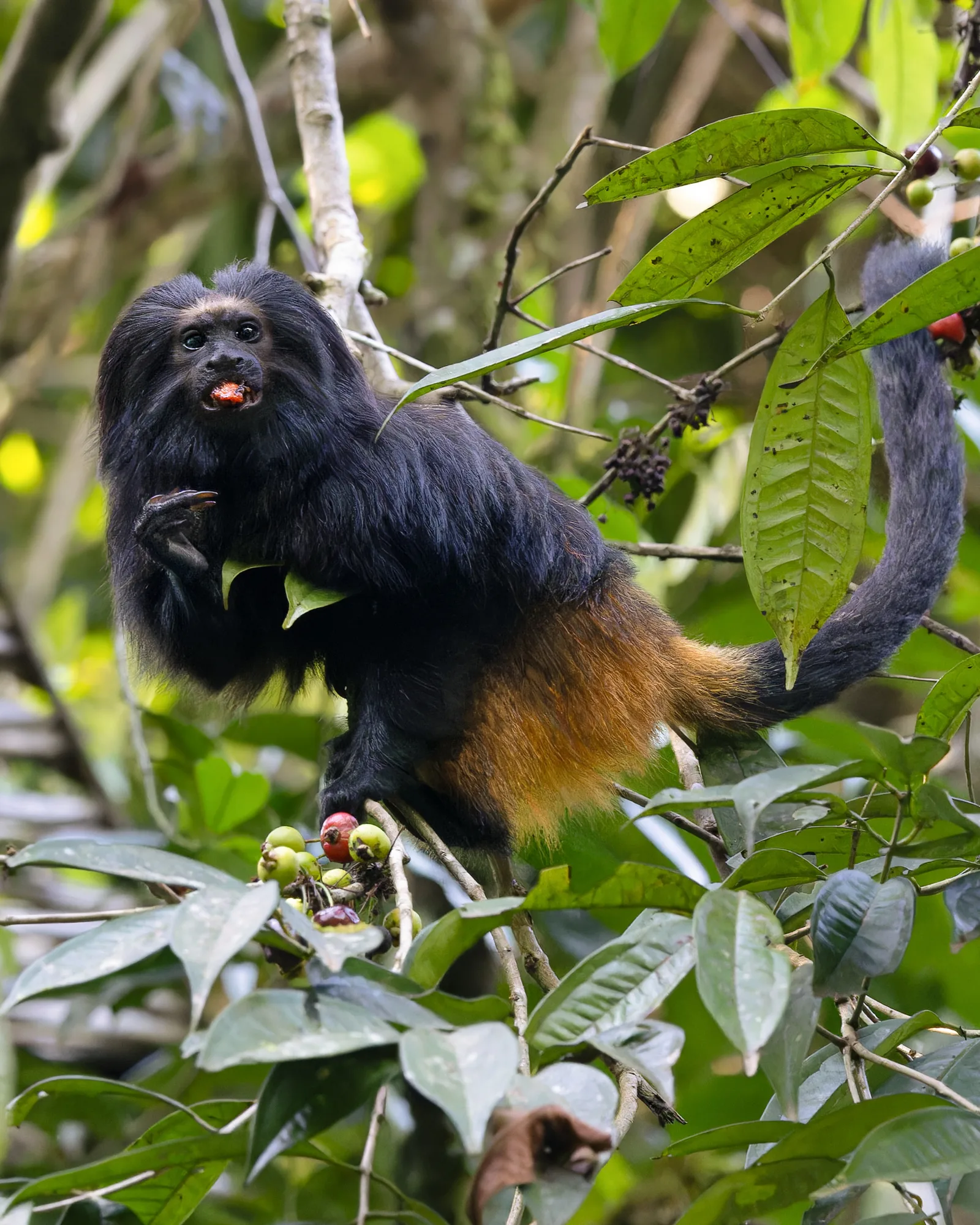
Black lion tamarin
Leontopithecus chrysopygus
Mammals — Primates (Callitrichidae)
The black lion tamarin is one of Brazil’s rarest and most emblematic primates, as well as a symbol of conservation in the Atlantic Forest of São Paulo State’s interior. Endemic and highly dependent on well-structured forests, it embodies one of the country’s most delicate — and important — primate-conservation stories.
Endemic to the inland Atlantic Forest
A diurnal species with cooperative social organization, the black lion tamarin lives in small family groups. Its survival depends directly on forest connectivity, making it extremely sensitive to fragmentation.
📍 Biomes it inhabits
An Atlantic Forest endemic, it is restricted to western São Paulo State. It inhabits seasonal semideciduous forests, especially well-preserved remnants and areas connected by forest corridors.
🌍 Conservation status (IUCN)
EN · EndangeredAccording to the IUCN, the species is classified as EN (Endangered). Habitat loss, population isolation, and small effective population size are its main risk factors.
🔬 Scientific classification
- Kingdom
- Animalia
- Phylum
- Chordata
- Class
- Mammalia
- Order
- Primates
- Family
- Callitrichidae
- Genus
- Leontopithecus
- Species
- Leontopithecus chrysopygus (Mikan, 1823)
⚙️ Specifications and metrics
- Body mass: 500–700 g (18–25 oz).
- Body length: 25–30 cm (10–12 in), plus a long tail measuring 35–40 cm (14–16 in).
- Claws: Tegulae, adapted for moving across trunks and branches.
- Fur: Predominantly black, with a golden mane confined to the head.
- Behavior: Highly vigilant and territorial.
- Generation length: ~6–7 years — sensitive to population bottlenecks.
Diet: Omnivorous — fruit, insects, small vertebrates, and plant exudates.
📅 Life cycle
- Gestation: ~125–130 days.
- Litters: Usually 1–2 young.
- Parental care: Cooperative, involving the entire group.
- Lifespan: Up to 15 years in the wild; longer under managed care.
🔗 Ecological ripple effect
The black lion tamarin disperses seeds and controls insects, contributing to forest regeneration. Conserving it requires connected landscapes that simultaneously benefit dozens of other species.
🤔 Why it matters
- Extremely restricted distribution.
- Strong dependence on forest corridors.
- Small, isolated populations.
- An icon of conservation in São Paulo State.
🧪 Did you know?
- It was considered extinct for decades before being rediscovered.
- Conservation projects include genetic management and translocations.
- The epithet chrysopygus means “golden buttocks.”
- It is one of Brazil’s four endemic lion tamarins.
Small discoveries
- Diurnal
- Activity that occurs mainly during the day.
- IUCN
- International Union for Conservation of Nature — the global authority for assessing extinction risk.
- Tegulae
- Elongated, curved nails characteristic of callitrichids, used in foraging.