.webp&w=1920&q=82)
.webp&w=1920&q=82)
.webp&w=1920&q=82)
.webp&w=1920&q=82)
.webp&w=1920&q=82)
.webp&w=1920&q=82)
.webp&w=1920&q=82)
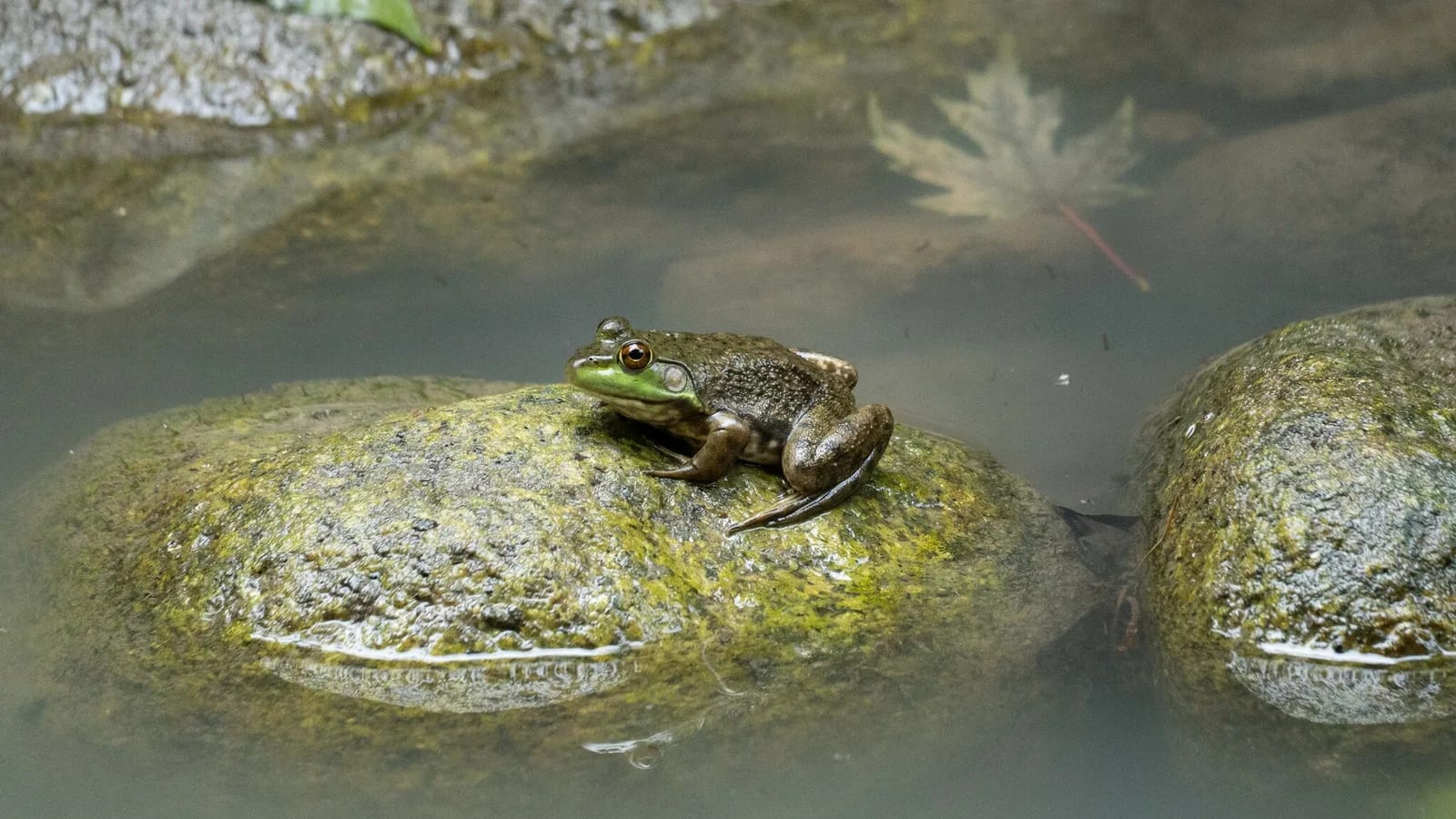
American bullfrog
Lithobates catesbeianus
Amphibians — Anurans (Ranidae)
The American bullfrog is one of the world's largest anurans and a classic example of a high-impact invasive species. Although native to North America, its introduction to other continents—including Brazil—has had profound effects on local aquatic ecosystems.
Aquatic giant and global invader
An invasive species, the American bullfrog combines rapid growth, high fecundity, and a generalist feeding strategy. These traits, together with a lack of effective natural predators, favor its spread and the displacement of native amphibians.
📍 Biomes it inhabits
Native to eastern North America, the species has been introduced to several countries in South America, Europe, and Asia. In Brazil, it occurs as an invasive non-native species, especially around aquaculture facilities, reservoirs, and artificial water bodies.
🌍 Conservation status (IUCN)
LC · Least ConcernAccording to the IUCN, the species is classified as LC (Least Concern) within its native range. This status does not apply to the ecological impacts it causes in regions where it has been introduced.
🔬 Scientific classification
- Kingdom
- Animalia
- Phylum
- Chordata
- Class
- Amphibia
- Order
- Anura
- Family
- Ranidae
- Genus
- Lithobates
- Species
- Lithobates catesbeianus (Shaw, 1802)
⚙️ Specifications and metrics
- Body mass: Up to ~750 g (26 oz; exceptionally larger).
- Body length: Up to 20 cm (8 in).
- Vocalization: Deep, powerful call audible over long distances.
- Locomotion: Long hind limbs adapted for swimming and jumping.
- Habitat: Highly aquatic; rarely strays from water.
- Generation length: ~2–3 years.
Diet: Highly generalist carnivore — insects, other amphibians, fish, reptiles, waterbirds, and small mammals, depending on local availability.
📅 Life cycle
- Reproduction: Oviparous.
- Egg-laying: Thousands of eggs per breeding event.
- Development: Large tadpoles with a prolonged larval stage.
- Lifespan: Up to ~8–10 years in the wild.
🔗 Ecological ripple effect
As an invasive species, the American bullfrog directly preys on native amphibians, competes for resources, and may serve as a pathogen reservoir, contributing to local population declines. Its management is a priority in Brazilian herpetofauna conservation programs.
🤔 Why it matters
- One of the world's most studied invasive species.
- Capable of profoundly altering aquatic communities.
- Associated with the spread of disease among amphibians.
- Difficult to eradicate once established.
🧪 Did you know?
- It was introduced to Brazil for commercial meat farming.
- Its call resembles a bull's bellow, giving rise to its common name.
- Tadpoles can take more than a year to complete metamorphosis.
- Control programs focus on preventing further introductions.
Small discoveries
- Biological invasion
- An organism introduced beyond its native range that causes significant ecological impacts.
- Invasive non-native species
- Established populations outside the species' natural range.
- IUCN
- International Union for Conservation of Nature — the global authority on extinction-risk assessment.
- Oviparous
- Eggs laid directly in water, with aquatic larval development.
- Pathogen reservoir
- An organism that carries pathogens without experiencing the disease's most severe effects.