.webp&w=1920&q=82)
.webp&w=1920&q=82)
.webp&w=1920&q=82)
.webp&w=1920&q=82)
Alagoas curassow
Mitu mitu
Birds — Galliformes (Cracidae)
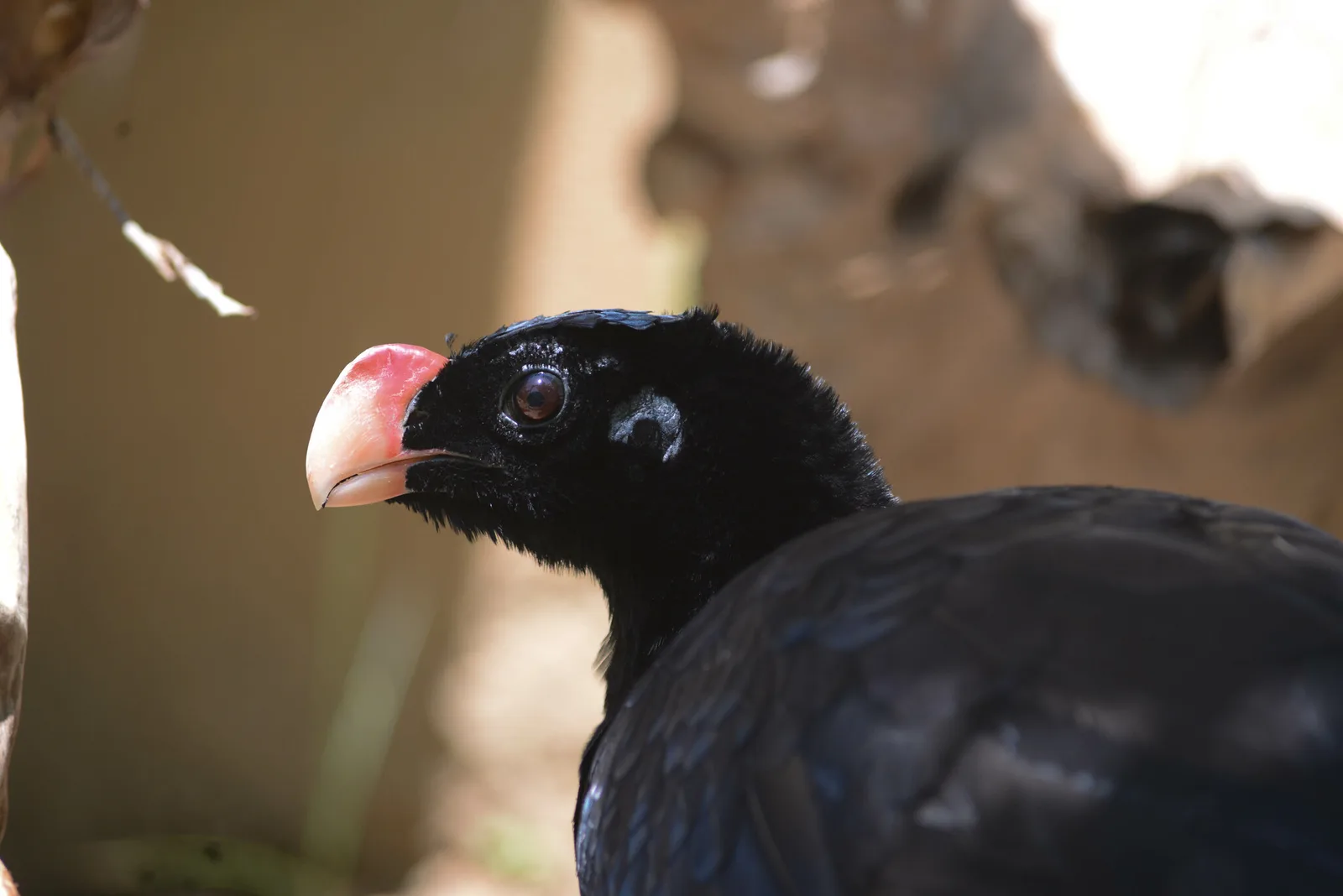
The Alagoas curassow is an absence that still breathes: it no longer survives as a wild population, yet endures through a lineage under human care and attempts to return it to the Atlantic Forest. Endemic to Brazil, it bears the signature of a species nearly lost before it was fully understood: a two-toned bill, a bare patch beside the ear, and buff-tipped tail feathers.
The great black bird of Alagoas’ Atlantic Forest, whose return depends on forest, protection, and genetic memory.
The Alagoas curassow is a large cracid native to northeastern forests and found naturally only in Brazil. For decades it was mistaken for an Amazonian species; morphological and genetic studies confirmed its distinct identity. Today’s population descends from just one male and two females that bred in captivity—an extreme genetic narrowing that has made every pairing part of a conservation strategy.
📍 Biomes it inhabits
Its biome is the Atlantic Forest. Confirmed records are concentrated in Alagoas, in low-elevation coastal forests; the species is associated with lowland remnants, and there is no evidence that it originally occurred in the highlands. Sugarcane plantations have extensively replaced this landscape, fragmenting the forest the curassow needs in order to live beyond captive breeding facilities again.
🌍 Conservation status (IUCN)
EW · Extinct in the WildThe IUCN Red List classifies the Alagoas curassow as Extinct in the Wild. Forest devastation and hunting caused the loss of its free-ranging population, while the small number of founders left a genetic bottleneck that demands careful management. The conservation program maintains birds in captivity, separates individuals with differing degrees of hybridization, and supports experimental reintroductions in protected remnants of Alagoas; without protection from hunting and without continuous forest, a release alone is not enough.
🔬 Scientific classification
- Kingdom
- Animalia
- Phylum
- Chordata
- Class
- Aves
- Order
- Galliformes
- Family
- Cracidae
- Genus
- Mitu
- Species
- Mitu mitu (Linnaeus, 1766)
⚙️ Specifications and metrics
- Length: About 90 cm (35 in).
- Body mass: About 3 kg (6.6 lb).
- Plumage: Predominantly black, with a purplish-blue gloss. The bill is two-toned, dark red at the base and pale or pinkish at the tip; a small bare patch surrounds the ear, and the outer tail feathers end in buff.
- Vocalization: Poorly documented. Field searches used recordings, but the consulted sources do not provide a verifiable acoustic description or onomatopoeia for the species.
Diet: Its diet in the wild is poorly known. In late 1978, three birds were recorded feeding on the fruit of a tree in the myrtle family in Roteiro. The consulted sources offer no sound basis for detailing other food items or seasonal variation.
📅 Life cycle
- Reproduction: Natural breeding is poorly documented. In captivity, females may reach breeding age at around 3 years, and a clutch of two eggs has been recorded between September and November.
- Nest: An active nest was observed in Roteiro in 1978, but the consulted sources do not reliably describe its height, support, or architecture in the wild.
- Incubation: The length of natural incubation is not well established. Under captive management, artificially incubated eggs hatched after an average of 28–30 days.
- Lifespan: Up to 30 years in captivity; no comparably well-documented estimate exists for birds in the wild.
🔗 Ecological ripple effect
Its ecological role must be approached honestly: it remains poorly measured because the species disappeared from the wild so early. The curassow is known to have eaten the fruit of at least one myrtle relative; its absence therefore erases interactions between a large bird and forest plants that were never fully studied. The clearest damage is also historical: Alagoas’ Atlantic Forest lost a singular lineage and a large-bodied component of its fauna before its role in the ecosystem could be fully understood.
🤔 Why it matters
- It is endemic to Brazil and confined to the northeastern Atlantic Forest.
- It became a symbol of ex situ conservation: the captive population was rebuilt from only three breeding founders.
- Its recovery requires conservation genetics, because historical hybridization with the razor-billed curassow cannot be identified by appearance alone in every bird.
- Features of the bill, ear region, and tail helped confirm that it is a distinct species, rather than a displaced Amazonian population.
- Its story concentrates the loss of lowland forests and hunting pressure in the Pernambuco Endemism Center.
🧪 Did you know?
- The species had already appeared in a 17th-century illustration connected to natural-history accounts from Dutch Brazil.
- A two-toned bill, a small bare area beside the ear, and buff tips on the outer tail feathers are features used to identify the Alagoas curassow.
- The active nest recorded in Roteiro in 1978 was found at the same site where three birds were feeding on the fruit of a myrtle relative.
- The population that saved the species from total extinction descends from one male and two females that managed to breed in captivity.
- In 2019, six captive-bred birds were released in a private Atlantic Forest reserve in Rio Largo, Alagoas, as part of a monitored reintroduction process.
Small discoveries
- Endemic
- A species that occurs naturally only within a defined geographic area.
- Extinct in the Wild
- A category for a species with no known wild population, surviving only in captivity, cultivation, or outside its original range.
- Genetic bottleneck
- An extreme reduction in the number of ancestors that lowers a population’s genetic diversity.
- Rectrices
- Tail feathers used in flight, steering, and visual signals.
- Reintroduction
- The planned return of individuals to an area from which the species has disappeared, with monitoring and protection.
📚 References
- Lista Vermelha da IUCN - Mitu mitu
- ICMBio - Plano de Acao Nacional para a Conservacao do Mutum-de-alagoas
- Silveira, Olmos e Long, 2004 - Taxonomy, history, and status of Alagoas Curassow Mitu mitu
- Costa et al., 2017 - Recovering the Genetic Identity of an Extinct-in-the-Wild Species
- Pesquisa FAPESP - A gaiola que salva
- Pesquisa FAPESP - De volta para a Mata Atlantica
- GBIF — Mitu mitu