.webp&w=1920&q=82)
.webp&w=1920&q=82)
.webp&w=1920&q=82)
.webp&w=1920&q=82)
.webp&w=1920&q=82)
.webp&w=1920&q=82)
.webp&w=1920&q=82)
Blue morpho
Morpho menelaus
Insects — Lepidoptera (Nymphalidae)
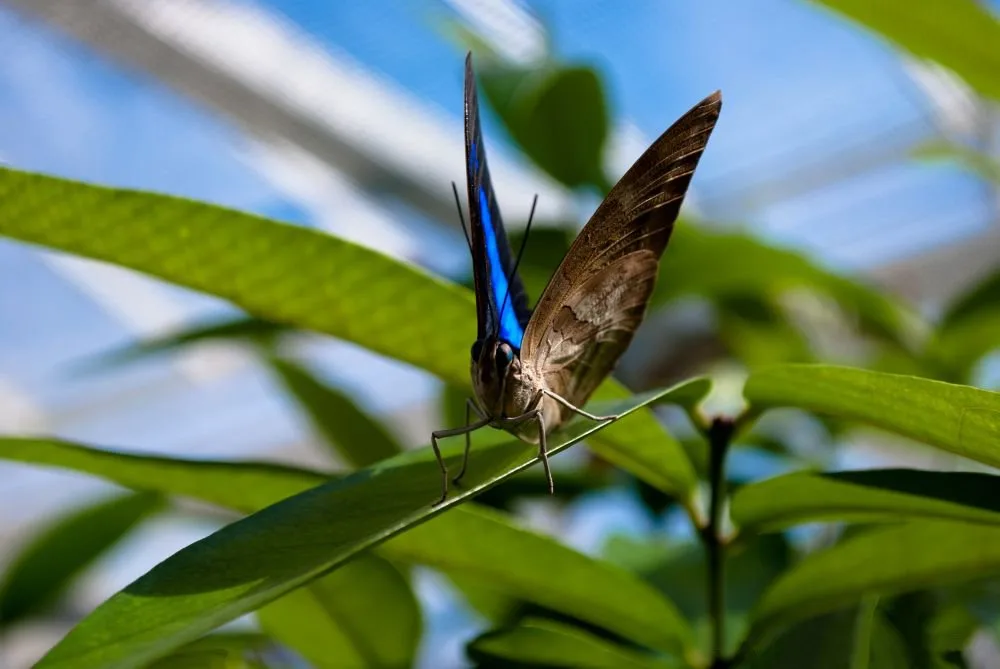
Morpho menelaus is one of the most striking butterflies of tropical forests, celebrated for the flashes of iridescent blue that appear and vanish as it flies between shade and shafts of light. Beauty here is no accident: it is a refined strategy for survival.
A shimmer that reveals how the forest works
The blue morpho usually flies low through the forest’s humid interior. When it opens its wings, blue erupts; when it closes them, it nearly vanishes. The contrast confuses predators: in seconds, the butterfly seems to appear and disappear.
📍 Range and habitat
Distribution: The Amazon and northern South America.
Habitat: humid tropical forests, especially in the understory and near watercourses.
⚠️ Relationship with humans
Conservation: a species not formally assessed for the IUCN Red List.
Relationship: widely used in environmental education and as inspiration for biomimicry (how nature ‘designs’ light).
🔬 Scientific classification
- Kingdom
- Animalia
- Phylum
- Arthropoda
- Class
- Insecta
- Order
- Lepidoptera
- Family
- Nymphalidae
- Genus
- Morpho
- Species
- Morpho menelaus (Linnaeus, 1758)
🔬 Morphology and adaptations
- Wingspan: 12–15 cm (4.7–5.9 in).
- Non-pigmented blue: Its sheen comes from structural coloration, like a natural microscopic mirror.
- Lower surface: Brown with eyespots, aiding defense when it alights with its wings closed.
- Adult feeding: It draws in liquids—sap, minerals, and decaying fruit.
Diet: The adult draws in liquids—sap, minerals, and decaying fruit. The caterpillar feeds on specific host plants.
🔄 Life cycle and behavior
📅 Development
- Type: complete metamorphosis (egg–larva–pupa–adult).
- Caterpillar: it feeds on specific host plants, tying the species to forests with plant diversity.
🌙 Behavior
- Sociality: solitary.
- Activity: diurnal.
- Strategy: an undulating flight and visual contrast—a trick of light that confuses predators.
🌍 Role in the Ecosystem
- A connecting link: throughout its life cycle, it connects plants (caterpillars) and predators (adults and caterpillars as food).
- Natural pressure on vegetation: caterpillars feed on leaves and take part in the balance that shapes forest renewal.
- Energy in circulation: it provides food for birds, reptiles, and other understory hunters.
- Reading the forest: its presence often accompanies forest environments with well-preserved structure and resources.
💡 Why does it matter?
- Because it shows that ‘beauty’ in nature is function—and function sustains ecosystems.
- Because there is no such thing as ‘too small’: common species keep the flow of life moving every day.
- Because when ecological networks lose pieces, the forest loses resilience and its capacity to recover.
- Because protecting biodiversity means protecting invisible relationships—not only famous species.
💫 Why does this butterfly matter?
Morpho menelaus is not a species assessed in detail by the IUCN. That does not mean it is ‘less important.’ It means its value emerges in the forest’s day-to-day life—in what almost never makes the headlines.
This butterfly exists because it serves a purpose: in a single organism, the forest gains an herbivore (in the caterpillar stage), prey (for multiple predators), and a sign of a functioning environment (when the understory is alive, humid, and diverse). It does not sustain the ecosystem alone—but it is part of the whole that keeps everything standing.
Reflection: when species like this vanish, the first thing to disappear is not a ‘symbol.’ What is lost is function: relationships between plants and animals, the balance of consumption and renewal, energy circulating in the understory. Biodiversity does not collapse all at once; it comes undone gradually, in the details.
Small discoveries
- Iridescent blue
- Blue produced by microstructures that reflect light; it is not a blue pigment.
- Predator confusion
- A visual effect that makes it harder for a predator to keep the target ‘locked on’ during flight.
- Understory
- The lower layers of the forest, near the ground, where shade and moisture prevail.
- IUCN Red List
- A global list of extinction risk that has historically covered vertebrates better than the immense diversity of insects.
- Structural coloration
- Nanostructures in the wing scales that reflect certain wavelengths.
- Eyespots
- Markings that resemble eyes and divert attacks toward less vital areas.
- IUCN
- The Red List is a global system, but insect coverage is far lower than that for vertebrates.