.webp&w=1920&q=82)
.webp&w=1920&q=82)
.webp&w=1920&q=82)
.webp&w=1920&q=82)
East Brazilian Chachalaca
Ortalis araucuan
Birds — Galliformes (Cracidae)
Before it emerges among the leaves, the East Brazilian Chachalaca usually announces itself: two partners send a loud, rhythmic, repeated song down from the canopy, as if the forest had struck up a conversation. Endemic to Brazil, this bird makes the wooded fragments of the Northeast and the country’s east the stage for one of Brazilian birdlife’s most unmistakable choruses.
The duet that carries through the canopies of eastern Brazil.
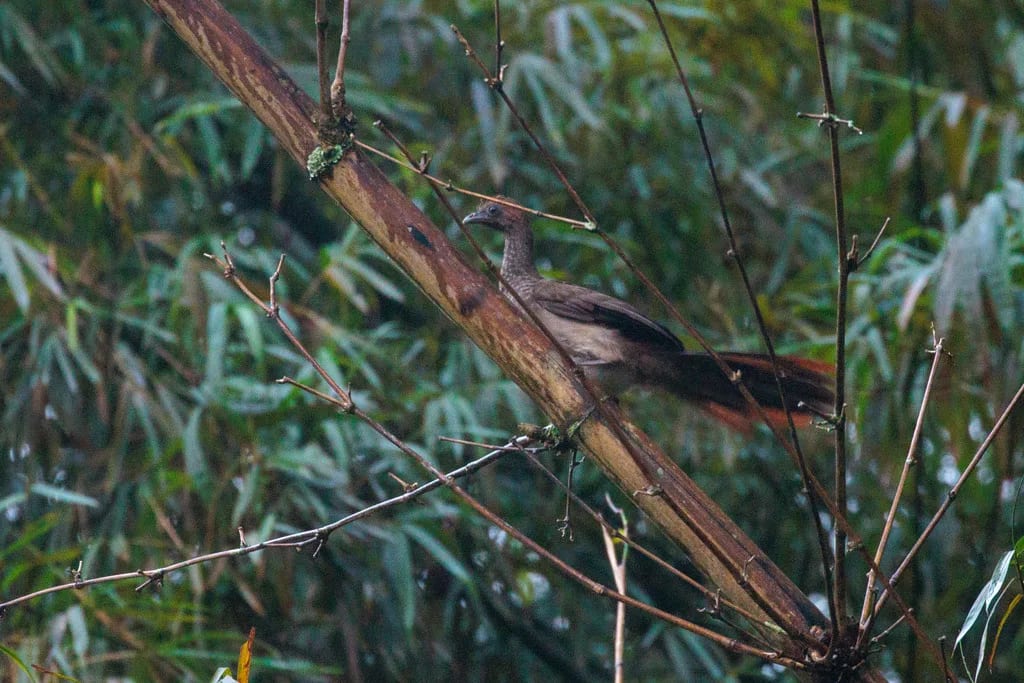
Ortalis araucuan, the East Brazilian Chachalaca, is a medium-sized cracid with a long tail and a body built for life among branches. A rufous crown, speckled breast, and pale belly help identify it, but its voice almost always gives it away first. Usually seen in small groups, it moves through trees and inhabits settings ranging from mature and secondary forests to caatinga—the dry thorn-scrub biome of Brazil—and coastal vegetation.
📍 Biomes it inhabits
The species occurs naturally only in Brazil, making it endemic to the country. Its range follows eastern Brazil, from Rio Grande do Norte and Pernambuco to Minas Gerais and Espírito Santo, encompassing the Atlantic Forest and areas of caatinga. It uses both forest and secondary growth, as well as coastal vegetation, provided there is tree cover for it to forage and move through the canopy.
🌍 Conservation status (IUCN)
LC · Least ConcernThe available global assessment classifies it as Least Concern. That category does not eliminate the need for care: as a species endemic to Brazil and dependent on tree-filled landscapes, it needs forest remnants, secondary forests, and wooded corridors to remain connected. Protecting native tree cover preserves not only a place for the East Brazilian Chachalaca to live, but also the continuity of its movements and duet song across the landscape.
🔬 Scientific classification
- Kingdom
- Animalia
- Phylum
- Chordata
- Class
- Aves
- Order
- Galliformes
- Family
- Cracidae
- Genus
- Ortalis
- Species
- Ortalis araucuan (Spix, 1825)
⚙️ Specifications and metrics
- Length: About 50 cm (20 in).
- Body mass: No consistently published body-mass range for the species was found in the sources consulted.
- Plumage: Brown upperparts; an ochre-rufous crown and nape; a dark throat and breast marked with pale spots; a white or whitish belly; and bluish undertail coverts.
- Vocalization: Highly vocal. In duet, the pair gives a booming, rhythmic call, transcribed as “ha-ga-GAA-gogok,” in repeated sequence.
Diet: Feeds on fruit, leaves, and flowers. It forages chiefly in trees and occasionally on the ground; photographs document it feeding on fruits such as rose apple, banana, and queen palm fruit. Seasonal variation in its diet is not yet well documented for the species.
📅 Life cycle
- Reproduction: Still poorly known. Nests and chicks have been recorded from January to May in northeastern Brazil; one nest studied in Alagoas held three eggs, two of which hatched.
- Nest: In one record from Pedra Talhada Biological Reserve in Alagoas, the nest formed a platform of lianas atop a banana plant at the edge of a swamp and was lined with dried green leaves.
- Incubation: The length of incubation has not been reliably established in species-specific studies found for this bird.
- Lifespan: No consistently published longevity estimate for the species was found in the sources consulted.
🔗 Ecological ripple effect
When a fruit-eating bird no longer moves through the canopy, the effect can reach beyond its silence. By consuming fruit and traveling among vegetation patches, the East Brazilian Chachalaca may play a role in the fate of seeds and the renewal of plant life. Its disappearance would diminish that ecological circulation and remove from wooded habitats a voice that also signals the presence of group life.
🤔 Why it matters
- It is endemic to Brazil, so its conservation depends entirely on Brazilian landscapes.
- It eats fruit, leaves, and flowers and may help move seeds among wooded areas.
- Its duet song is an acoustic hallmark of the canopy and helps reveal its presence even when the bird is out of sight.
- It also occurs in secondary forests, underscoring the importance of conserving and restoring mosaics of tree-covered vegetation.
- Its breeding remains poorly known, making every observation of a nest or chick a meaningful contribution to Brazilian science.
🧪 Did you know?
- It occurs naturally only in Brazil, from the Northeast to eastern Minas Gerais and Espírito Santo.
- The species is monotypic: no subspecies are recognized.
- In small groups, it usually forages high in the trees, but it can come down to the ground.
- Its duet call has been transcribed as “ha-ga-GAA-gogok” and may be repeated continuously.
- One nest studied in Alagoas held three eggs; two hatched on the same day, and the third was infertile.
Small discoveries
- Endemic
- A species that occurs naturally only in a particular region.
- Tree layer
- The layer formed by the trees in a plant community.
- Frugivorous
- Feeding on fruit.
- Monotypic
- A species for which no subspecies are recognized.
📚 References
- Birds of the World — East Brazilian Chachalaca, Ortalis araucuan
- eBird — aracuã-de-barriga-branca, Ortalis araucuan
- BirdLife DataZone — East Brazilian Chachalaca, Ortalis araucuan, avaliação da Lista Vermelha da IUCN
- Studer, A. e Crozariol, M. A. (2022). New breeding information on Brazilian birds. 1: Rheidae, Tinamidae, Anhimidae, Anatidae, Cracidae and Podicipedidae.
- WikiAves — aracuã-de-barriga-branca, Ortalis araucuan
- GBIF — Ortalis araucuan