.webp&w=1920&q=82)
.webp&w=1920&q=82)
.webp&w=1920&q=82)
.webp&w=1920&q=82)
Scaled Chachalaca
Ortalis squamata
Birds — Galliformes (Cracidae)
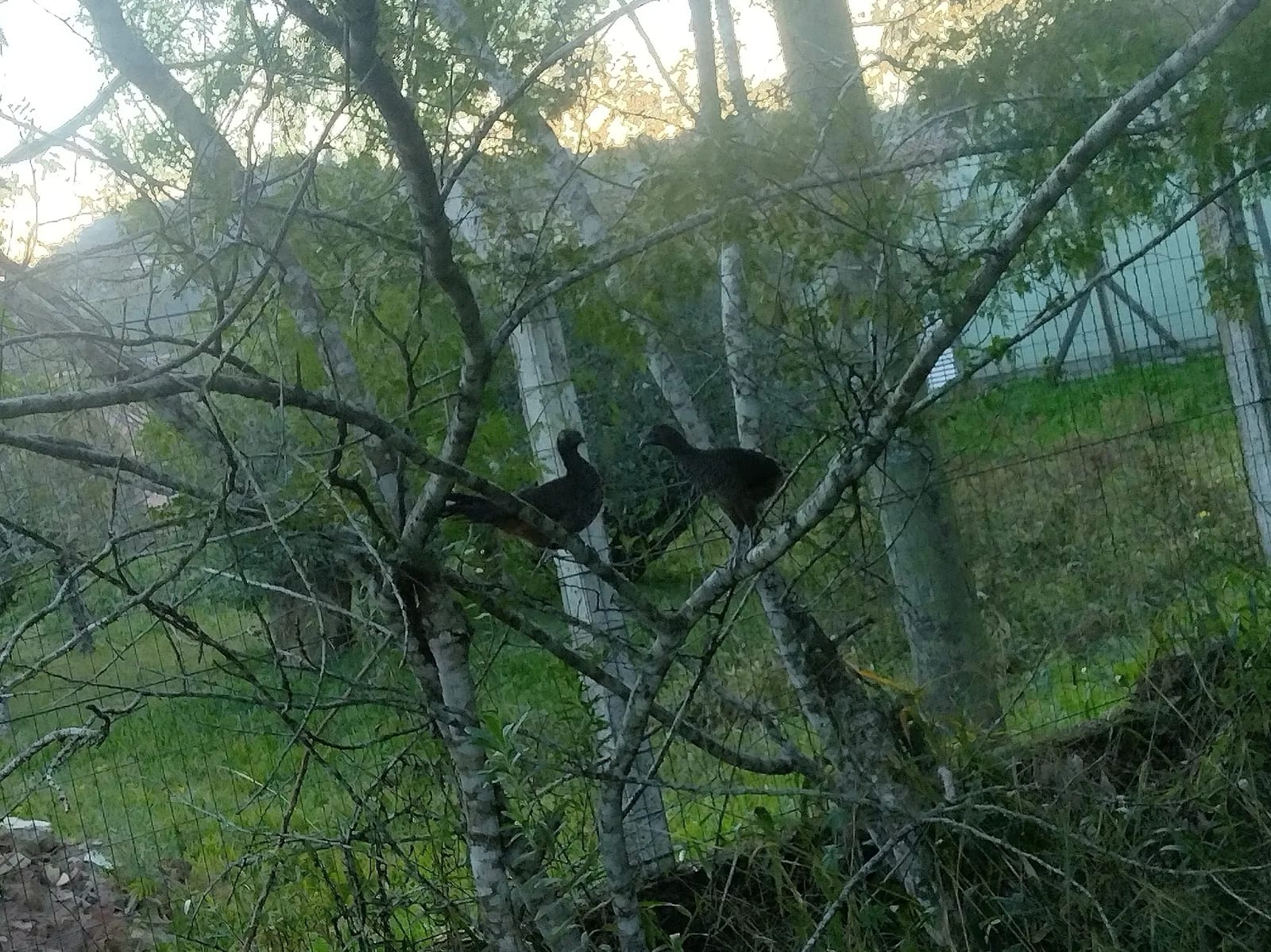
Before it appears high in the forest, the Scaled Chachalaca announces itself: its harsh, insistent call carries through the morning along the green edges of southern Brazil. Endemic to the country, it descends to the ground, climbs into the trees, and wears on its breast the pale pattern that explains its name.
The choral voice of the southern Atlantic Forest.
The Scaled Chachalaca is a cracid endemic to Brazil, restricted to the southern coastal strip of the country's east, especially in Paraná, Santa Catarina, and Rio Grande do Sul. It is a robust bird with a visibly social life: it commonly appears in small groups, walking in search of food or perching among the trees. Its scaled breast, small red wattle, and piercing cry make it easy to recognize even when the forest still seems empty.
📍 Biomes it inhabits
It occurs naturally only in Brazil, in the Atlantic Forest biome, along the southern and southeastern coast, especially in Paraná, Santa Catarina, and Rio Grande do Sul. It is associated chiefly with lowland rainforests, but also occupies forest edges and secondary vegetation; this tolerance helps explain encounters in peri-urban areas, provided there are trees, food, and shelter.
🌍 Conservation status (IUCN)
LC · Least ConcernIn BirdLife International's global IUCN assessment, the Scaled Chachalaca is classified as Least Concern. The assessment recognizes its large range and reasonable tolerance of secondary habitats, but also indicates a suspected declining population trend. Deforestation and fragmentation, logging, and hunting remain pressures; conserving connected remnants and curbing hunting therefore remain relevant measures.
🔬 Scientific classification
- Kingdom
- Animalia
- Phylum
- Chordata
- Class
- Aves
- Order
- Galliformes
- Family
- Cracidae
- Genus
- Ortalis
- Species
- Ortalis squamata R.Lesson, 1829
⚙️ Specifications and metrics
- Length: About 50 cm (20 in).
- Body mass: Between 498 and 620 g (18–22 oz); males tend to be heavier than females.
- Plumage: Mostly brown, with a reddish-brown back and wings; the dark breast feathers have pale edges that create its scaled appearance. The throat is bare and bears a small red wattle.
- Vocalization: Mostly in the morning and late afternoon, it gives a harsh, very loud group call, repeated as re-a-tok or aracuã.
Diet: It feeds mainly on fruit, tender leaves, and shoots; observations also record small invertebrates, including insects and earthworms. It forages in small groups, both on the ground and in the trees, and may use forest edges, gardens, and fruit feeders. Fruit and new growth vary in availability through the year, but specific studies quantifying seasonal variation in its diet are lacking.
📅 Life cycle
- Reproduction: Records of breeding activity are concentrated between September and January in northern Santa Catarina; the available data for the species remain scarce and localized.
- Nest: A shallow nest shaped like a basket of leaves and twigs; local records include tangles of vines, branches, fallen trunks, and abandoned nests of other birds.
- Incubation: The consulted sources did not yield a reliable incubation period specific to Ortalis squamata.
- Lifespan: The consulted sources did not yield reliable data on lifespan in the wild specific to the species.
🔗 Ecological ripple effect
By consuming fruit and moving over the ground and through the trees, the Scaled Chachalaca may carry seeds far from the parent plant. If it disappears from a forest fragment, the forest loses a fruit consumer and a potential route for seed dispersal; in already fragmented landscapes, that tends to impoverish the connections among plants, birds, and other animals. The absence of its flocks also silences one of the most striking calls of southern forest edges.
🤔 Why it matters
- It is a bird endemic to Brazil and a characteristic presence in the southern Atlantic Forest.
- By eating fruit, leaves, and shoots, it takes part in the feeding relationships between vegetation and forest fauna.
- Its loud, repetitive call helps detect flocks and makes the species useful in bird surveys and monitoring.
- Its presence at forest edges and in secondary vegetation helps explain how forest birds respond to landscape fragmentation.
- It is also known as aranguá and jacuiquira, attesting to the richness of Brazilian common names for wildlife.
🧪 Did you know?
- The name squamata alludes to the pale edges of the breast feathers, which create a scale-like pattern.
- Although it is a forest bird, it forages both on the ground and in the trees.
- Its harsh call, resembling aracuã, inspired its Brazilian common name and is heard chiefly at the beginning and end of the day.
- The species is monotypic: no subspecies are recognized.
- Sound records for the species include song, call, and alarm call.
Small discoveries
- Endemic
- Occurring naturally only within a particular geographic area.
- Secondary vegetation
- Vegetation that grows back after deforestation, clearing, or another disturbance.
📚 References
- BirdLife International DataZone: Scaled Chachalaca, Ortalis squamata
- Birds of the World: Scaled Chachalaca, Ortalis squamata
- eBird: Scaled Chachalaca, Ortalis squamata
- WikiAves: aracuã-escamoso, Ortalis squamata
- Instituto Rã-bugio para Conservação da Biodiversidade: Ortalis squamata
- Xeno-canto: Scaled Chachalaca, Ortalis squamata
- GBIF — Ortalis squamata