.webp&w=1920&q=82)
.webp&w=1920&q=82)
.webp&w=1920&q=82)
.webp&w=1920&q=82)
Buff-browed Chachalaca
Ortalis superciliaris
Birds — Galliformes (Cracidae)
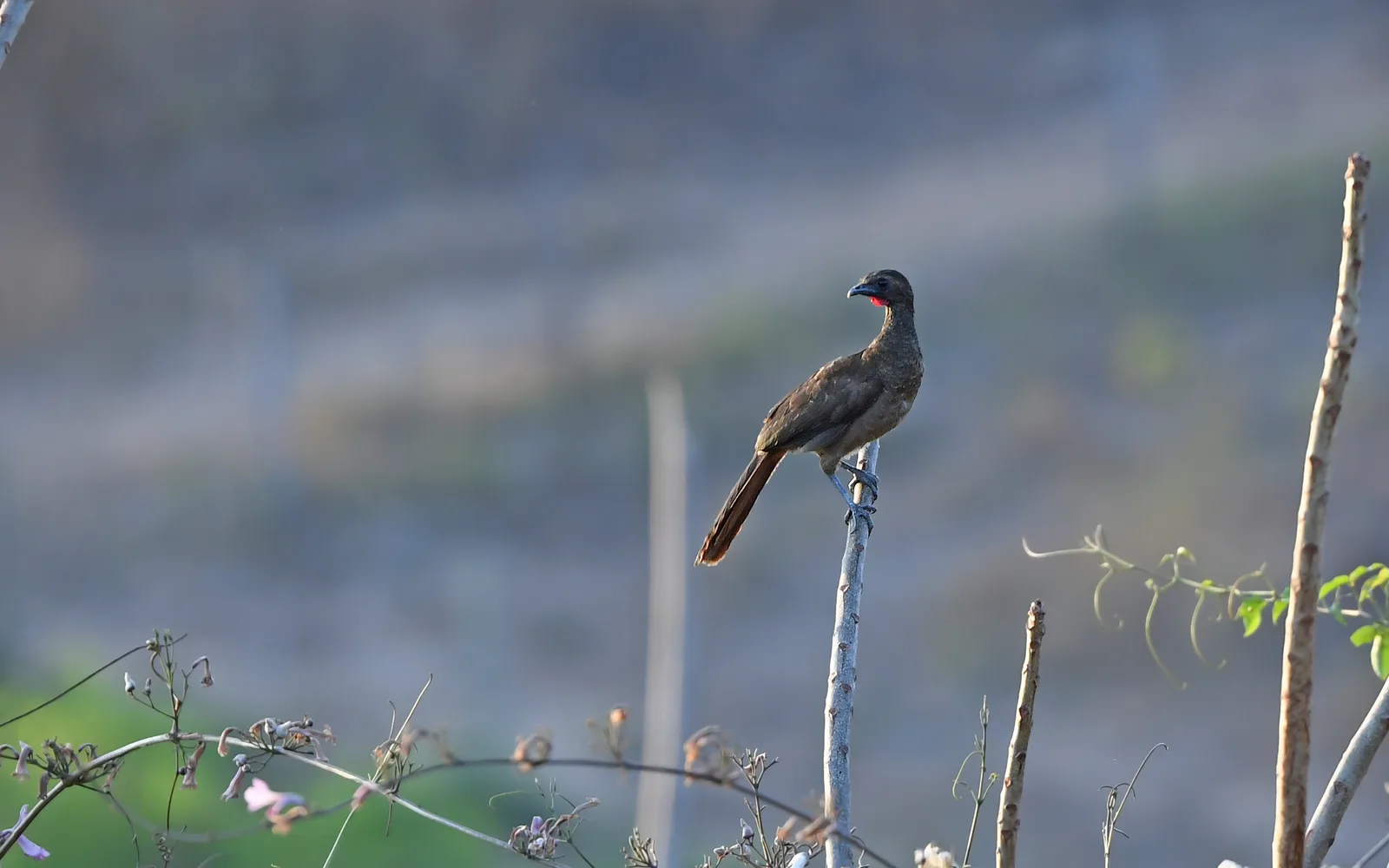
Before it comes into view, the Buff-browed Chachalaca usually announces itself: from within the thicket comes an insistent, harsh, loud TJURRE-wruh. When it appears among the branches, the pale stripe above its eye reveals a bird that occurs naturally only in Brazil, as if it knew every passage along the forest edge.
The harsh voice of regenerating forests in northern and northeastern Brazil.
The Buff-browed Chachalaca, Ortalis superciliaris, is a cracid endemic to Brazil, restricted to a band south of the Amazon River, from Pará to Piauí and northern Tocantins. A small, brown, gregarious chachalaca, it is identifiable by a pale eyebrow stripe that cuts across the head. Among chachalacas, it stands out as the only species with such a visibly contrasting eyebrow stripe.
📍 Biomes it inhabits
Its range reaches parts of the Amazon and the Cerrado—Brazil’s savanna—where it uses várzea—seasonally flooded Amazonian forest—as well as seasonal forests, forest edges, palm groves, secondary growth, and gallery forests. It is not confined to the shaded forest interior: it moves through the middle story and canopy, but also uses the ground to look for food, especially in secondary growth and tangled vegetation.
🌍 Conservation status (IUCN)
LC · Least ConcernThe species is globally classified as Least Concern on the IUCN Red List, but its status deserves attention because its entirely Brazilian range is relatively restricted. Forest loss and fragmentation, hunting, and the wildlife trade can affect its populations, especially when they eliminate the vegetation corridors connecting forest edges, secondary growth, and older forests.
🔬 Scientific classification
- Kingdom
- Animalia
- Phylum
- Chordata
- Class
- Aves
- Order
- Galliformes
- Family
- Cracidae
- Genus
- Ortalis
- Species
- Ortalis superciliaris G.R.Gray, 1867
⚙️ Specifications and metrics
- Length: Between 42 and 46 cm (17–18 in).
- Body mass: No published, species-specific estimate was found in the sources consulted.
- Plumage: Predominantly brown, darker above and paler below; the pale, contrasting eyebrow stripe is its most distinctive identification feature.
- Vocalization: Gives the typical chachalaca chorus: a noisy, harsh TJURRE-wruh, repeated continuously.
Diet: Feeds on fruit, seeds, leaves, and invertebrates. It forages in vegetation and on the ground, where it gathers some of these resources; it therefore alternates between branches and ground without abandoning the protection of tangled vegetation. Seasonal variation in its diet is not yet well documented in sources specific to the species.
📅 Life cycle
- Reproduction: There are records of breeding activity between December and February; the timing may vary locally.
- Nest: Builds a nest of dry leaves, twigs, and small branches in small trees. Clutches of up to three white, spotted eggs have been reported.
- Incubation: The length of incubation was not found in a specific, reliable source for the species.
- Lifespan: No specific, reliable longevity estimate was found for the species.
🔗 Ecological ripple effect
By consuming fruit and seeds and moving between the ground, middle story, and canopy, the Buff-browed Chachalaca may help move seeds across the landscape. If it disappears, this flow of plant material is likely to shrink: plants that depend on animals to carry seeds to clearings, forest edges, and recovering areas lose one of the vectors that helps reassemble vegetation.
🤔 Why it matters
- It is endemic to Brazil, so its conservation depends directly on decisions made in the country.
- By eating fruit and seeds, it may help disperse plants through the forests and secondary growth it uses.
- It uses forest edges, secondary forests, and thickets, habitats that are decisive for connecting fragments and restoring altered landscapes.
- Its loud call makes its presence recognizable even when the bird remains hidden in vegetation.
- Its pale eyebrow stripe, unusual among chachalacas, makes the species a useful identification reference for birdwatchers.
🧪 Did you know?
- The Buff-browed Chachalaca occurs naturally only in Brazil.
- Its pale, contrasting eyebrow stripe is a singular feature among chachalacas.
- Its call can be described as a TJURRE-wruh repeated without pause, far easier to hear than to see the bird in the forest.
- Although it walks and hops along branches, it often comes down to the ground to forage.
- Nests have been recorded in small trees, made of dry leaves, twigs, and small branches.
Small discoveries
- Endemic
- A species that occurs naturally only in one region or country.
- Supercilium
- A stripe of feathers above the eye, resembling an eyebrow.
- Middle story
- The intermediate layer of forest vegetation, between the understory and the canopy.
- Capoeira
- Vegetation that regrows after an area has been disturbed or abandoned.
📚 References
- IUCN Red List of Threatened Species — Ortalis superciliaris
- BirdLife International DataZone — Buff-browed Chachalaca Ortalis superciliaris
- eBird — Aracuã-de-sobrancelhas Ortalis superciliaris
- Birds of the World — Buff-browed Chachalaca Ortalis superciliaris
- WikiAves — aracuã-de-sobrancelhas Ortalis superciliaris
- GBIF — Ortalis superciliaris