.webp&w=1920&q=82)
.webp&w=1920&q=82)
.webp&w=1920&q=82)
.webp&w=1920&q=82)
Osprey
Pandion haliaetus
Birds — Accipitriformes (Pandionidae)
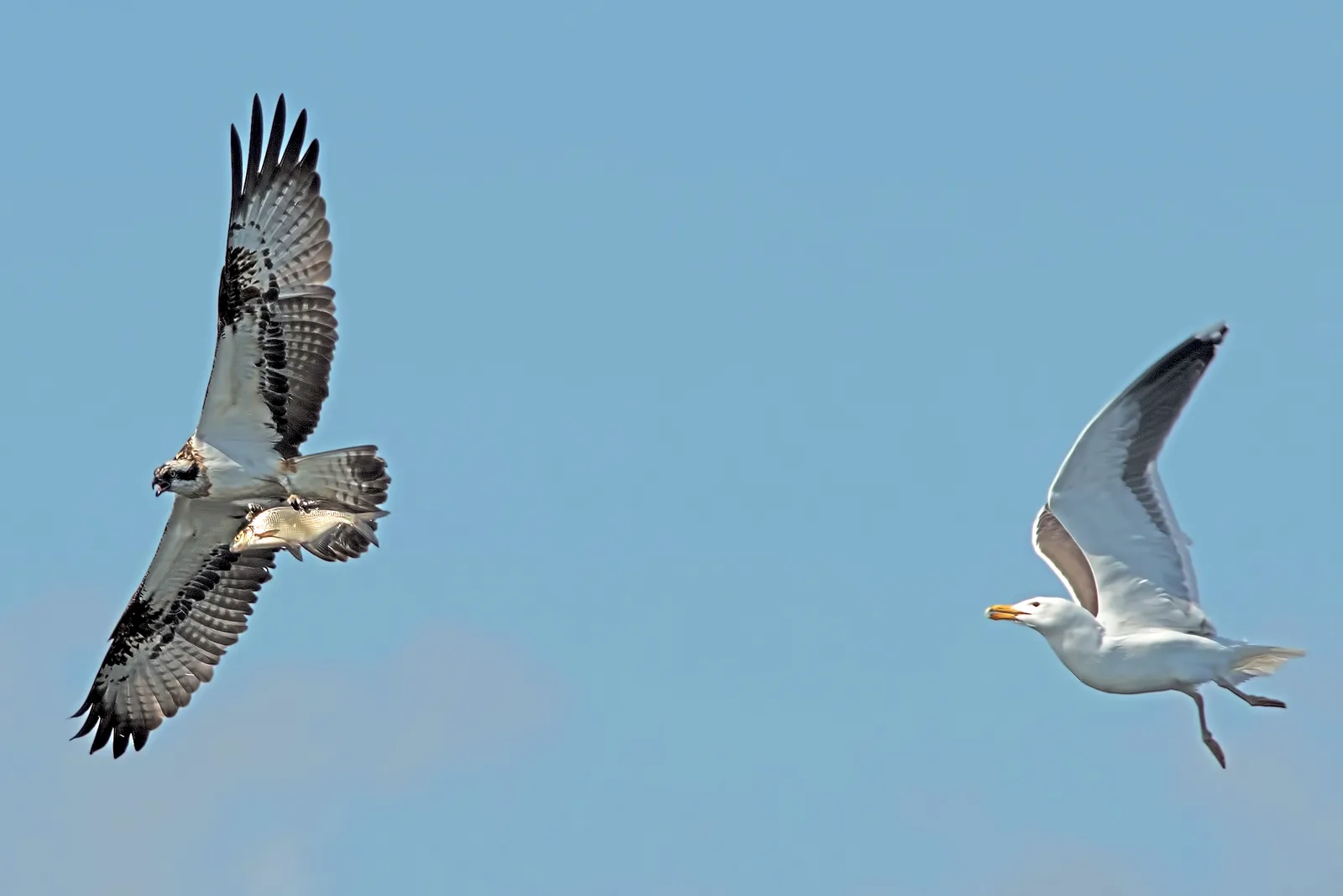
It patrols the water as though reading an unseen map. When a fish nears the surface, the Osprey folds its wings, thrusts forward its talons, and enters the water feet-first; moments later, it reappears with its prey held firm between its toes. In Brazil, this hunter that crosses continents turns rivers, estuaries, and lagoons into meeting points between hemispheres.
The bird of prey that finds fish by the gleam of the water.
The Osprey, Pandion haliaetus, is a bird of prey with a near-global distribution, present on every continent except Antarctica. Its silhouette of long, angular wings—white below and dark at the wrists—often draws an M in the sky. In Brazil, it arrives mainly as a migrant from North American populations and concentrates wherever fish are available, from the Amazon interior to coastal habitats.
📍 Biomes it inhabits
In Brazil, the Osprey has been recorded in all six biomes, but its presence does not depend on a particular terrestrial vegetation type: it depends on water and fish. It uses great Amazonian rivers, inland lagoons and reservoirs, wetlands, estuaries, and the coast, perching on isolated trees, poles, and tall structures that offer an unobstructed view for fishing. Band recoveries show that major rivers in Amazonas and Pará are important wintering areas for birds arriving from North America.
🌍 Conservation status (IUCN)
LC · Least ConcernGlobally, the Osprey is classified as Least Concern in the IUCN Red List's 2021 assessment, owing to its very broad range, large population, and globally increasing trend. That does not make local care dispensable: contamination of water bodies, loss of nesting trees and platforms, occupation of shorelines, and nestlings becoming entangled in plastic lines brought to the nest can compromise populations regionally. The species' history also recalls the effects of persistent pesticides, which once thinned eggshells and reduced populations in parts of North America.
🔬 Scientific classification
- Kingdom
- Animalia
- Phylum
- Chordata
- Class
- Aves
- Order
- Accipitriformes
- Family
- Pandionidae
- Genus
- Pandion
- Species
- Pandion haliaetus (Linnaeus, 1758)
⚙️ Specifications and metrics
- Length: About 54–58 cm (21–23 in).
- Body mass: Generally about 1.0–2.05 kg (2.2–4.5 lb); females tend to be larger.
- Plumage: The back and upper wings are brown; the underparts and head are mostly white, with a brown stripe across the eye. In flight, the dark wrists contrast with the pale undersides of the wings.
- Vocalization: It gives high whistles and chirps. Near the nest, the sequence can intensify into an undulating alarm scream.
Diet: A specialist in live fish, it searches for prey near the surface or in shallow water, flying over rivers, lakes, and estuaries before briefly hovering or plunging feet-first. Spiny scales on its soles and its reversible fourth toe help it grip slippery fish; after a capture, it usually carries the fish to a perch. The availability of accessible fish determines the best hunting sites and changes with the seasons and water levels. Other vertebrates occur only occasionally in its diet.
📅 Life cycle
- Reproduction: Northern breeding populations reproduce during the local spring and summer. In courtship, the male may perform undulating flights while carrying fish or nest material; in Brazil, the species is observed mainly as a migratory visitor.
- Nest: A bulky platform of sticks, lined with bark, grass, algae, or other materials. It may stand high in trees, on cliffs, towers, poles, channel markers, and artificial platforms; pairs may reuse it for years.
- Incubation: In breeding areas, the clutch contains 1–4 eggs and incubation lasts about 36–42 days.
- Lifespan: It can live for about 15–20 years; longevity varies among individuals and populations.
🔗 Ecological ripple effect
If the Osprey ceased to cross these habitats, aquatic food webs would lose a predator specialized in surface fish, and the landscapes would lose a visible sign of the connection between clean water, available fish, and preserved shores. Because it hunts high in the food chain and gathers material in exposed nests, its presence and breeding success help researchers detect contamination and environmental changes that also reach other species. The loss would not be only that of a striking bird: it would reduce a migratory link between Brazilian rivers and ecosystems on other continents.
🤔 Why it matters
- It preys on fish and forms part of the food chains of rivers, lagoons, estuaries, and coastal zones.
- It serves as an environmental sentinel: persistent contaminants and changes in fish availability can appear in its breeding success.
- It links Brazil to continental migration; band recoveries have documented North American birds wintering mainly along major Amazonian rivers.
- The specialization of its feet, nostrils, and dive has made the species a classic case of adaptation to fishing among birds of prey.
- It also belongs to Brazilian vernacular: among its many common names are gavião-pescador, guincho, and uiracuir.
🧪 Did you know?
- It is the only bird of prey that dives to capture live fish as its principal food.
- Its fourth toe can rotate backward, creating a grip with two toes forward and two back; the soles have spiny scales that make it harder for fish to escape.
- Its nostrils have valves that help prevent water from entering during a dive.
- A bird that breeds in the north and winters south of the Equator may travel more than 200,000 km (124,000 mi) over its lifetime.
- A study of 90 band recoveries in Brazil found a concentration of birds in Amazonian states, especially near major rivers.
Small discoveries
- Migratory bird
- A bird that moves periodically between regions, generally following the seasons and the availability of resources.
- Estuary
- The stretch where a river's freshwater meets the sea's saltwater.
- Incubation
- The period during which eggs are kept warm until they hatch.
- Wintering
- The seasonal stay of a migratory bird outside its breeding area.
📚 References
- BirdLife International DataZone — Osprey Pandion haliaetus Species Factsheet
- Birds of the World — Osprey Pandion haliaetus, Bierregaard et al. 2020
- Cornell Lab of Ornithology — Osprey Life History
- Cornell Lab of Ornithology — Osprey Sounds
- WikiAves — águia-pescadora Pandion haliaetus
- Mestre e Bierregaard Jr. 2009 — The role of Amazonian rivers for wintering ospreys
- GBIF — Pandion haliaetus