.webp&w=1920&q=82)
.webp&w=1920&q=82)
.webp&w=1920&q=82)
.webp&w=1920&q=82)
.webp&w=1920&q=82)
.webp&w=1920&q=82)
.webp&w=1920&q=82)
Brazilian Wandering Spider
Phoneutria nigriventer
Arachnids — Araneae (Ctenidae)
Feared, swift, and widely known, the Brazilian wandering spider is one of Brazil's most studied spider species. In Phoneutria nigriventer, its reputation stems from its venom, yet its scientific, ecological, and medical significance extends far beyond popular fear.
Between fear and science
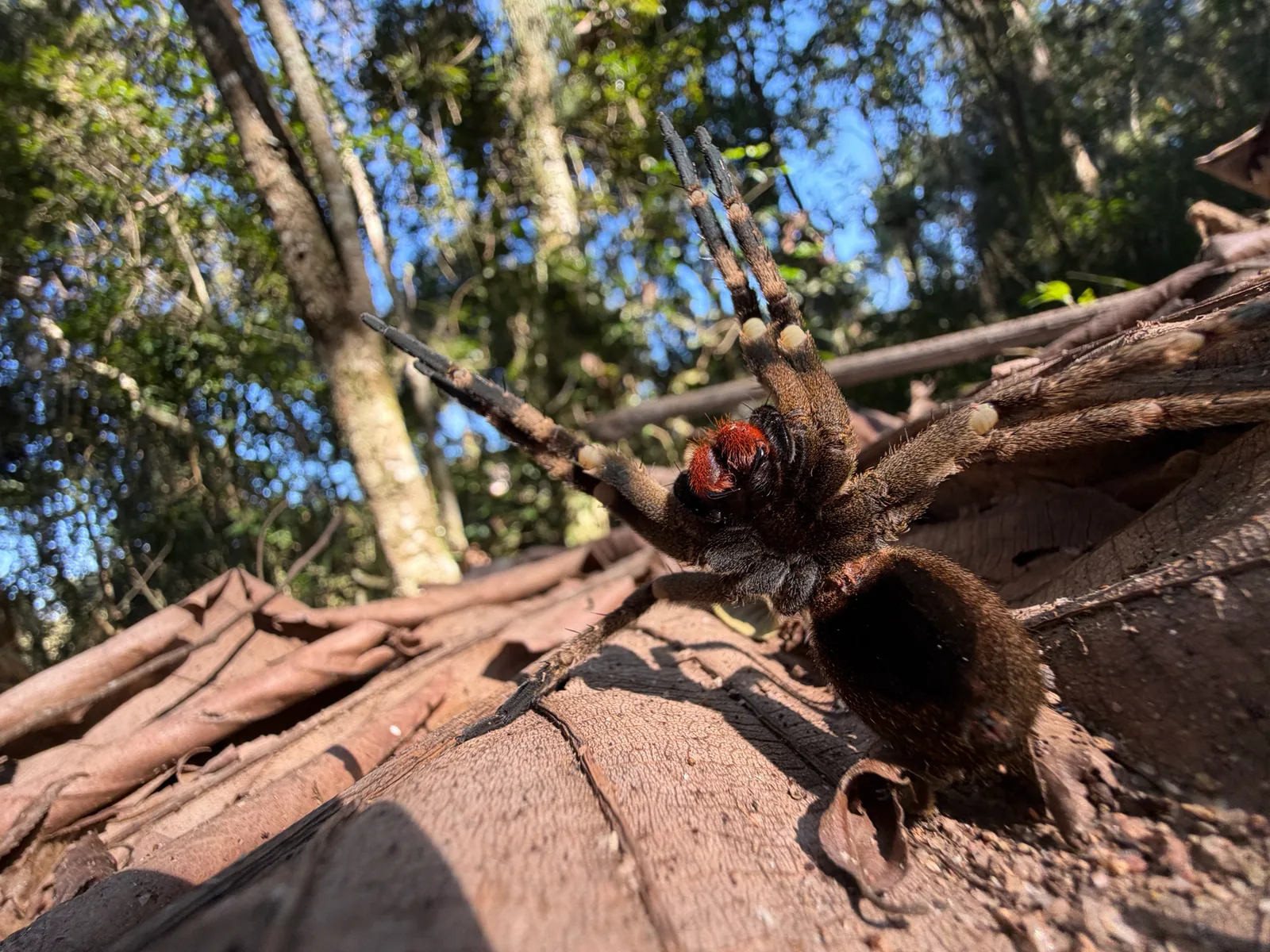
The Brazilian wandering spider is known in Brazil as aranha-armadeira, a name inspired by its characteristic defensive posture: when threatened, it raises its front legs and displays its fangs. Despite its dangerous reputation, serious accidents are rare, and the species plays a fundamental role in the ecological balance of the environments it inhabits.
📍 Range and habitat
Distribution: Brazil, Paraguay, Uruguay, and Argentina.
Habitat: Tropical and subtropical forests, agricultural areas, gardens, and urban environments. It lives on the ground and in dark places, such as woodpiles, debris, and banana plants.
⚠️ Relationship with humans
Conservation: A species without a specific formal IUCN assessment. It is relatively common across its range.
Relationship: Considered Brazil's most medically important spider. Its neurotoxic venom can be serious, especially in children, and a bite requires immediate medical attention. Although most cases have good outcomes, severe complications can occur without treatment. Specific antivenom is widely available and highly effective when administered promptly. The species should be avoided and respected, not handled or needlessly exterminated, as it plays an important ecological role as a predator.
🔬 Scientific classification
- Kingdom
- Animalia
- Phylum
- Arthropoda
- Class
- Arachnida
- Order
- Araneae
- Family
- Ctenidae
- Genus
- Phoneutria
- Species
- Phoneutria nigriventer (Keyserling, 1891)
🔬 Morphology and adaptations
- Size: Robust body with long legs; leg span can exceed 15 cm (6 in).
- Coloring: Brown and gray tones, with pale markings on the abdomen.
- Locomotion: Extremely fast, capable of covering short distances at high speed.
- Venom: Complex venom, rich in neurotoxins widely studied by science.
Diet: An active predator — it captures insects and other small animals; it does not build webs to hunt.
🔄 Life cycle and behavior
📅 Development
- Type: Growth through molts.
- Oothecae: Females produce protected egg sacs, generally hidden in the ground.
🌙 Behavior
- Activity: Primarily nocturnal.
- Hunting: Active — it does not build webs to capture prey.
- Defense: A threat display before biting, with a preference for retreating when possible.
🌍 Role in the Ecosystem
- An efficient predator: it controls populations of insects and other small animals.
- Scientific foundation: its venom contributes to advances in neuroscience and pharmacology.
- Natural balance: it forms part of terrestrial food chains.
💡 Why is it important to know?
- Because information reduces fear and accidents.
- Because dangerous spiders also have scientific value.
- Because coexistence begins with knowledge.
- Because eliminating natural predators disrupts ecosystems.
💫 Why does the Brazilian wandering spider matter?
Phoneutria nigriventer occupies a singular place: it is both a symbol of danger and a source of scientific knowledge. Its venom, feared by many, is also raw material for medical discoveries.
To understand it is to replace panic with respect and recognize that even the most feared organisms have a legitimate role in the web of life.
Reflection: how many solutions for the future may be hidden in the very animals we have learned to fear?
Small discoveries
- Venom
- A substance produced by animals to immobilize prey or defend themselves.
- Ecological balance
- The natural regulation of populations of other organisms.
- Banana plants
- Dense plant structures close to the ground.
- IUCN
- The global list of threatened species; most tropical spiders do not have an individual assessment.
- Neurotoxic venom
- Venom that acts on the nervous system and can cause serious systemic effects.
- Neurotoxins
- Proteins and peptides that affect the nervous system.