.webp&w=1920&q=82)
.webp&w=1920&q=82)
.webp&w=1920&q=82)
.webp&w=1920&q=82)
.webp&w=1920&q=82)
.webp&w=1920&q=82)
.webp&w=1920&q=82)
Bahia smooth-horned frog
Proceratophrys boiei
Amphibians — Anurans (Odontophrynidae)
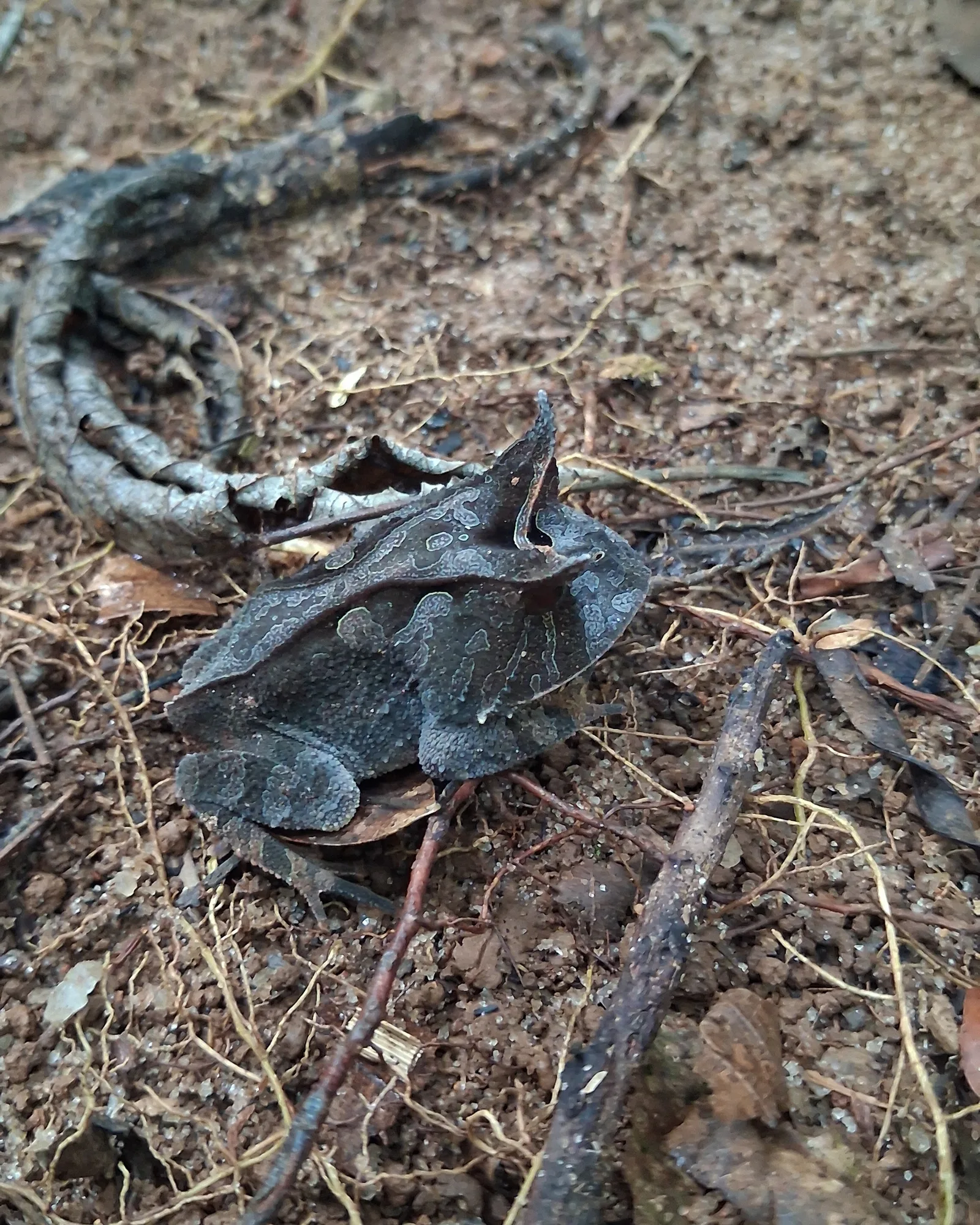
Proceratophrys boiei is a medium-sized anuran of the Atlantic Forest, known for its cryptic appearance and skin projections above the eyes that give it the look of “horns.” It is an ambush predator highly adapted to forest leaf litter.
Cryptic predator of the Atlantic Forest floor
A specialist ambush predator, the Bahia smooth-horned frog spends much of its time motionless among dry leaves, where its coloration and body texture provide nearly perfect camouflage. Its “horns” have no offensive function; instead, they heighten the cryptic effect of its silhouette.
📍 Biomes it inhabits
It occurs across much of Brazil's eastern Atlantic Forest, with confirmed records in the states of Bahia, Espírito Santo, Rio de Janeiro, São Paulo, Minas Gerais, Paraná, and Santa Catarina. It is associated with well-preserved humid forests, generally in rolling to montane terrain with abundant leaf litter.
🌍 Conservation status (IUCN)
LC · Least ConcernAccording to the IUCN, the species is classified as LC (Least Concern). Even so, fragmentation of the Atlantic Forest may affect local populations.
🔬 Scientific classification
- Kingdom
- Animalia
- Phylum
- Chordata
- Class
- Amphibia
- Order
- Anura
- Family
- Odontophrynidae
- Genus
- Proceratophrys
- Species
- Proceratophrys boiei (Wied-Neuwied, 1824)
⚙️ Specifications and metrics
- Body mass: Up to ~60–80 g (2–3 oz).
- Body length: 7–10 cm (3–4 in).
- Head: Broad, with supraocular appendages.
- Coloring: Brown, tan, or grayish, resembling dry leaves.
- Locomotion: Limited; brief, explosive movements.
- Generation length: ~3–4 years.
Diet: Generalist carnivore — large insects, arachnids, and occasionally small vertebrates, captured from ambush.
📅 Life cycle
- Reproduction: Oviparous, associated with forest pools and streams.
- Egg-laying: Hundreds of eggs.
- Development: Aquatic tadpoles, generally in lentic or slow-flowing environments.
- Lifespan: Estimated at ~8–10 years in the wild.
🔗 Ecological ripple effect
As a leaf-litter ambush predator, Proceratophrys boiei regulates populations of invertebrates and small vertebrates. Its presence indicates forests with well-preserved soil structure and a natural accumulation of leaf litter.
🤔 Why it matters
- Extreme camouflage among dry leaves.
- “Horns” that heighten its cryptic effect.
- A highly efficient ambush predator.
- Dependent on the integrity of forest leaf litter.
🧪 Did you know?
- The genus Proceratophrys is known as the horned frogs.
- It is often noticed only when it moves or calls.
- It can remain motionless for long periods.
- It is easily mistaken for dry leaves on the forest floor.
Small discoveries
- Ambush
- A strategy of remaining still and camouflaged until prey approaches.
- Nearly perfect camouflage
- The ability to blend visually into the surroundings.
- IUCN
- International Union for Conservation of Nature — the global authority on extinction-risk assessment.
- Supraocular appendages
- Skin projections above the eyes, common in the genus Proceratophrys.
- Oviparous
- Eggs laid directly in water, with an aquatic larval stage.