.webp&w=1920&q=82)
.webp&w=1920&q=82)
.webp&w=1920&q=82)
.webp&w=1920&q=82)
.webp&w=1920&q=82)
.webp&w=1920&q=82)
.webp&w=1920&q=82)
.webp&w=1920&q=82)
.webp&w=1920&q=82)
Giant otter
Pteronura brasiliensis
Mammals — Carnivorans (Mustelidae)
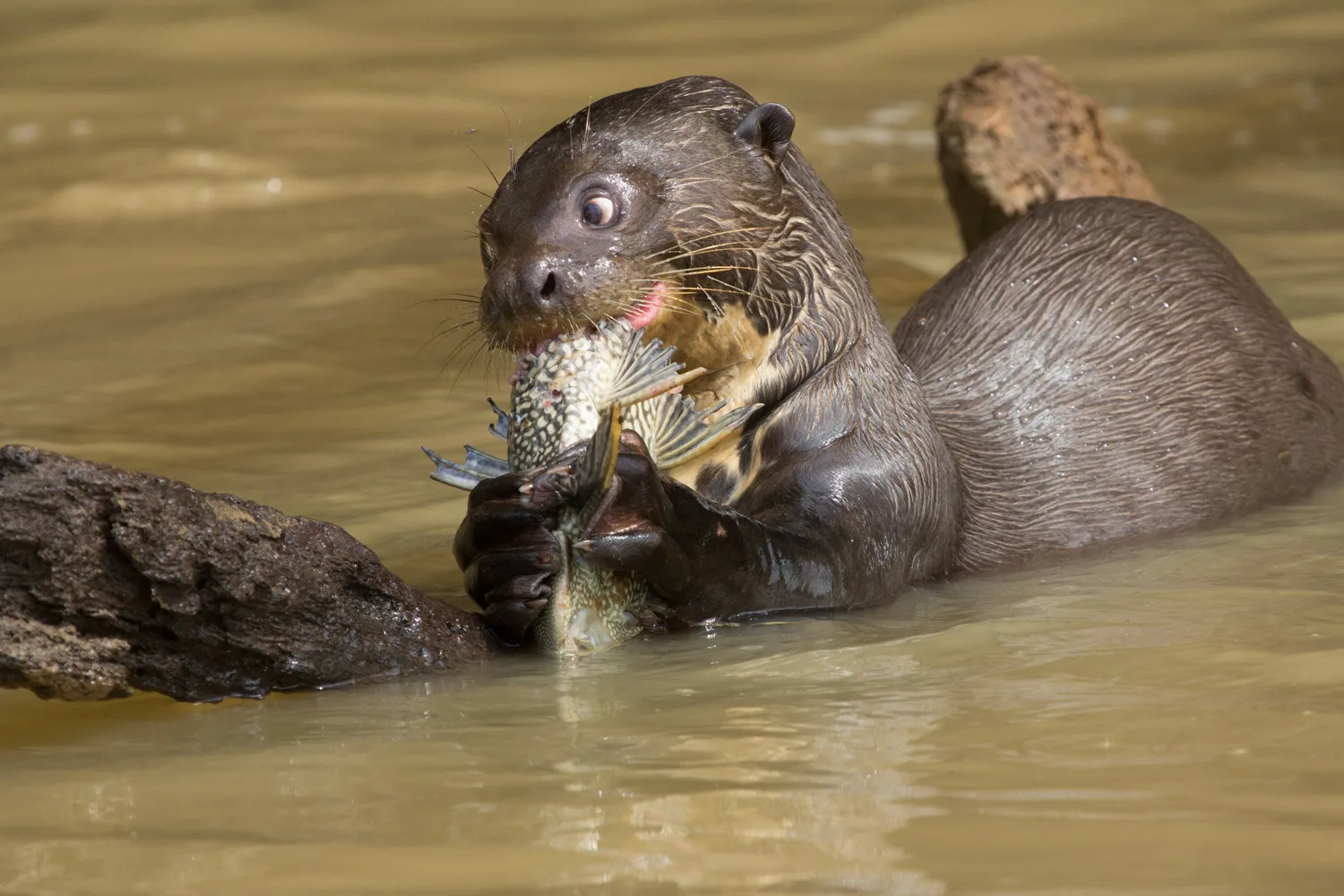
The giant otter is the world's largest mustelid and one of South America's most charismatic aquatic predators. In Brazil, it symbolizes the integrity of rivers, lakes, and floodplains, serving as a global benchmark for the conservation of inland aquatic ecosystems.
Sentinel of the great tropical rivers
An aquatic and highly social species, the giant otter sits at the top of riverine food chains. Its presence signals clean water, abundant fish, and healthy riparian landscapes — conditions growing ever rarer worldwide.
📍 Biomes it inhabits
It occurs chiefly in the Amazon and the Pantanal — the world's largest tropical wetland — with records in the Cerrado — Brazil's savanna — in rivers and flood-prone areas, as well as in parts of the interior Atlantic Forest. Brazil supports one of the species' largest remaining populations.
🌍 Conservation status (IUCN)
EN · EndangeredAccording to the IUCN, the species is classified as EN • Endangered. Its population trend is declining, driven by degradation of aquatic habitats, human conflict, and pollution.
🔬 Scientific classification
- Kingdom
- Animalia
- Phylum
- Chordata
- Class
- Mammalia
- Order
- Carnivora
- Family
- Mustelidae
- Genus
- Pteronura
- Species
- Pteronura brasiliensis Zimmermann, 1780
⚙️ Specifications and metrics
- Body mass: 22–32 kg (49–71 lb).
- Body length: Up to 1.80 m (5 ft 11 in), including the muscular tail.
- Morphology: Fully webbed feet, adapted for sustained swimming.
- Physiology: Exceptional lung capacity for prolonged dives.
- Communication: A complex vocal repertoire used for social cohesion and territorial defense.
- Generation length: ~7–8 years — slow population recovery.
Diet: Piscivorous — fish, and occasionally crustaceans and small aquatic vertebrates.
📅 Life cycle
- Gestation: ~65–70 days; litters of 1–5 pups.
- Parental care: Cooperative; the whole group helps protect and feed the young.
- Social organization: Stable, territorial family groups.
- Lifespan: 10–15 years in the wild; longer under human care.
🔗 Ecological ripple effect
As an apex predator, the giant otter regulates fish populations and helps maintain the balance of aquatic ecosystems. Conserving it safeguards entire watersheds, benefiting biodiversity, sustainable fisheries, and water security.
🤔 Why it matters
- It is the world's largest mustelid.
- It lives in highly cooperative family groups.
- It requires long stretches of intact river.
- It is extremely sensitive to water pollution.
🧪 Did you know?
- It has pale throat markings unique to each individual.
- Its calls can be heard over great distances.
- The name Pteronura refers to its laterally flattened tail.
- The presence of giant otters indicates rivers of high environmental quality.
Small discoveries
- Aquatic
- An organism that depends directly on aquatic environments for feeding and reproduction.
- IUCN
- International Union for Conservation of Nature — the global authority on extinction-risk assessment.
- Webbed
- Complete interdigital membranes that increase swimming efficiency.
- Prolonged dive
- Remaining underwater while actively hunting.