.webp&w=1920&q=82)
.webp&w=1920&q=82)
.webp&w=1920&q=82)
.webp&w=1920&q=82)
Black-backed Tanager
Tangara peruviana
Birds — Passeriformes (Thraupidae)
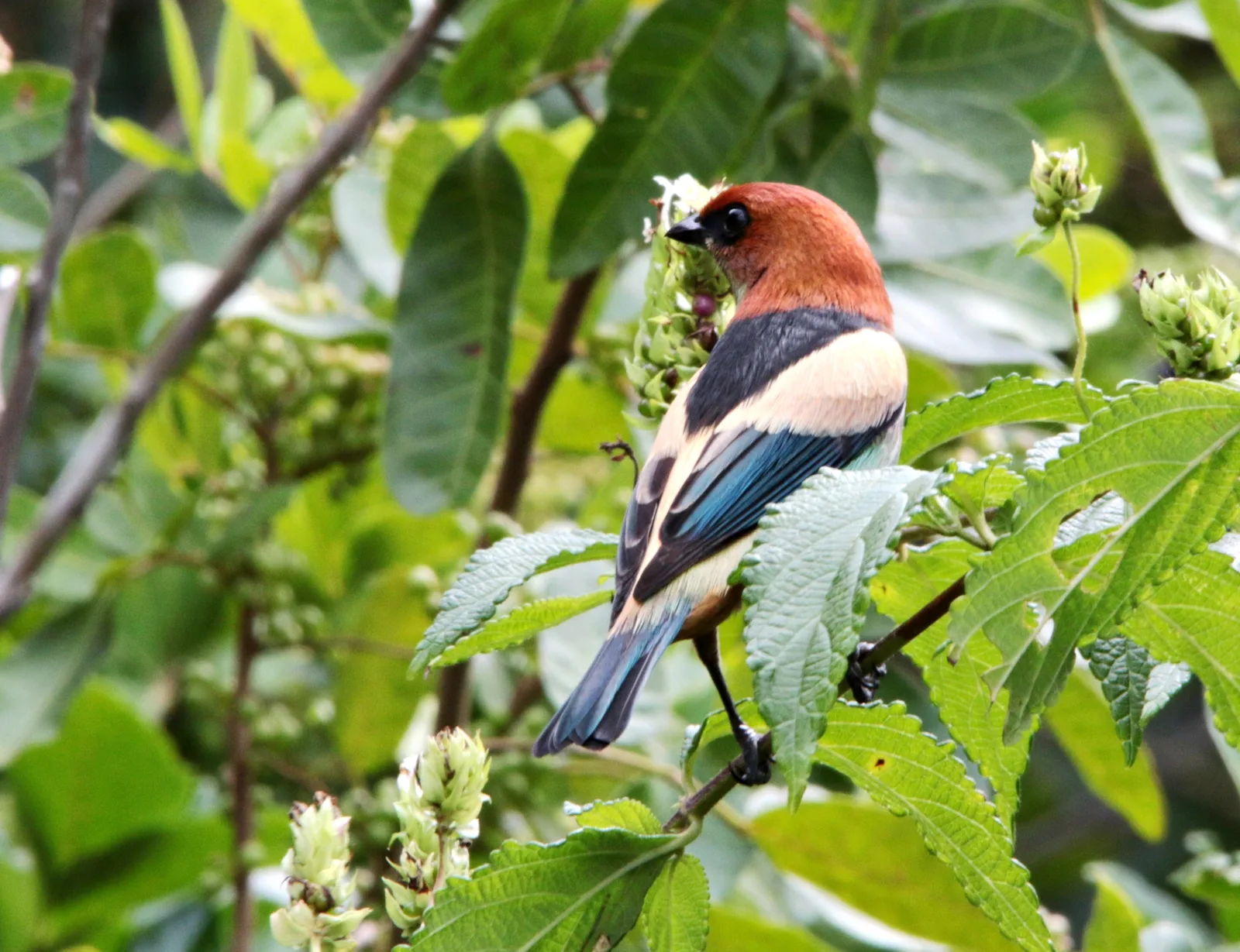
The Black-backed Tanager seems to carry a piece of sky and forest on its feathers: blue wings, blue-green below, cinnamon on the head, and black across the male’s back. Yet what truly sets it apart is a life in motion through Brazil’s restingas — coastal sandbank vegetation — following the rhythms of fruit ripening along the shore.
Color in transit through Brazil’s restingas.
The Black-backed Tanager is endemic to Brazil: it occurs naturally nowhere else. Rare and locally distributed, it occupies a coastal belt in the Southeast and South, with regular records from Espírito Santo to Rio Grande do Sul and recent occurrence in Bahia as well. In some regions it appears in winter; in others it remains year-round, part of the scene in low forests and coastal vegetation.
📍 Biomes it inhabits
In the Atlantic Forest, the Black-backed Tanager finds its most characteristic setting in coastal forests on sand and in restingas. These environments, shaped by poor soil, salty winds, and mosaic vegetation, offer fruit, shelter, and routes between forest, edge, orchard, and garden. The species lives mainly on the coastal plain; its appearances beyond it, in montane areas, are occasional and seem linked to the period outside breeding.
🌍 Conservation status (IUCN)
VU · VulnerableThe IUCN’s global assessment classifies the Black-backed Tanager as Vulnerable, and ICMBio’s national assessment places it in the same category. Its population is considered rare, localized, fragmented, and declining. The principal risk is the loss and deterioration of restingas and coastal forests, pressured by real-estate expansion, tourism infrastructure, human disturbance, and fire; capture for the illegal trade is also a documented threat. Conserving the species means maintaining continuous, well-managed stretches of coastal vegetation, including beyond the boundaries of protected areas.
🔬 Scientific classification
- Kingdom
- Animalia
- Phylum
- Chordata
- Class
- Aves
- Order
- Passeriformes
- Family
- Thraupidae
- Genus
- Stilpnia
- Species
- Tangara peruviana (Desmarest, 1806)
⚙️ Specifications and metrics
- Length: About 15 cm (5.9 in).
- Plumage: The male combines a cinnamon-colored head, black mask and back, blue-green underparts, and bluish wings; the female is paler, lacks the black mask, and is predominantly greenish.
- Vocalization: It gives a thin, loud, drawn-out call transcribed approximately as seeeeek, as well as brief, very high ti, tic, or si notes. The source consulted does not describe a formal song.
Diet: Its documented diet includes fruit and arthropods. The species forages in pairs or small groups, chiefly in coastal forests, along edges, and in gardens. Across part of its range, its seasonal movements follow fruit availability: in Rio de Janeiro, its arrival coincides with the ripening of certain fruits, including Schinus pepper trees.
📅 Life cycle
- Reproduction: Its known breeding range appears restricted to the coasts of São Paulo, Paraná, and Santa Catarina; in other areas, its occurrence may be seasonal.
- Nest: The nest’s structure and location are not securely documented in the sources consulted.
- Incubation: No verifiable source was found for the length of incubation.
- Lifespan: There is no reliable longevity estimate specific to the species.
🔗 Ecological ripple effect
No study has isolated and measured the effect of the Black-backed Tanager’s disappearance. Even so, losing a bird that eats fruit and arthropods and moves in pairs or small groups impoverishes the web of interactions in the restinga. In a landscape already fragmented, a mobile component of the coastal bird community, sensitive to continuity among forest, edge, and fruiting vegetation, would also vanish. Its specific impact on seed dispersal still needs study.
🤔 Why it matters
- It is endemic to Brazil and represents a part of biodiversity that occurs naturally in no other country.
- It is a vulnerable species associated with restingas and coastal forests, environments under intense pressure from coastal development.
- Its seasonal movements tied to fruiting help reveal how fauna responds to the Atlantic Forest’s calendar of resources.
- Its occurrence along edges, in gardens, and in orchards brings the conservation of coastal landscapes closer to people’s everyday lives.
- The male’s striking plumage and the very high call make the species a memorable ambassador for birds of the restinga.
🧪 Did you know?
- The Black-backed Tanager is endemic to Brazil: its natural distribution lies entirely within the country.
- It does not behave the same way across its range: it may migrate during the austral winter in Rio de Janeiro and Espírito Santo, yet is resident along parts of the Santa Catarina coast.
- In Rio de Janeiro, its seasonal arrival coincides with fruit ripening; in São Paulo, it becomes more common in the austral winter.
- The species is monotypic, meaning that no subspecies are recognized.
- The male has a black back and dark mask; the more subdued female lacks that mask.
Small discoveries
- Endemic
- Occurring naturally only within a particular geographic area.
- Restinga
- A set of coastal vegetation types associated with sandy plains and shaped by proximity to the sea.
- Arthropods
- A group of animals with an external skeleton and jointed legs, such as insects and spiders.
- Monotypic
- A species for which no subspecies are recognized.
📚 References
- BirdLife International. 2018. Tangara peruviana. The IUCN Red List of Threatened Species.
- ICMBio. 2018. Livro Vermelho da Fauna Brasileira Ameaçada de Extinção, volume 3, ficha de Tangara peruviana.
- Birds of the World. Black-backed Tanager, Stilpnia peruviana.
- eBird. Saíra-sapucaia, Stilpnia peruviana.
- WikiAves. Saíra-sapucaia, Stilpnia peruviana.
- GBIF — Tangara peruviana